




Most people come to therapy wary of being vulnerable in their relationships. They may say things like:
- “If I tell him how I really feel, what if he thinks I’m being clingy?”
- “I am not going to text her first. I have to know for sure that she likes me before I say anything.”
- “I don’t really like going to museums, but my partner loves it. I can’t say anything because I don’t want them to hate me.”
We are often afraid to be our authentic selves, even though being seen and accepted for who we are is, arguably, what we desire most. The need to belong and connect with others is an evolutionary impulse and, therefore, essential to our survival.
New studies have shown that being authentic improves brain health, leads to greater life satisfaction, mental well-being and experiencing more meaning in life. When we are inauthentic, we disconnect from our partners as well as our true selves.
Here are three reasons why we sometimes prefer to hide our true selves in relationships and some important mindset shifts you could make to embrace authenticity and deepen your relationships.
1. You’re Afraid Your Partner Won’t Like What They See
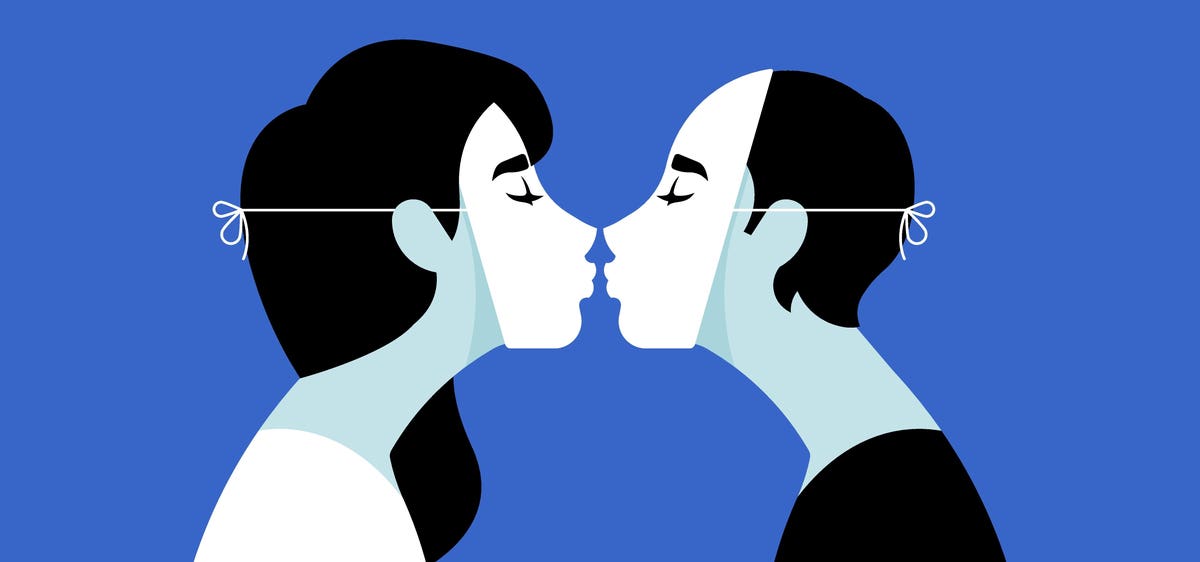
What often drives inauthentic behavior in relationships is the fear of rejection and not being able to meet your partner’s standards. This fear can force us to bend over backwards and become someone else entirely to be perceived as likable and appealing.
However, you may have found that continuously acting like someone you are not or being what you think your partner wants can be emotionally draining. It also continuously reinforces the belief that you are not enough or worthy as you are because you expend most, if not all, of your energy trying to fit an imaginary mold.
Here are a couple of thought exercises to try when your fear of rejection becomes overwhelming:
- If a friend of yours was pretending to be someone else for the sake of their partner’s happiness, would you advise them to continue the relationship or re-evaluate it?
- If your partner finds your true, authentic self to be unappealing, would your energy be better spent trying to appease them or looking for someone who appreciates you as you are?
In most cases, however, people might preemptively steer clear of moments of vulnerability with their partner as they are operating from the assumption that they will not be pleased with what they discover. In these scenarios, it is important to remind oneself that flaws and imperfections are actually the core elements responsible for bringing people close.
Research published in the Journal of Experimental Social Psychology confirms that when partners perceive each other as authentic, it leads to better relationship outcomes including increased trust, greater relationship commitment and satisfaction.
After all, if you do not reveal your true self to your partner, how will you ever know if they truly love every version of you?
2. You Don’t Like What You See
Your relationship with yourself is one of the most important, albeit turbulent, relationships you’ll ever have. When you do not like, understand or know your true self, it can be hard to articulate or express yourself without filters.
Further, when we have self-critical beliefs, we might engage in confirmation bias, where we look to our environment to confirm the beliefs we already have, while simultaneously wanting to be proved wrong. For example, if you believe you are not good enough, you would want a partner who makes you feel the opposite, which is an unfair expectation to burden them with.
Or, you could also be unconsciously finding partners who confirm your negative beliefs about yourself, which might lead you to damaging or emotionally unavailable partnerships instead of healthy ones.
We can change this by working on our self-beliefs and taking more cues from our environment to confirm that we can be ourselves and be loved for it. A new study published in Personality and Social Psychology Bulletin has found that ‘self-enhancement’ or seeing yourself in a positive light increases authenticity and well-being. Therefore, opening up, feeling accepted by loved ones, and having self-compassion can provide real-life evidence that it is safe to be seen.
3. You’re Chasing The Illusion Of The Perfect Self
Do you ever find yourself thinking that if you just had a different face, a different body or a better personality, that everything would be better?
Social Comparison Theory tells us that it is natural to compare ourselves to others. Wanting to “fit in” comes from an evolutionary instinct to be part of a group and thereby increase your chances of survival. In modern day society, survival often means gaining acceptance through validation from others. We are taught from a young age that how people view us is more important than how we view ourselves.
We may also be avoiding conflict and judgment, especially if we have been criticized by others before and don’t want to take that chance again. In trying to be accepted, however, we constantly reject our authentic selves, forgetting that the opinions of others are far from objective fact. The standards for perfection in society are entirely made up, but who you are doesn’t have to be.
A new study finds that such “externalized self-perceptions,” or evaluating oneself by perceived societal standards, damages emotional intimacy in relationships. The researchers found that those who externalized their self-perception were less likely to have a strong sense of self, which is linked to reduced emotional intimacy. Another study has also shown that perfectionism is linked to mental illnesses such as depression and anxiety.
You can start healing this pattern by reminding yourself that you don’t owe it to anyone to be perfect or likable. Explore the parts of yourself that you do and do not like, and ask yourself why.
Give yourself unconditional and radical permission to experience the real you. Remind yourself that perceiving yourself through someone else’s gaze can make you a stranger to yourself, unaware and unable to articulate what you need and want from a partner and your relationship.
If you follow this philosophy long enough, you can learn to let a supportive partner into your inner world that values your authenticity as much as you do.
Conclusion
Without authenticity, emotionally intimate and fulfilling relationships are impossible. The fear of rejection, negative self-beliefs, societal conditioning and the elusive ideal of the perfect self can make us hide behind a facade of who we think we should be. Embracing authenticity offers profound benefits for our mental health and greater emotional intimacy with our partners, allowing for meaningful relationships and the ability to connect more deeply with ourselves than ever before.
Read the full article here