





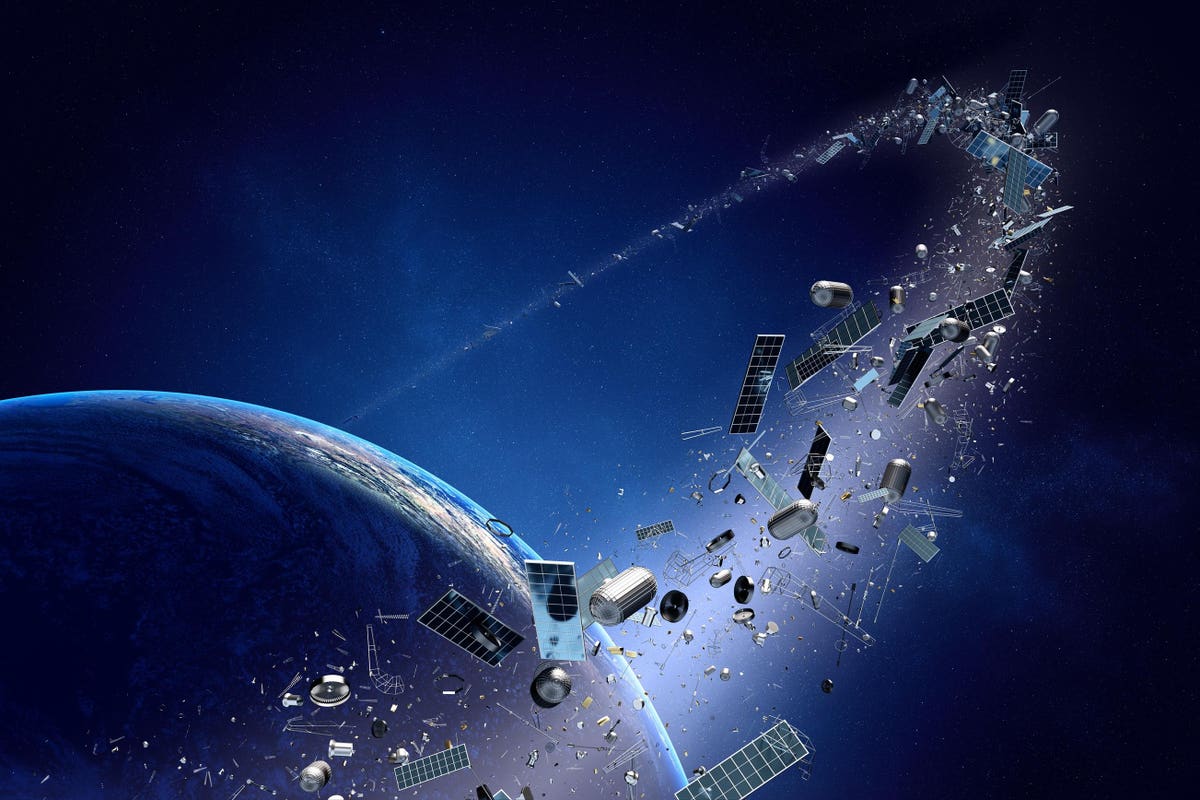
Earlier this month two big pieces of space junk came unsettlingly close to colliding over our heads in low-earth orbit.
“It looks like the collision would have been almost head-on, so worst-case energy-wise,” astronomer and leading orbital traffic watcher Jonathan McDowell from the Harvard-Smithsonian Center for Astrophysics wrote on X (formerly Twitter).
Orbital monitoring and data company LeoLabs noticed the near-miss between a defunct Soviet era Russian satellite and a used Chinese rocket body on Sept. 13.
“While we’ve seen more nail biting events, this one is notable,” the firm wrote on X. “If these two objects had collided, the number of resulting cataloged fragments would have likely been (around) 3,000.”
That would be almost double the amount of fragments eventually created by a Russian anti-satellite (ASAT) demonstration conducted in 2021 that was roundly condemned by the international community and considered to be one of the most consequential and destructive events in the history of low-earth orbit.
The Russian satellite, known as Cosmos 807, was a 400 kilogram (882 pounds) payload launched in 1976. LeoLabs reports that it has been whipping around Earth in recent years while coming a little too close for comfort to both operational satellites and defunct junk, including at least six fragments created by the 2021 Russian ASAT test.
Meanwhile, the two-ton Chinese CZ-4C spent rocket has been doing much the same for the past five years, popping up in what LeoLabs calls High PC (for probability of collision) conjunctions over 140 times.
“This event illustrates an emerging trend of “old” and “new” derelict objects mixing,” according to LeoLabs. “This is contributing to concerns about the inevitable massive-on-massive collision that will likely produce thousands of fragments, posing a risk to satellites we rely on.”
High-Altitude Highway Over Your Head
While the three-dimensional space considered to be low-earth orbit is massive and exponentially more than, say, the surface area of Earth and our navigable airspace, it is a different environment that’s filling up fast.
In the nascent commercial space era led by SpaceX and its growing Starlink constellation, the number of satellites and other objects has ballooned in the past decade. Between 1957 and 2014, the world launched a total of over 7,000 objects into space, according to UN data. In the eight years that followed, we launched another 7,000. In other words, more than half the stuff in space was put there in the last decade.
Add to this that the lack of an atmosphere allows objects to travel around Earth at speeds around five miles a second and you’ve got a lot of kinetic energy increasing the destructive potential of any collision.
This is what makes near misses by two dead objects so anxiety-inducing. At least with active satellites like the thousands of Starlinks, many can be maneuvered out of the way of a potential collision.
For defunct space junk, it’s all luck. And the odds of a big collision are on the rise in the domain of low-earth orbit that’s essentially unregulated at this point.
But, Why Care?
All this can seem like a distant concern far from affecting any of our daily lives. For the most part, that’s true. Right up until the moment it affects almost every aspect of our daily lives.
Many orbital observers fret about a hypothetical scenario known as Kessler Syndrome in which a cascading series of orbital collisions create more and more clouds of space junk fragments. The domino effect of impacts could continue until all satellites are destroyed and access to space becomes too dangerous to replace or service them. Our global society built on instantaneous exchange of data being constantly relayed and routed via satellite quickly takes a technological step backwards by about 50 years or more.
This scenario is only hypothetical, of course. There could be a number of ways to mitigate it that are currently being investigated. It’s not clear how much redundancy is built in to the system right now if this cascade were to begin tomorrow, or if (yikes) it was already set in motion by the Kremlin’s ASAT demonstration in 2021.
The good news is that low-earth orbit is, um… low. That means much of the junk we send there today is designed to eventually re-enter the Earth’s atmosphere, burn up and dispose of itself. An elegant solution to the space junk problem.
But at the same time, traffic in the region is getting worse every day and there’s no cop on the beat.
Read the full article here