





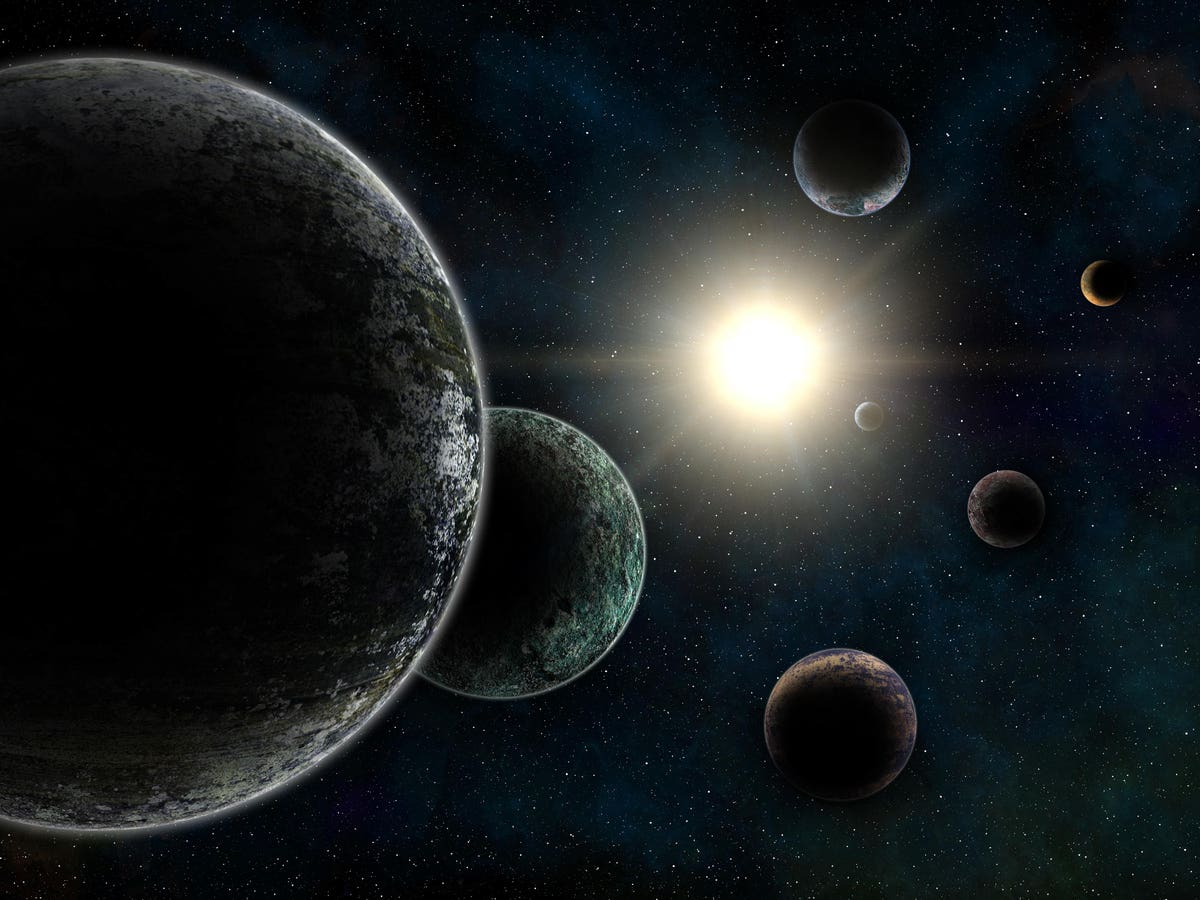
There could be 11,000 Earth-like exoplanets around sun-like stars within 326 light-years, according to a scientist.
The mathematical study, which could help astronomers and astrobiologists in the hunt for life, also claims that life could exist on an exoplanet as little as 65 light-years away.
The intriguing insights come from a draft of a paper published on pre-print platform arXiv by Piero Madau at the University of California’s Department of Astronomy & Astrophysics. A new mathematical framework in the search for habitable exoplanets and extraterrestrial life beyond the solar system, it uses the latest observational data, including from NASA’s new defunct Kepler Space Telescope, which found 2,662 exoplanets between 2009 and 2018.
Beyond The Drake Equation
The new framework is an update to the Drake Equation, the brainchild of astrophysicist Frank Drake in the 1960s, which summarizes the factors in a successful search for extraterrestrial life – either technologically advanced civilizations or just simple microbial life evolving on a habitable planet. Since there is almost no definitive data the Drake equation requires multiple assumptions, estimates and guesses and mostly a tool for thinking about how to begin the search for extraterrestrial life in the cosmos.
Types Of Exoplanets
Madau’s framework is designed to give exoplanet-hunters a better statistical understanding of how different types of planets around different kinds of stars form as well as their age and frequency. Its key finding are:
- Within 326 light-years of the sun there are statistically 11,000 Earth-size planets in the habitable zone of K-type (sun-like) stars.
- The solar system is younger than 77% of close star systems with rocky exoplanets.
- Rocky exoplanets outnumbered giant Jupiter-like exoplanets when the universe was young.
- Statistically, the closest life-harboring Earth-like planet is 65 light-years distant.
Looking For Biosignatures
This last claim depends on microbial life arising as soon as it did on Earth – so, a billion years after becoming habitable – on just 1% of rocky exoplanets. “If simple life is abundant, it is also old, as it would have emerged more than eight billion years ago in about one third of all life-bearing planets today,” writes Madau. “Older Earth analogs are more likely to have developed sufficiently complex life capable of altering the environment and producing detectable oxygenic biosignatures.”
Biosignatures are trace gases in the atmospheres of planets that could provide hints that life exists on the surface. However, Madau also points out that if life arises in only 1-in-10,000 rocky exoplanets around sun-like stars then Earth is the only life-hosting planet in the solar neighborhood.
Emergence Of Life
The paper argues that since simple life emerged on Earth within a billion years of it being habitable, the same could be true for the many rocky exoplanets that Kepler found in the habitable zones around stars. The habitable zone is sometimes called the “Goldilock’s zone” because it refers to an orbit that is just the right distance from a star to be not too hot and not too cold—and where liquid water could exist on the surface. That knowledge “invites the question of how often (if at all) life may have arisen on other worlds in the past,” writes Madau, arguing that answering that will require us knowing:
- How many potentially habitable rocky exoplanets there are.
- What each exoplanet’s climate is like.
- Whether tell-tale chemical biomarkers exist in every exoplanet’s atmosphere.
Although a lot of space telescopes both now and in future have and will have exoplanet science at their core, it’s impractical for humanity to ever finish these three tasks, argues Madau. “The gathering of comprehensive data for each individual system is impractical if not impossible, so a statistical perspective is necessary to prioritize targets for follow up observations,” he writes.
Wishing you clear skies and wide eyes.
Read the full article here