



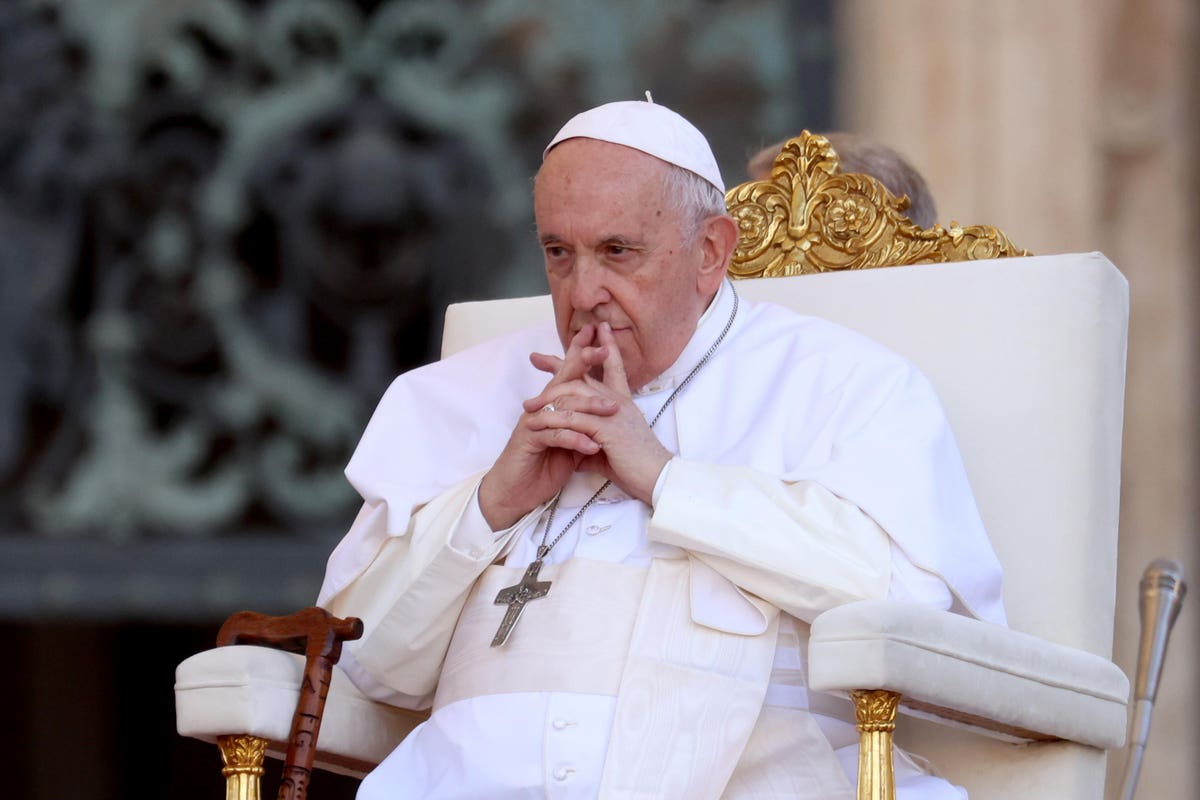
Pope Francis is among the most important moral leaders of our times. His public pronouncements often focus on moral dimensions of global challenges. While he is outspoken on climate issues, it is less clear whether his climate pronouncements affect public policy and individual behavior. This raises the question of how moral reasoning might influence climate politics.
In 2015 Pope Francis wrote an Encyclical Letter, Laudato Si’, in which he noted, “Saint Francis of Assisi reminds us that our common home is like a sister with whom we share our life and a beautiful mother who opens her arms to embrace us. …This sister now cries out to us because of the harm we have inflicted on her by our irresponsible use and abuse of the goods with which God has endowed her.”
Last week, in an Apostolic Exhortation, Laudate Deum, he said, “Eight years have passed since I published the Encyclical Letter Laudato Si’, when I wanted to share with all of you, my brothers and sisters of our suffering planet, my heartfelt concerns about the care of our common home. Yet, with the passage of time, I have realized that our responses have not been adequate, while the world in which we live is collapsing and may be nearing the breaking point.” The Pope criticized Western countries for their insufficient commitment to climate policy and individuals for their “irresponsible lifestyles.” In doing so, Pope Francis noted the pervasive government, market, and individual failures to address climate change.
How Might Pope Francis’ Appeals Influence Climate Attitudes?
Pope’s moral and institutional authority should enhance climate’s media salience, create normative pressure, and eventually lead to policy and behavioral change. Does it?
Given his stature, we expect Pope’s pronouncements to be covered widely in the media. Yet, the New York Times’s Climate and Environment section (web version) has not covered Laudate Deum yet. We wonder if dramatic events such as wars in Ukraine and the Middle East, or the refugee crisis in the U.S., are crowding out the media coverage of Pope’s pronouncement.
Individuals get information on policy issues from multiple platforms. It is possible that they could receive Pope’s climate messages via Twitter/X, or Facebook chats. But if most individuals function in echo chambers, they probably gravitate towards platforms that suit their political views. In the U.S., partisanship tends to determine our echo chambers. A recent Pew survey shows that in the U.S., partisanship, not religious affiliation, drives climate preferences. 82% of Catholics who are Democrats or lean toward the Democratic Party say global climate change is an extremely or very serious problem, but only a quarter of Republican Catholics express the same concern.
Pope Francis’ climate message has not altered climate attitudes in Catholic countries such as Italy either, where exposure to his message is more likely. In a recent paper (“Pope Francis, climate message, and meat tax: evidence from survey experiment in Italy”) co-authored with Nela Mrchkovska, we explored if referencing Pope Francis’ encyclical, Laudato Si’, motivates individuals to donate €20 to a hypothetical nongovernmental organization (NGO) that advocates for a meat tax. For context, the livestock sector accounts for about 14% of greenhouse gas emissions and several European countries have discussed a meat carbon tax. Moreover, meat consumption in the world is rising, which brings up the issue of demand management via taxes. We found that the Pope’s message did not impact support levels, even among Catholics.
Why is Moral Messaging not Working?
We see multiple reasons for the low impact of Pope’s messaging on climate attitudes and behaviors. Religious individuals might think that the Pope should not meddle in climate politics which is contentious and divisive. In fact, in our Italian study, willingness to support meat tax diminished among the highly religious when they were exposed to the Pope’s message.
Furthermore, when climate policies impose significant costs on specific sectors—just think of the ongoing strike by United Auto Workers—moral messaging might not be effective.
Lastly, moral messaging gets ignored when it clashes with widespread consumerism and the devotion to carbon-intensive lifestyles. As per the Pew report, only 10% of Americans, including 8% of the religiously affiliated, say it is morally wrong to drive low gas mileage cars. Similarly, only 3% of U.S. adults say this is morally wrong to eat food that takes a lot of energy to produce. As we have noted recently, while young people are very concerned about climate change, they flock to celebrities that promote consumerism (what the Pope calls, “irresponsible lifestyles”), and have a shockingly high carbon footprints.
What type of moral messaging might support pro-climate attitudes and promote “responsible lifestyles? Moral Foundation Theory suggests that moral reasoning that individuals employ could be traced to six basic types of moral foundations (care, fairness, loyalty, authority, sanctity, and liberty). The implication is that moral messaging from authority figures such as Pope Francis, the Dalai Lama, and the Archbishop of Canterbury may not have a universal appeal (even among their congregants). Thus, moral arguments must be tailored to specific audiences. For example, if loyalty (patriotism) and liberty (economic freedom) are moral foundations that appeal to Republicans, perhaps climate change should be framed in terms of national defense or economic development.
In sum, climate politics must pay attention to two factors. First, how to compensate actors who lose from climate policy. Second, which moral foundations might persuade climate opponents to support policy actions? Without careful examination of both, climate policy progress will continue to lag.
Read the full article here