


Startup DreamersStartup Dreamers
  • Home
  • Startup
  • Money & Finance
  • Starting a Business
    • Branding
    • Business Ideas
    • Business Models
    • Business Plans
    • Fundraising
  • Growing a Business
  • More
    • Innovation
    • Leadership
Trending

Trump Media Scales Back Plans for Its Own Prediction Market

May 26, 2026

Scientists May Have Been Wrong About Europa’s Water Plumes

May 26, 2026

The US Is Using AI to Hunt Down Insider Trading on Polymarket

May 25, 2026
Facebook Twitter Instagram
  • Newsletter
  • Submit Articles
  • Privacy
  • Advertise
  • Contact
Facebook Twitter Instagram
Startup DreamersStartup Dreamers
  • Home
  • Startup
  • Money & Finance
  • Starting a Business
    • Branding
    • Business Ideas
    • Business Models
    • Business Plans
    • Fundraising
  • Growing a Business
  • More
    • Innovation
    • Leadership
Subscribe for Alerts
Startup DreamersStartup Dreamers
Home » Giant Planets Like Jupiter Can Be Bad News For Life, Say Scientists
Innovation

Giant Planets Like Jupiter Can Be Bad News For Life, Say Scientists

adminBy adminNovember 2, 20232 ViewsNo Comments3 Mins Read
Facebook Twitter Pinterest LinkedIn Tumblr Email

Massive planets like Jupiter—now at its brightest and best in the night sky—can prevent Earth-sized planets from becoming Earth-like by upsetting their orbits and destroying climates.

That’s the conclusion of a new paper published today in The Astronomical Journal, which details how the pull of gas giants can fundamentally change the futures of more minor planets orbiting the same star.

There are four gas giant planets in our solar system—Jupiter, Saturn, Uranus and Neptune. The largest, Jupiter, has colossal gravitational effects that deflect asteroids and comets that could otherwise threaten Earth.

Destructive role

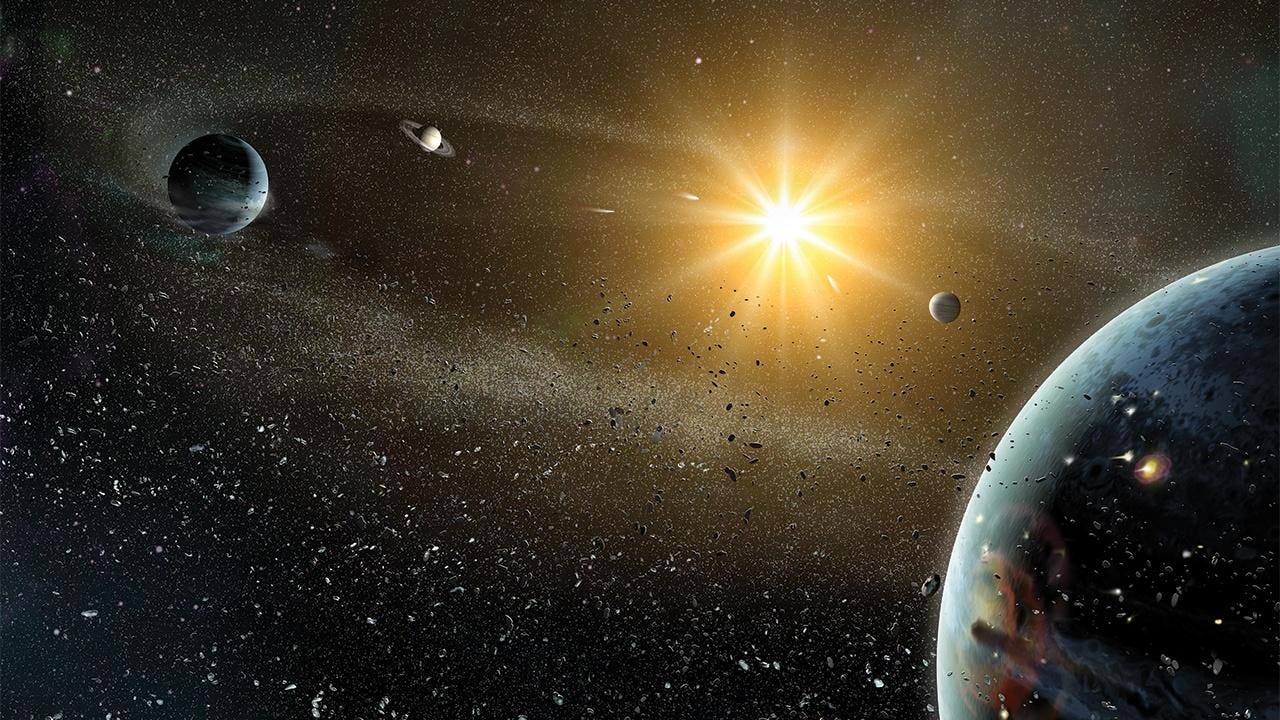
In other star systems, gas giants can play a much more destructive role. As an example, the authors studied HD 141399, a star system also with four gas giant planets, which is 121 light-years from the solar system in the constellation Boötes. They did computer simulations to see if the four gas giant planets ejected any planets out of the star’s habitable zone.

Habitable zone

The habitable zone of a star—sometimes called a Goldilocks zone—is the distance from a star a planet needs to be for liquid water to exist on its surface. That’s thought to be a prerequisite for life. It’s bordered on either side by a “boil line” (where a world is too close to a star and where water would boil away) and an “ice line” (where water would freeze).

Chaotic place

HD 141399 is a chaotic place with “four Jupiters acting like wrecking balls, throwing everything out of whack,” said Stephen Kane, first author of the paper and an astrophysicist at the University of California – Riverside. Earth would be unlikely to stay where it is if it was in this system, the simulations showed. “There are only a select few areas where the giants’ gravitational pull would not knock a rocky planet out of its orbit and send it flying right out of the zone,” said Kane.

More evidence

A second paper, also published today by the same authors, also suggests that gas giants can cause chaos. It found that a suspected Earth-size planet in the habitable zone of a star just 30 light-years from the solar system, called GJ 357, is likely much larger. “It’s probably not terrestrial, so you couldn’t have life on it,” said Kane. Simulations suggest that the gravitational chaos caused by the planet—now thought to be 10 times the mass of Earth—is preventing other, more minor planets from orbiting in the habitable zone alongside it. It’s a warning that planets found to orbit in the habitable zone of a star shouldn’t be assumed to be capable of hosting life, said the authors.

“Our work gives us more reasons to be very grateful for the planetary configuration we have in our solar system,” said Kane.

Wishing you clear skies and wide eyes.

Read the full article here
Share. Facebook Twitter Pinterest LinkedIn Tumblr Email

Related Articles

Scientists May Have Been Wrong About Europa’s Water Plumes

Innovation May 26, 2026

If Your Name Isn’t Western, AI Could Cost You The Promotion.

Innovation May 25, 2026

What Is ‘Dusking?’ Namibia Named Best Place To Watch Day Turn To Night

Innovation May 24, 2026

Senator Cassidy’s Loss Shows Political Risk of Public Health Leadership

Innovation May 23, 2026

The AI-In-Education Problem Isn’t Cheating. It’s Passivity.

Innovation May 22, 2026

Google I/O 2026 Turned Gemini Into An Agent Platform

Innovation May 21, 2026
Add A Comment

Leave A Reply Cancel Reply

Editors Picks

Trump Media Scales Back Plans for Its Own Prediction Market

May 26, 2026

Scientists May Have Been Wrong About Europa’s Water Plumes

May 26, 2026

The US Is Using AI to Hunt Down Insider Trading on Polymarket

May 25, 2026

If Your Name Isn’t Western, AI Could Cost You The Promotion.

May 25, 2026

WhatsApp Adds Meta AI Chats That Are Built to Be Fully Private

May 24, 2026

Latest Posts

Mira Murati Wants Her AI to ‘Keep Humans in the Loop’

May 23, 2026

Senator Cassidy’s Loss Shows Political Risk of Public Health Leadership

May 23, 2026

The Chinese App That Puts Instagram to Shame

May 22, 2026

The AI-In-Education Problem Isn’t Cheating. It’s Passivity.

May 22, 2026

The Real Losers of the Musk v. Altman Trial

May 21, 2026
Advertisement
Demo

Startup Dreamers is your one-stop website for the latest news and updates about how to start a business, follow us now to get the news that matters to you.

Facebook Twitter Instagram Pinterest YouTube
Sections
  • Growing a Business
  • Innovation
  • Leadership
  • Money & Finance
  • Starting a Business
Trending Topics
  • Branding
  • Business Ideas
  • Business Models
  • Business Plans
  • Fundraising

Subscribe to Updates

Get the latest business and startup news and updates directly to your inbox.

© 2026 Startup Dreamers. All Rights Reserved.
  • Privacy Policy
  • Terms of use
  • Press Release
  • Advertise
  • Contact

Type above and press Enter to search. Press Esc to cancel.

GET $5000 NO CREDIT