





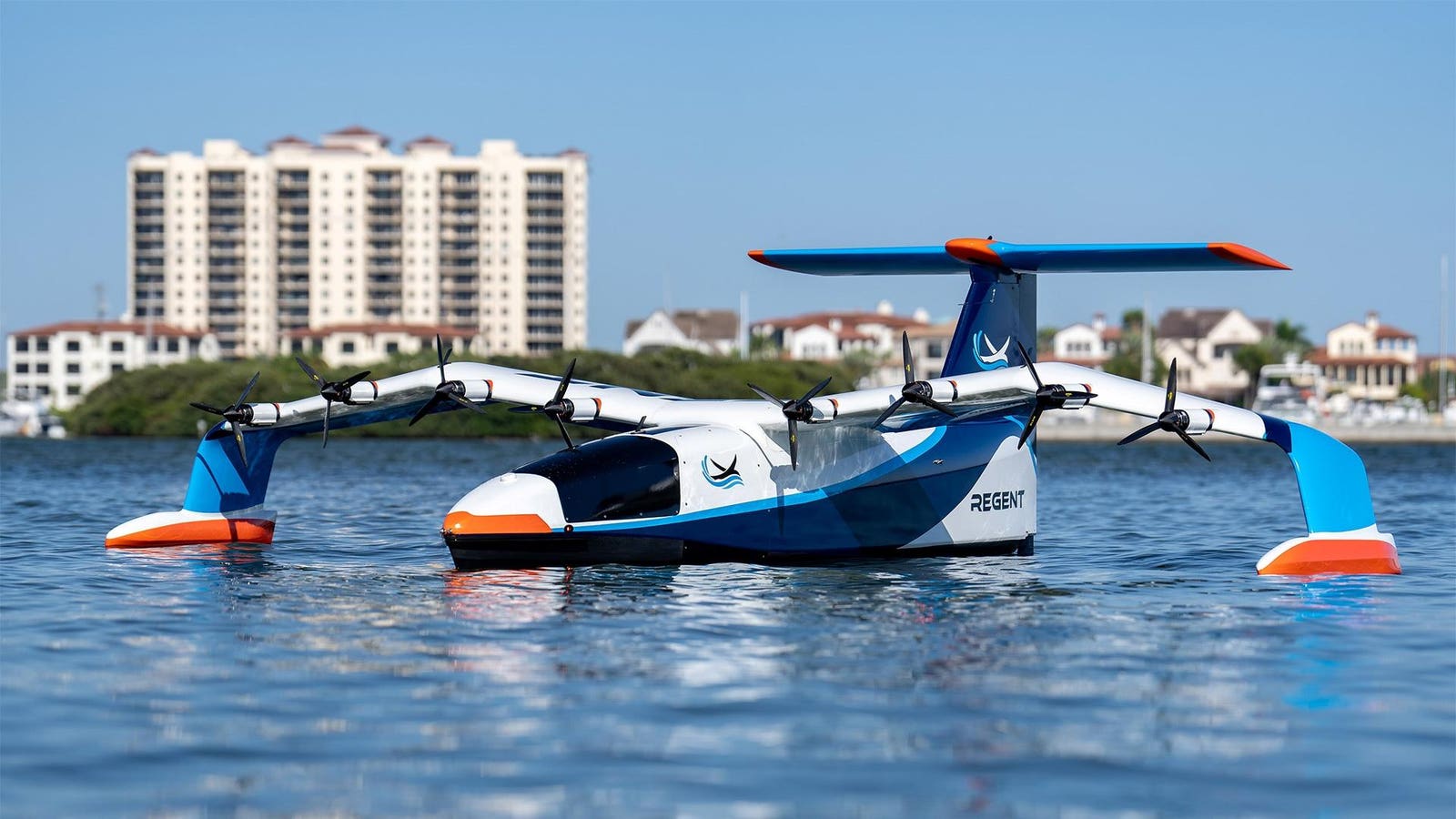
Rhode Island-based Regent has raised $90 million to get its 12-passenger electric seaglider, a low-flying plane that operates only over water, into production by mid-decade. The business jet-like vehicle will travel up to 180 miles at speeds as fast as 180 mph.
By Alan Ohnsman, Forbes Staff
Electric vertical takeoff and landing air taxis, or eVTOLS, could be an exciting new way to zip around urban landscapes someday and have soaked up billions of investment dollars. But exactly when they go into commercial service and how much rides in the copter-like vehicles will cost isn’t so clear.
Billy Thalheimer, who worked on eVTOLs for Boeing’s Aurora Flight Sciences and spacecraft at Blue Origin and Virgin Galactic, thinks a different type of battery-powered aircraft can get to market faster and be more affordable for passengers: seagliders. Resembling futuristic business jets, they’ll take off from ordinary waterfront docks, first operating like boats on hydrofoil stilts over the water at 40 mph or 50 mph. Once they reach open areas they lift off and fly about five to 10 meters above the water. His startup, Regent, is testing quarter-scale prototypes and aims to be in production in about three years, with commercial units ferrying passengers between Hawaii’s islands or around the Florida coast for an estimated $40 a ride, Thalheimer said.
Thalheimer and his Aurora colleague Mike Klinker, a fellow MIT-trained aeronautical engineer, started Regent in 2020 to focus on high-speed coastal travel and have since raised about $90 million, including a $60 million round in October, from Mark Cuban, Peter Thiel (through both his family fund and Founders Fund), Lockheed Martin, Japan Airlines and Hawaiian Airlines, among others. Their initial product, the Viceroy, is designed to carry up to a dozen passengers and two crew up to 180 miles per charge at speeds of up to 180 miles per hour with no exhaust pollution.
The seaglider’s affordability makes it especially attractive to backers like Cuban. “I love the concept,” the billionaire investor told Forbes. “The EV side aside, the ability to cut travel time efficiently and inexpensively is a game changer.”
Because it flies low and only over water, certification of the Viceroy will be determined by the U.S. Coast Guard, a process Thalheimer expects to be much faster than eVTOLS, which would require a lengthy, years-long certification process by the Federal Aviation Administration.
At Aurora the path to commercialization looked like “a billion dollars and a decade,” Thalheimer told Forbes. “And it was more than just even the commercial certification. We were prototyping and just waiting on an email from the FAA that would clear us to (test) fly.”
The gull-winged Viceroy, with twelve sets of propellers and a battery equivalent to seven Teslas, doesn’t require a licensed pilot to operate since it essentially hovers over the water and the controls are similar to that of a boat. Its motors, battery packs and other key components are also designed to be easily swapped out and replaced if anything goes wrong to ensure that maintenance costs are as low as possible.
“We end up halving the cost, compared to existing best-in-class small aircraft,” Thalheimer said recently at the CoMotion LA mobility conference in Los Angeles. “That ends up being, on our 12-passenger Viceroy, about 40 cents a seat mile. So a 100-mile mission, let’s say between the islands of Hawaii, for example, you’re looking at $40” a ticket, he said.
By comparison, a one-way helicopter flight from Long Beach, California, to Catalina Island, a 40-mile journey, costs about $180. Lilium, a well-funded eVTOL startup, estimates its cost per seat mile will be about $2.25, or nearly five times Regent’s target — carrying less than half as many passengers less than half as far.
Some of these savings come from the energy savings of flying low, close to the ocean, rather than thousands of feet in the air as airplanes and helicopters do.
For example, as long ago as World War II, military pilots knew that flying low was a good way to conserve fuel, said Mortez Gharib, a professor of aeronautical engineering at Caltech and director of the university’s Center for Autonomous Systems and Technologies.
“When you fly very near boundaries, it can be ground or water, you create an air cushion. That air cushion basically allows you to have some artificial lift,” said Gharib, who’s not affiliated with Regent.
Passengers might also like a key safety feature: unlike planes, helicopters and eVTOLs, if there’s any sort of power or motor failure on a seaglider, they’ll just float like a boat.
Seagliders For The Saudis, Tourists And Marines
Thalheimer said that initial interest in Regent’s seagliders was from ferry operators but the number of potential customers is expanding substantially.
“We’ve seen airlines and the aviation field pick up a lot,” Thalheimer said. “We’re starting to see airlines really think of themselves as transportation operators, thinking about that whole end-to-end customer journey. And seagliders can fit really nicely into that picture.” Particularly for airports located adjacent to harbors and bays, he said.
In addition to Hawaii and Florida, Regent seagliders will also end up in NEOM, the futuristic urban zone Saudi Arabia is building and that will feature a range of new types of transportation, said Christian Thiel, its head of future mobility. NEOM is also a Regent investor.
“It will be fully integrated with our multimodal system,” Thiel said at the CoMotion conference. “We have 450 kilometers of coastline to be served. … We have marine infrastructure in planning and design — we don’t have existing infrastructure. So we can start from scratch to design and ensure that all our major hubs along this coastline can be served going forward with seagliders.”
And it’s not just tourists and coastal commuters that might be riding Regent’s seagliders in a few years. In October the company won a $4.8 million contract from the U.S. Marine Corps to demonstrate the potential of its hybrid craft as a new type of island-hopping vehicle to haul people or supplies.
Thalheimer said Regent is also designing a much larger, 100-passenger version of its seaglider, though it’s not due until around 2030. That’s mainly because of the limitations of current battery technology, so Thalhemier is exploring using a hydrogen fuel cell system instead. The company estimates it has potential orders for future seagliders worth as much as $8 billion from airlines and ferry companies, including deposits for its first seaglider deliveries. Still, the bulk of that won’t materialize into revenue until commercial deliveries ramp up.
Regent has sufficient funds to continue prototyping and start test flights with human passengers in 2024. It’s also setting up its first production facility in Rhode Island.
But more money will be needed to scale up commercial operations.
“We’re planning on flying next year, probably very late next year, so that next fundraise will probably be in early 2025,” Thalheimer said. He didn’t detail how much Regent would be seeking at that time. But he hopes to launch as soon as feasible: “how quickly do we spool up the manufacturing line, prove the safety and deliver it to the customers?”
MORE FROM FORBES
Read the full article here