




Startup DreamersStartup Dreamers
  • Home
  • Startup
  • Money & Finance
  • Starting a Business
    • Branding
    • Business Ideas
    • Business Models
    • Business Plans
    • Fundraising
  • Growing a Business
  • More
    • Innovation
    • Leadership
Trending

ICE Asks Companies About ‘Ad Tech and Big Data’ Tools It Could Use in Investigations

January 30, 2026

Today’s Wordle #1686 Hints And Answer For Friday, January 30

January 30, 2026

Meta Seeks to Bar Mentions of Mental Health—and Zuckerberg’s Harvard Past—From Child Safety Trial

January 29, 2026
Facebook Twitter Instagram
  • Newsletter
  • Submit Articles
  • Privacy
  • Advertise
  • Contact
Facebook Twitter Instagram
Startup DreamersStartup Dreamers
  • Home
  • Startup
  • Money & Finance
  • Starting a Business
    • Branding
    • Business Ideas
    • Business Models
    • Business Plans
    • Fundraising
  • Growing a Business
  • More
    • Innovation
    • Leadership
Subscribe for Alerts
Startup DreamersStartup Dreamers
Home » Light-Based Chips Could Help Slake AI’s Ever-Growing Thirst for Energy
Startup

Light-Based Chips Could Help Slake AI’s Ever-Growing Thirst for Energy

adminBy adminJune 19, 20243 ViewsNo Comments3 Mins Read
Facebook Twitter Pinterest LinkedIn Tumblr Email

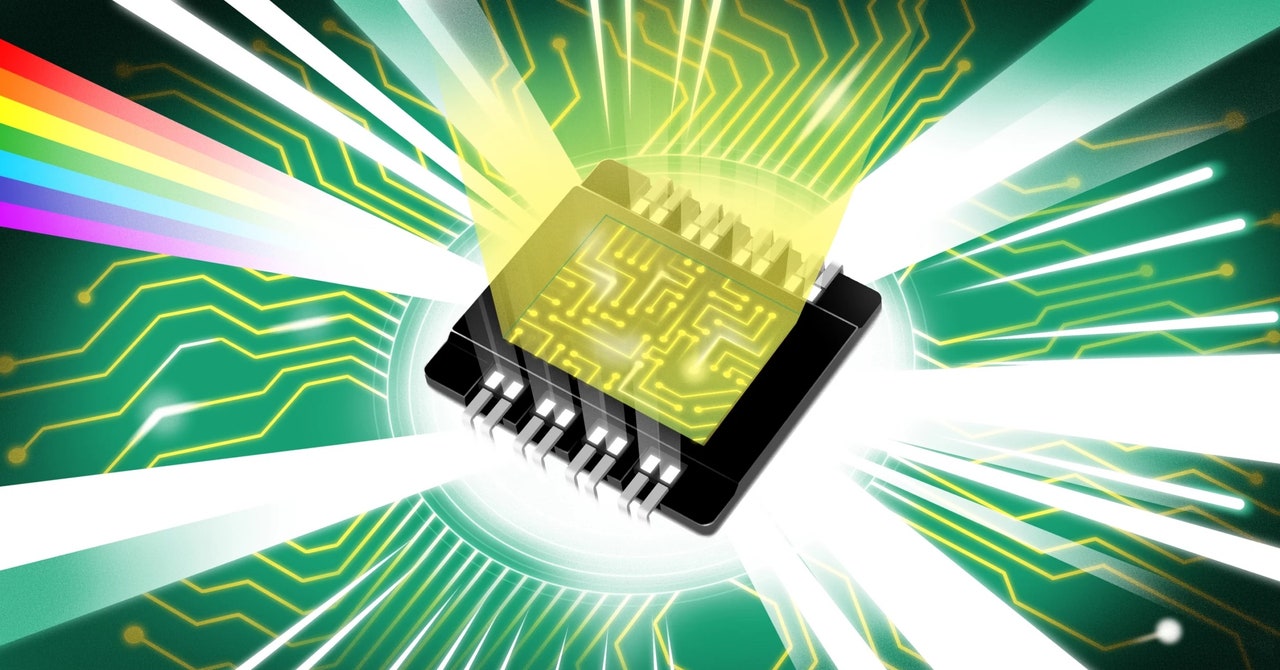
“What we have here is something incredibly simple,” said Tianwei Wu, the study’s lead author. “We can reprogram it, changing the laser patterns on the fly.” The researchers used the system to design a neural network that successfully discriminated vowel sounds. Most photonic systems need to be trained before they’re built, since training necessarily involves reconfiguring connections. But since this system is easily reconfigured, the researchers trained the model after it was installed on the semiconductor. They now plan to increase the size of the chip and encode more information in different colors of light, which should increase the amount of data it can handle.

It’s progress that even Psaltis, who built the facial recognition system in the ’90s, finds impressive. “Our wildest dreams of 40 years ago were very modest compared to what has actually transpired.”

First Rays of Light

While optical computing has advanced quickly over the past several years, it’s still far from displacing the electronic chips that run neural networks outside of labs. Papers announce photonic systems that work better than electronic ones, but they generally run small models using old network designs and small workloads. And many of the reported figures about photonic supremacy don’t tell the whole story, said Bhavin Shastri of Queen’s University in Ontario. “It’s very hard to do an apples-to-apples comparison with electronics,” he said. “For instance, when they use lasers, they don’t really talk about the energy to power the lasers.”

Lab systems need to be scaled up before they can show competitive advantages. “How big do you have to make it to get a win?” McMahon asked. The answer: exceptionally big. That’s why no one can match a chip made by Nvidia, whose chips power many of the most advanced AI systems today. There is a huge list of engineering puzzles to figure out along the way—issues that the electronics side has solved over decades. “Electronics is starting with a big advantage,” said McMahon.

Some researchers think ONN-based AI systems will first find success in specialized applications where they provide unique advantages. Shastri said one promising use is in counteracting interference between different wireless transmissions, such as 5G cellular towers and the radar altimeters that help planes navigate. Early this year, Shastri and several colleagues created an ONN that can sort out different transmissions and pick out a signal of interest in real time and with a processing delay of under 15 picoseconds (15 trillionths of a second)—less than one-thousandth of the time an electronic system would take, while using less than 1/70 of the power.

But McMahon said the grand vision—an optical neural network that can surpass electronic systems for general use—remains worth pursuing. Last year his group ran simulations showing that, within a decade, a sufficiently large optical system could make some AI models more than 1,000 times as efficient as future electronic systems. “Lots of companies are now trying hard to get a 1.5-times benefit. A thousand-times benefit, that would be amazing,” he said. “This is maybe a 10-year project—if it succeeds.”


Original story reprinted with permission from Quanta Magazine, an editorially independent publication of the Simons Foundation whose mission is to enhance public understanding of science by covering research developments and trends in mathematics and the physical and life sciences.

Read the full article here
Share. Facebook Twitter Pinterest LinkedIn Tumblr Email

Related Articles

ICE Asks Companies About ‘Ad Tech and Big Data’ Tools It Could Use in Investigations

Startup January 30, 2026

Meta Seeks to Bar Mentions of Mental Health—and Zuckerberg’s Harvard Past—From Child Safety Trial

Startup January 29, 2026

The Math on AI Agents Doesn’t Add Up

Startup January 28, 2026

How Claude Code Is Reshaping Software—and Anthropic

Startup January 27, 2026

China’s Renewable Energy Revolution Is a Huge Mess That Might Save the World

Startup January 25, 2026

How China’s ‘Crystal Capital’ Cornered the Market on a Western Obsession

Startup January 24, 2026
Add A Comment

Leave A Reply Cancel Reply

Editors Picks

ICE Asks Companies About ‘Ad Tech and Big Data’ Tools It Could Use in Investigations

January 30, 2026

Today’s Wordle #1686 Hints And Answer For Friday, January 30

January 30, 2026

Meta Seeks to Bar Mentions of Mental Health—and Zuckerberg’s Harvard Past—From Child Safety Trial

January 29, 2026

Today’s Wordle #1685 Hints And Answer For Thursday, January 29

January 29, 2026

The Math on AI Agents Doesn’t Add Up

January 28, 2026

Latest Posts

How Claude Code Is Reshaping Software—and Anthropic

January 27, 2026

U.S. Revamps Wildfire Response Into Modern Central Organization

January 27, 2026

Studies Are Increasingly Finding High Blood Sugar May Be Associated With Dementia

January 26, 2026

China’s Renewable Energy Revolution Is a Huge Mess That Might Save the World

January 25, 2026

Google’s Last Minute Offer For Pixel Customers

January 25, 2026
Advertisement
Demo

Startup Dreamers is your one-stop website for the latest news and updates about how to start a business, follow us now to get the news that matters to you.

Facebook Twitter Instagram Pinterest YouTube
Sections
  • Growing a Business
  • Innovation
  • Leadership
  • Money & Finance
  • Starting a Business
Trending Topics
  • Branding
  • Business Ideas
  • Business Models
  • Business Plans
  • Fundraising

Subscribe to Updates

Get the latest business and startup news and updates directly to your inbox.

© 2026 Startup Dreamers. All Rights Reserved.
  • Privacy Policy
  • Terms of use
  • Press Release
  • Advertise
  • Contact

Type above and press Enter to search. Press Esc to cancel.

GET $5000 NO CREDIT