





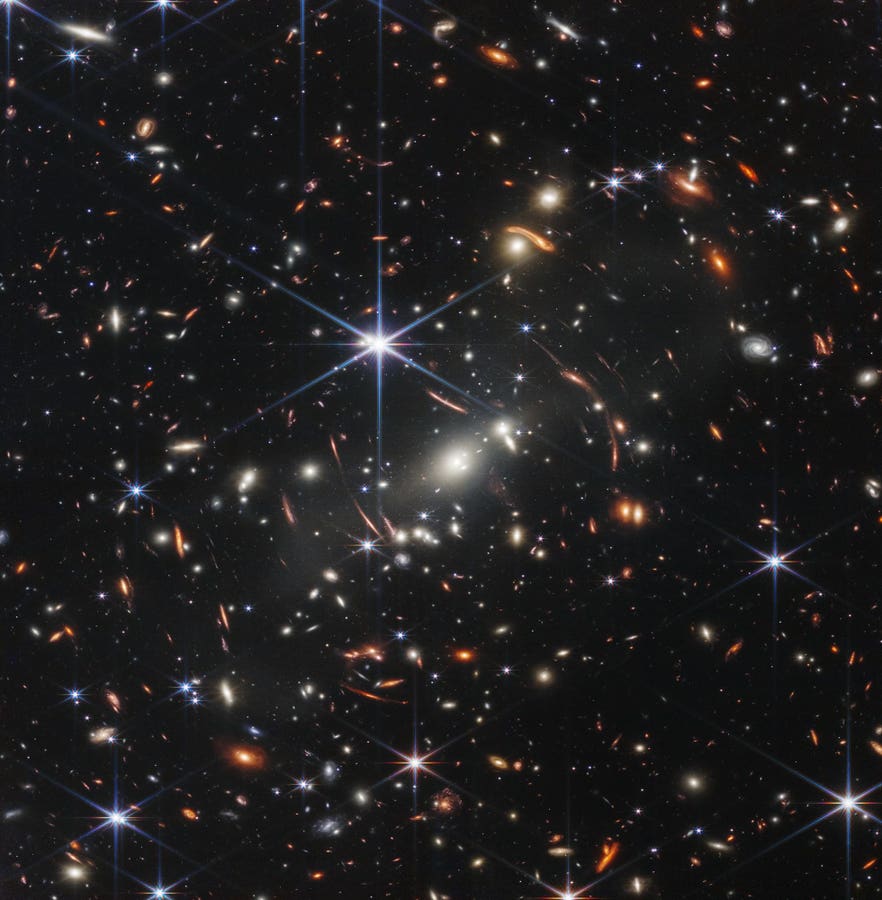
In one fell swoop, NASA’s James Webb Space Telescope has largely revolutionized much of what astronomers know about the formation and assembly of the earliest galaxies in the cosmos. Webb has not only pushed back the tape of galaxy formation, but even mainstream observational astronomers now realize that their models need updating to explain what Webb has been seeing only 300 million years after the big bang.
To answer the question of how mass assembles in the early Universe and how galaxies are forming their stars, it’s clear that the models we’ve developed for the nearby Universe need to be updated for the distant universe, Alex Cameron, a postdoctoral researcher in astrophysics at the University of Oxford, tells me in his office.
The physics of how stars form, how they evolve, is very complex, and there are big uncertainties in our models, says Cameron. So, before we start questioning the age of the universe and how old these galaxies must be, we need to do a lot of work to better calibrate our understanding of the stars themselves, says Cameron.
Theoretical Tension
The success we have had in shattering records for the most distant galaxies implies that galaxy formation got underway very early in the history of the universe, Andy Bunker, professor of Astrophysics at the University of Oxford, told me via email. The fact that we see the fingerprints of heavy elements such as carbon and oxygen in the most distant galaxies implies that previous generations of stars have already formed, and that “first light” in the universe happened even earlier, he says.
Bright galaxies appear to be ubiquitous in the early cosmos.
Everywhere we look, we’re finding a lot of bright galaxies, says Cameron. The challenge is to disentangle whether these galaxies are bright because they’ve got a lot of stars in them or whether they’re bright, because the stars that have formed are brighter than typical present-day stars, he says. The signatures that we’re getting from these observations tell us that there’s a lot that we don’t understand about the properties of these very early stars, says Cameron.
Webb’s Cosmological Cornucopia
In less than three years, Webb’s sensitivity to galaxy formation is arguably more than in the past twenty years with Hubble and large ground-based telescopes, Richard Ellis, professor of astrophysics at University College London, tells me via email.
Bunker Agrees
Webb has revealed that some galaxies at the earliest epochs are very bright in the ultraviolet, which is telling us something about how stars form vigorously in these early galaxies, says Bunker.
What’s most puzzling about these early galaxies?
The standard picture posits that galaxies assemble their stars gradually over time via infalling gas and mergers, says Ellis. Yet, the earliest galaxies are often more luminous than ones seen later, he says.
The relative abundances of some chemical elements at these high redshifts are also unusual with astronomers particularly puzzled by why galaxies at such early times are so rich in the element of nitrogen.
But are we in sight of the cosmological holy grail?
I think we are observing these systems at a special time, perhaps close to the moment of their birth, says Ellis. They could be unusually luminous because they may be bursting into life a few tens of millions of years after formation; in this case they would not be able to sustain this luminosity for very long, he says.
Yet they may also simply have more massive stars than those seen in galaxies at later times.
Either way, it’s pointing to the fact we may be getting close to a “holy grail” when galaxies first emerged from darkness, says Ellis.
As For Finding True Cosmic Dawn?
It may not be possible to find a “chemically pristine” galaxy first emerging from darkness, says Ellis.
That’s because the five-to-ten-million-year window in time when this gas had such a primordial composition was so short.
But when the gas is first heated by young stars it will induce an absorption signal in the cold gas seen against the glow of the big bang, says Ellis. The Square Kilometer Array (a massive international radio telescope project) nearing completion in Western Australia has the potential to see this clinching signal in concert with further progress with Webb, he says.
Read the full article here