





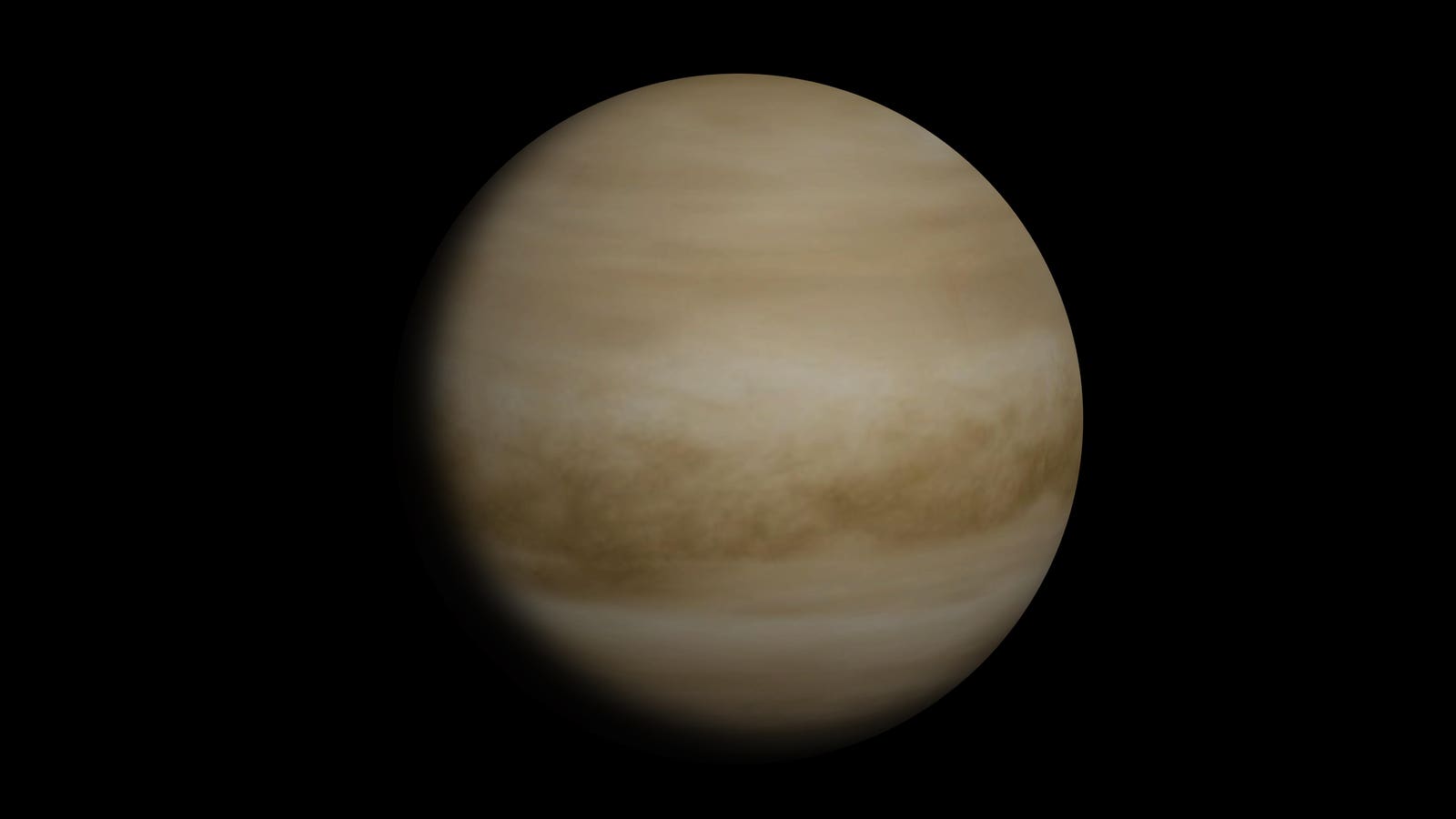
New data from a retired NASA telescope suggests that there is atomic oxygen in the atmosphere of Venus. Although it’s been inferred before, this is the first direct detection on the planet’s day side.
Revealed today in a paper published in the journal Nature Communications, scientists say that oxygen is produced on the dayside of Venus by carbon dioxide and carbon monoxide decomposing as they’re subjected to sunlight. Circulation patterns on Venus then transport it to the night side, too.
The findings will help scientists figure out why Venus’ atmosphere is so different to Earth’s and also support future space missions to Venus, say the researchers—and there are a trio of them coming up (see below).
The oxygen was found about 60 miles up in the Venusian atmosphere by researchers using NASA’s SOFIA, a Boeing 747SP with a 2.5-meter diameter telescope, in observations made in November 2021. SOFIA has since been retired.
Toxic Atmosphere
Rocky, a similar size to Earth and about the same distance from the sun, Venus also has a comparable amount of carbon. However, planetary scientists have known since the 1960s that modern Venus has thick, sulphuric acid clouds and an atmosphere 50 times denser than Earth’s.
It’s mostly carbon dioxide and nitrogen. While its clouds are about 86ºF its surface can reach 900°F, which is hot enough to melt lead.
Although scientists have wondered if Venus could have been habitable before a runaway greenhouse effect boiled away its water, doubt was cast on that by a study from the University of Chicago earlier this year. That study’s computer simulations sought to explain how Venus got its present-day atmosphere. They found very few ways for the planet to retain water and moderate temperatures for long enough for life to take hold.
Phosphine On Venus
Although this detection of atomic oxygen is a first, it’s arguably not as exciting as the recent discovery of phosphine on Venus. Initially discovered in 2020, earlier this year it was confirmed that traces of phosphine—a gas thought to be a sign of life—had definitely been inferred in the atmosphere of Venus.
Phosphine comprises hydrogen and phosphorus and is a flammable and toxic gas on Earth.
At the very least, it’s evidence of weird chemistry going on in the cloud tops of Venus, with another explanation being a stunning discovery—acid-resistant microbial life on another planet.
Just a few days ago, new data from NASA’s Juno spacecraft suggested that there are mineral salts and organic compounds on the surface of Jupiter’s giant moon Ganymede.
Venus Revisited
There are three new missions now being prepared to unveil more about Venus:
- NASA’s DAVINCI (launching 2029) will land a probe on its surface.
- NASA’s VERITAS (launching 2031) will map the planet’s volcanoes from orbit.
- European Space Agency’s EnVision (launching early 2030s) will analyze the planet’s interior from orbit—and monitor trace gases in the atmosphere.
Exoplanet Analog
Knowing exactly how and why Venus is inhospitable to life and Earth is a paradise is critical to planetary scientists as they study exoplanets—planets that orbit stars other than the sun. After all, it’s highly possible that an exoplanet that seems Earth-like from a great distance is, in reality, more like Venus than Earth.
So if we’re ever to identify an Earth 2.0 we’ll need to know precisely why and how Venus and Earth came to be so dramatically different in terms of habitability.
Wishing you clear skies and wide eyes.
Read the full article here