




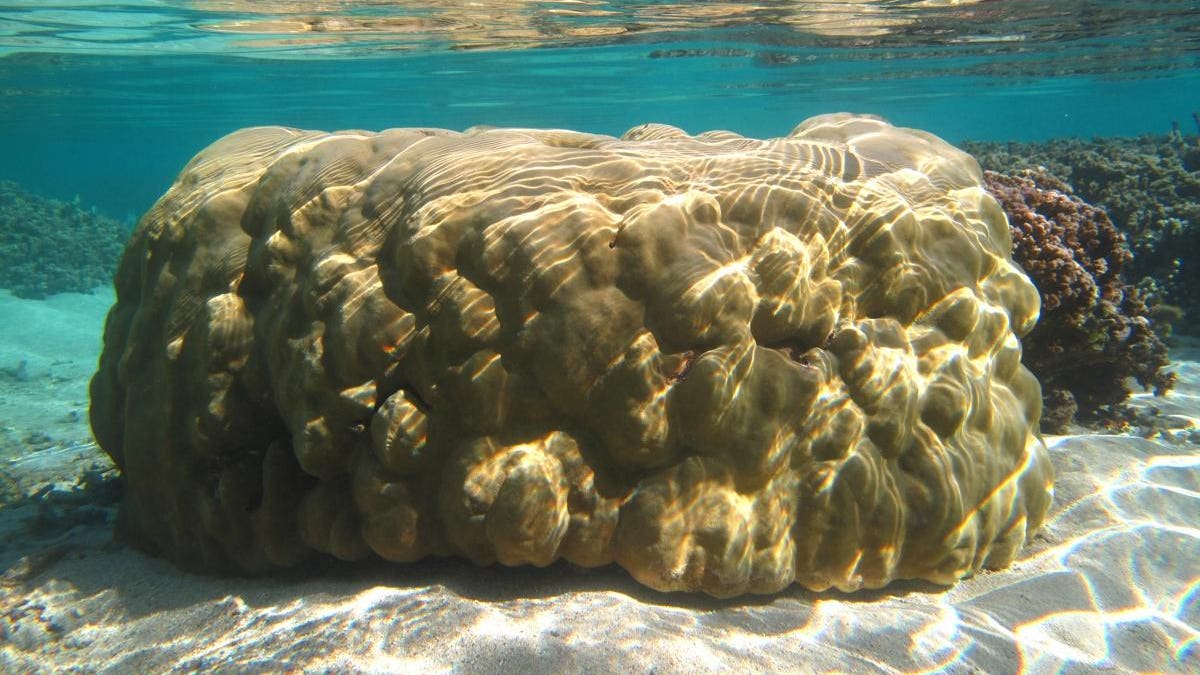
Resilient ‘super corals’ have recently been seen as potential saviors in the face of climate change and its destructive effects on coral reefs
© Copyright by GrrlScientist | hosted by Forbes | LinkTr.ee
Coral reefs are critically important habitats for countless animals as well as for people. Globally, one out of every four marine fishes spends at least some part of its life on a coral reef. Billions of people worldwide depend upon coral reefs for food, storm protection and for jobs. The imperilled coral reefs in the Florida Keys that you hear about daily in the news, for example, account for an infusion of some $2.4 million annually into the local economy and provide approximately half of the local jobs.
This year, many of the world’s coral reefs are either dying or are already dead because of the influx of seawater that has been superheated by climate change. This overheated water triggers corals to become “bleached.” Coral bleaching results when corals expel their colorful endosymbiotic algae, leaving the still living, but white, coral skeleton behind (more here). If the water cools quickly enough, the corals can survive. If not, they starve. But tragically, the seawater along the coast of Florida is now so hot that corals are quickly killed — without starving.
Scientists are working diligently to save the world’s coral reefs, or at least to minimize the damage they suffer from runaway climate change. As part of this work, researchers identified 34 species of resilient corals in two mangrove lagoons on Woody Isle and Howick Island that are part of the Great Barrier Reef Marine Park in Far North Queensland, Australia.
Often referred to as “super corals,” these corals can survive and even thrive in extreme environments such as mangrove lagoons, where they are regularly exposed to extreme low pH, low oxygen content and highly variable temperature conditions. These corals may provide scientists with novel information about how corals can survive stressors such as climate change and pollution.
For these reasons, super corals are viewed as potential sources of stress-tolerant corals for use in a variety of conservation strategies such as coral propagation and assisted evolution. Assisted evolution refers to conservation approaches designed to enhance certain traits such as temperature tolerance, growth or reproduction.
An international team of scientists is investigating these super corals so they can learn how to develop strategies to restore and protect fragile coral reefs.
Co-lead author of the study, Emma Camp, was a member of the team who originally discovered resilient mangrove-dwelling corals. She is a Chancellor’s Postdoctoral Research Fellow at the University of Technology Sydney, as well as an award-winning and internationally renowned corals expert. Dr Camp said that better understanding the strategies used by super corals to survive have meaningful implications for the future survival and suitability of resilient corals in restoration projects, and added that these discoveries are important because they “provide novel information on the mechanisms that support coral resilience to stressors such as climate change and pollution.”
“Understanding the mechanisms by which corals adapt and survive in extreme habitats is crucial for developing effective conservation strategies,” Dr Camp said in a statement.
This newest study focused on the reef-building coral species, Porites lutea. This is a stony coral that is native to the tropical Indo-Pacific region. It is a common species that can form “microatolls” in the intertidal zone; these microatolls are disc-shaped mounds with dead coral at the top and living corals around the perimeter that continue to grow outwards.
The researchers recently discovered that Porites lutea is a resilient coral: it thrives in both mangrove forests and in reefs. But what are the trade-offs associated with being able to tolerate major stresses caused by living in highly variable mangrove lagoons?
Already, Dr Camp and her collaborators have discovered that mangrove-dwelling corals have a reduction in genetic diversity and gene expression variability. Physiologically, they showed reduced calcification rates, which translates into slower growth for mangrove corals than for their reef counterparts. Further, the researchers also discovered changes in the skeletal structure of Porites lutea living in mangrove lagoons: these corals showed increased porosity and reduced density, traits that could potentially compromise their long-term survival if they are relocated to sites with strong wave action.
“While the discovery of ‘super corals’ in mangrove lagoons initially appeared promising, our research highlights potential risks associated with selective adaptation, including reduced genetic diversity and compromised skeletal properties,” Dr Camp pointed out.
“While this allows them to survive in the current harsh conditions, it may limit their ability to cope with future environmental stressors,” agreed study co-lead author, coral ecologist Tali Mass, a professor in the department of marine biology at the University of Haifa who studies how corals respond physiologically and morphologically to changes in their environment from the molecular to the organism level.
So are these super corals extra-resilient or not? Well, maybe.
“While there is little doubt that ‘super corals’ have a role to play in coral restoration programs, maintaining genetic diversity and careful consideration of the suitability of corals adapted to extreme environments is vital when planning restoration efforts,” Dr Camp replied.
The team is now working on how to integrate these super corals into the strategies of the Coral Nurture Program that is designing new approaches to maintaining genetic diversity and minimizing risks to coral reefs, particularly Australia’s Great Barrier Reef.
Source:
Federica Scucchia, Paul Zaslansky, Chloë Boote, Annabelle Doheny, Tali Mass & Emma F. Camp (2023). The role and risks of selective adaptation in extreme coral habitats, Nature Communications 14:4475 | doi:10.1038/s41467-023-39651-7
SHA-256: 9ab94921e06b203a216cb219d873f92ea4083642075e2e0be632939cd42949aa
Socials: Bluesky | CounterSocial | LinkedIn | Mastodon | MeWe | Post.News | Spoutible | SubStack | Tribel | Tumblr | Twitter
Read the full article here