




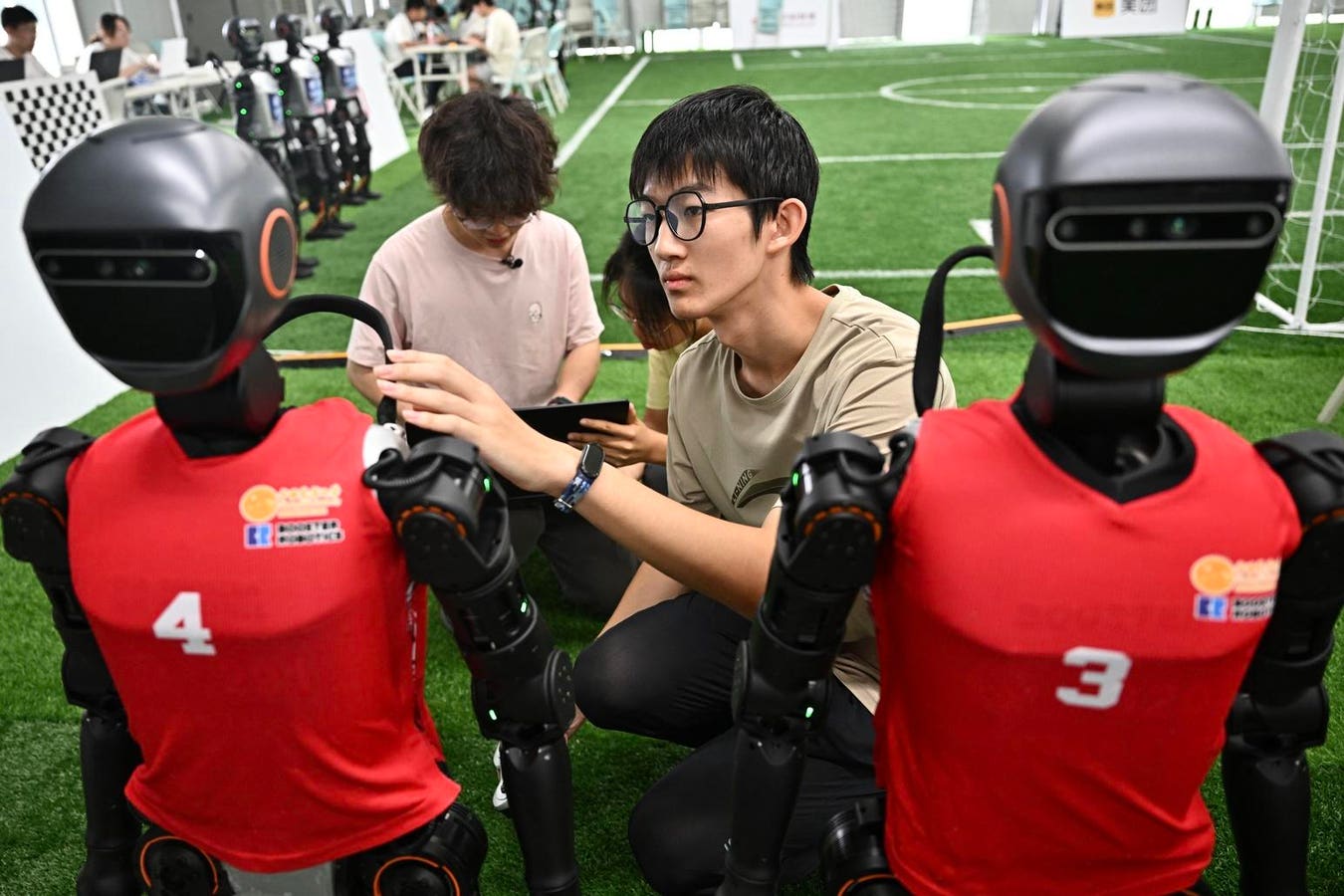
Earlier this year, a Peter Diamandis report found about 100 companies working on humanoid robots globally. A few short months later, there are 150 just in China. In fact, the humanoid robot hype is getting so potentially overheated that China’s economic planning agency is warning its robotics sector that too many companies are working on the technology. Too many companies are working on humanoids in China right now, says Li Chao, the spokesperson for China’s the National Development and Reform Commission (NDRC).
In an odd way, that’s probably good news for the United States.
Trimming the number of companies making humanoid robots will certainly be efficient, resulting in fewer duplicative products, Chao says. The question for America is whether it will be more effective in the long run.
Probably not, according to former leader of NASA’s robotics and AI unit, who is currently chairman of Robotics and Artificial Intelligence for consulting giant Alliant.
“There’s something that I think can beat a very efficient dictatorship,” Dr. Robert Ambrose told me in a recent TechFirst podcast. “And it’s a little messy. It’s a little chaotic. It maybe doesn’t always move in a straight line. But it’s American innovation and entrepreneurship.”
Humanoid robots are incredibly important, Ambrose says, for national competitiveness and geopolitical power over the next decade and beyond. The Russia-Ukraine war – dubbed the First Drone War by Ambrose – shows how important robots are in the military. That includes flying robots (drones) but also land-based and seagoing robots.
But robots are critical for peacetime success as well.
To explain why, Ambrose mentions two photos taken just 13 years apart in Times Square: one on Easter morning in the year 1900, and the second on Easter morning in the year 1913.
Invented elsewhere but popularized in America, the automobile served as one of the foundations of American economic and military power for a century.
“That was in America and that’s where all the innovation was happening … America was the disruptor,” Ambrose told me. “The rest of the world was the disrupted. You always want to be the disruptor, right? You don’t want to be the disrupted. Being the disrupted sucks.”
America “dined out” on the returns from that innovation for decades, he adds.
Robots – both humanoid and other form factors – are likely to be one of the key innovations that will serve as the backbone of both economic and military might over the next century. Robots will fill in for missing labor as Western populations age, as well as potentially making onshoring manufacturing financial feasible.
That, of course, threatens some of offshoring’s current cost advantage:
“What made China successful over the last 40 odd year is their low labor rate,” Diamandis told me when I interviewed him about his robotics report. “They had a lot of humans at very low cost that could manufacture almost anything … [but] the cost of living has been going up in China, so the labor rate per hour is going up.”
(Plus, there’s at least one company that is looking hard at military markets for its humanoid robots. More on this in a week, right here; hit Follow on my author page to ensure you see it.)
China’s advantage, Ambrose says, is huge levels of government support and financing.
That support and urging has led to the current bubble: 150 humanoid robotics companies. But left on their own to grow and eventually pop, bubbles can lead to immense innovation, like the late-90’s dot-com boom. Individually, it was very bad for many companies and many investors. As a whole, the investments pumped into no-hope startups like Pets.com alongside eventual massive winners like Amazon changed both the economy and how we live our lives, and served as the impetus for American tech giants to dominate most of the world.
China regulating or artificially dampening a humanoid robotics bubble risks popping not only the investment frenzy and the speculation, but also the innovation.
There lies a potential advantage for the United States: allowing innovation even if it’s messy.
The U.S. will need every advantage it can get. While there’s a lot of investment in robotics and humanoid robotics in general, including more than a billion dollars in Figure AI and $403 million in Apptronik, this may not be near enough, as China is reported to be investing $138 billion in a national robotics surge. And even if 100 of the 150 Chinese humanoid robotic companies fold or get acquired by surviving firms, 50 is still probably at least double the number of American humanoid robotics companies.
That’s why, Ambrose says, the industry still needs government help, at least as long as it’s the kind that doesn’t impede innovation. He participated in the National Robotics Initiative of 2011, which boosted innovation and investment in robotics.
“We were trying to build a pipeline, and it worked,” Ambrose told me. “The number of robotics startups in America exploded. The number of kids working in robotics exploded.”
That needs to happen again, he says.
“If we do nothing, then Japan will probably pass us and become number two … China will be number one, and then it’ll be a race to the bottom for us. And that doesn’t sound like America to me.”
Read the full article here