




The history books of the automotive industry contain whole chapters of cultural gaffes. The myth in these legends, though, is that such egregious errors always cost corporations billions when, in fact, many have not. For instance, the Chevy Nova didn’t cost GM sales in Spanish-speaking countries despite “no va” translating from Spanish as “no go.” The Japanese male engineers designed cars for their own anthropometric dimensions, but they serendipitously sold well in North America since U.S. females coincidentally had similar dimensions. And the Hyundai Kona translates to a “vulgar expression” for a lady’s privates in Portuguese, yet the Kona remains amongst the company’s best-selling cars during a banner year in Brazil. No, mistranslations don’t automatically equate to lower profits.
But sometimes those errors do equate to lower sales. Electric two-wheelers being imported to India have been tremendously low despite 1) stifling pollution (at the time of this article, Kolkata and Delhi are both in the 20 worst cities for air quality), 2) traffic avoidance in dense cities like Bangalore, and 3) India becoming the #3 automotive market (after China and the U.S.). And the reason for the poor sales just might be a simple lesson in User Experience (UX) design and designing for the cultural persona.
The Mistaken Assumption
Affordability. For decades, that was the defining characteristic of bringing any product to market in India: bring something inexpensive or you’ll be exiting akin to General Motors (2017) and Ford (1953 and 2022). As chronicled by Pradeb Biswas, “At times, there is a gap between what the car manufacturer perceives about the [Indian] market needs and what the car buyers actually seek.”
Given the aforementioned pollution and traffic, electric two-wheelers — mostly imported Chinese scooters — have attempted to penetrate the market in India for more than a decade with less than 1% market penetration. “When you look at the two-wheeler market in China and India,” suggests Dinesh Arjun, founder and CEO of India-based Raptee, “they are significantly different. In China, they are point-A-to-point-B and extremely utility-driven … with maximum speeds of 30 kph (19mph). More importantly, these vehicles are not expected to last a very long time; usually anywhere between 1.5 and 2.5 years.” As it turns out, what’s good for the goose is not good for the gander. “In India, even the most basic motorcycles are expected to go over 100kph (61mph) … and last 10-12 years. The average lifecycle of a motorcycle in India is 11.5 years.”
To that end, the market research suggested something that Gillette also discovered when rethinking their attempts at India: there’s a sense of personal pride that’s very important to the culture. “It’s not just a purely utilitarian product,” asserts Arjun, “but every vehicle is sold with a sense of pride about it. That will be the second largest purchase for any Indian household, and it tells of the socioeconomic status of the individual.”
The UX Lesson: Needs of the Persona
What was entirely missed heretofore: developing the product around the target customer (a.k.a. persona), testing early prototypes with actual customers akin to that definition, and adjusting the design based upon the feedback.
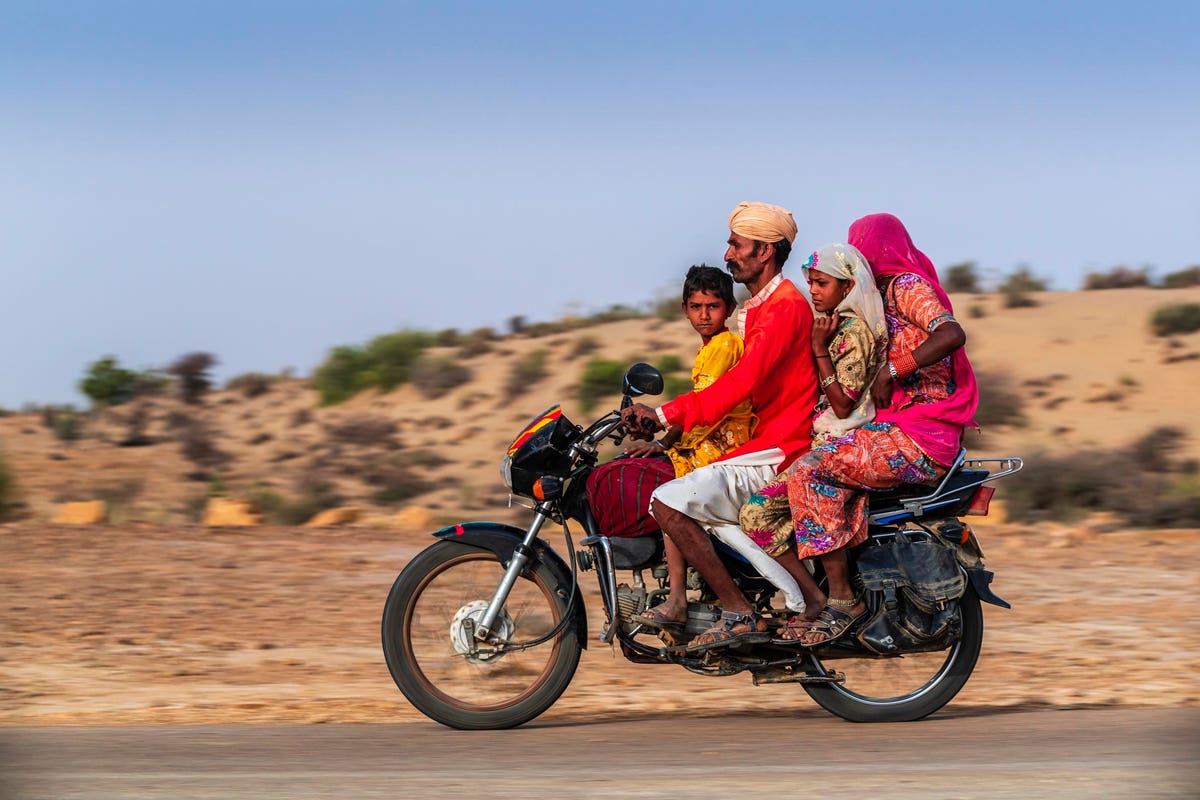
In this case, two clear examples were perceived sturdiness and passenger seating. Raptee created early digital twins (i.e., electronic simulations combined with Artificial Intelligence) using software technology from Altair, refined the design based upon simulation feedback and then tested it with customers within the region. “We understood [from our testing] that Indians were only going to buy an electric vehicle if it’s upgrade; not just cost of ownership. To overcome the stigma of traditional EV quality, we found customers needed greater steel reinforcement to trust the vehicle.” Additionally, the research showed extending the rear seat by 35mm was necessary since “… Indians like to travel with their spouse or their partner in the rear seat.”
Such UX testing is typically eliminated from the budget due to time or cost, however Raptee’s motorcycle shall hit the market in Q4 at $3,000, nearly a third less than alternative products. “Altair’s technology has allowed us to do all this effectively and cost-efficiently through a single platform, and avoid multiple iterations of traditional prototypes.”
Time will tell whether or not consumer sentiment transforms to such new, sustainable solutions or whether other market conditions (e.g., urban apartment dwellers without home charging solutions) will rule the day. Regardless, the Indian marketplace has once again reminded manufacturers wanting to cash-in that they must buy-in to user experience and cultural understanding.
Author’s Note
Coincidentally, I overheard this past week an executive’s pronouncement that “people love defining personas and then they never look at them again.” His blunt honesty wasn’t wrong, and yet it was. If a persona doesn’t help profits, Nielsen Norman Group lists “unused personas” as the #1 reason.
But a study by Cintell shows 71% of companies “… that exceed revenue and lead goals have documented personas compared to 37% that meet goals and 26% that miss them.” And Deloitte reports that customer-centric companies are 60% more profitable than the competition.
So learn the persona and its associated stakeholder requirements before designing the product, and you’ll drive the market. Otherwise, you’ll get taken for a ride.
Read the full article here