




Startup DreamersStartup Dreamers
  • Home
  • Startup
  • Money & Finance
  • Starting a Business
    • Branding
    • Business Ideas
    • Business Models
    • Business Plans
    • Fundraising
  • Growing a Business
  • More
    • Innovation
    • Leadership
Trending

Say Goodbye to the Undersea Cable That Made the Global Internet Possible

March 1, 2026

The Dilemma Of Profits V.S. Guardrails

March 1, 2026

‘Uncanny Valley’: Pentagon vs. ‘Woke’ Anthropic, Agentic vs. Mimetic, and Trump vs. State of the Union

February 28, 2026
Facebook Twitter Instagram
  • Newsletter
  • Submit Articles
  • Privacy
  • Advertise
  • Contact
Facebook Twitter Instagram
Startup DreamersStartup Dreamers
  • Home
  • Startup
  • Money & Finance
  • Starting a Business
    • Branding
    • Business Ideas
    • Business Models
    • Business Plans
    • Fundraising
  • Growing a Business
  • More
    • Innovation
    • Leadership
Subscribe for Alerts
Startup DreamersStartup Dreamers
Home » Humanoid Robot Mass Adoption Will Start In 2028, Says Bank Of America
Innovation

Humanoid Robot Mass Adoption Will Start In 2028, Says Bank Of America

adminBy adminMay 1, 202518 ViewsNo Comments3 Mins Read
Facebook Twitter Pinterest LinkedIn Tumblr Email

Humanoid robots will begin a mass adoption trend for commercial use as early as 2028, according to a new Bank of America research report. Annual shipments could hit 1 million by 2030, with a production cost of just $17,000 per unit.

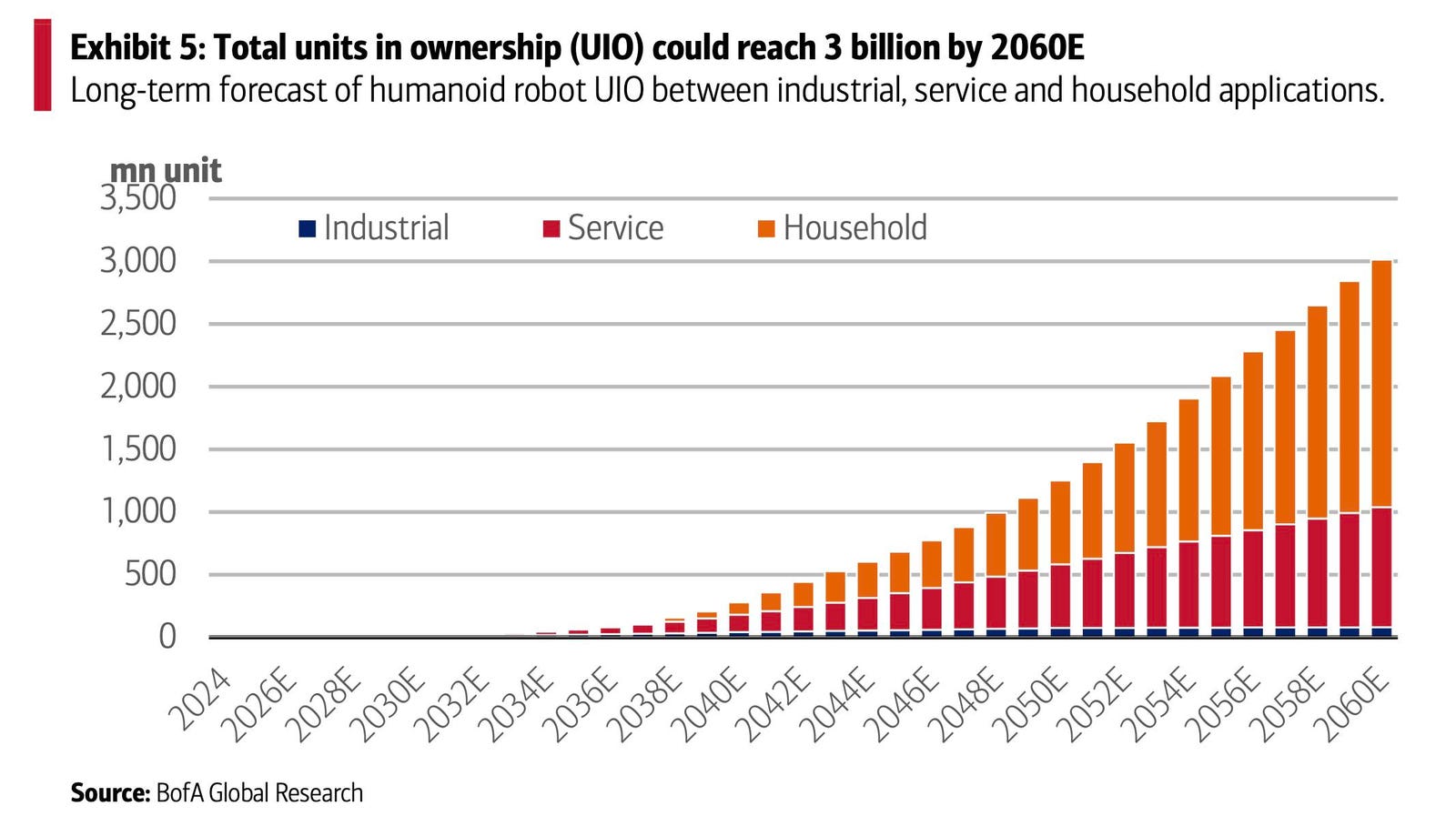
“BofA Global Research believes the adoption of humanoid robots will follow a three-stage development trajectory in the coming decade, starting from industrial and logistic applications, then on to business services, and finally to household use,” a company representative told me via email. “In the long run, BofA Global Research expects the total units in ownership for humanoid robots to reach an estimated three billion units globally by 2060.”

That three billion unit projection is based on three assumptions:

  1. Humanoid robots can replace 20% of the world’ industrial sector human employees
  2. Humanoid robots can replace between 1.5 and 2.5 works in the industrial and service sectors
  3. Humanoid robots will reach a penetration rate of .7 units per household

According to the report, the first mass commercializations period for humanoid robots will be from 2028 to 2034, and it will focus on commercial use. The second mass adoption period will be for home and all other uses, and will run from 2035 onwards. Futurists like Peter Diamandis have speculated that robots will help us in our homes with laundry, vacuuming, dishes, and all other tasks, and serve multiple purposes in healthcare, elder care, manufacturing, transport, and the service industry.

The future is starting now: Bank of America says that humanoid robot manufactures will ship 18,000 units this year, in 2025. By 2030, researchers expect that shipments will reach up to 10 million units globally per year.

Interestingly, the report suggests that the vast majority of humanoid robots will be household tools, with about two billion of the three billion shipped by 2060 in use in private homes, versus about a billion in the service industry, and only a few hundred million in industrial settings.

If so, that could be good news for human workers: many of the household robots will be replacing unpaid work that people do for themselves, rather than paid work by employees.

There are still challenges to mass adoption, the Bank of America says:

  1. Stronger AI to enable real-time interaction with humans
  2. Better motion control systems to support complex motions
  3. Enough real-world data to train the AI systems
  4. Improved sensory systems for accurate environmental information
  5. More computing power on the edge (i.e., onboard rather than in the cloud)
  6. Optimal designs to support mass production

In addition, there is regulatory risk: will nations regulate against humanoid robots in ways that delay or entirely stop deployments? Workers could rise up against them as well, with a historical precedent being the Luddite movement in the early 1800s in which textile workers protested against mechanized looms.

Over 100 global manufacturers are working on humanoid robots, and it’s a tough challenge.

One of the biggest: dextrous hands. Almost 20% of the cost of a robot is in the hands alone. One of the reasons why: more than half the complexity of a humanoid robot body is in the hands, Sanctuary AI CEO Geordie Rose told me last year.

Other major cost components include rotary actuators in joints, linear actuators, and the chips that drive the brain of a humanoid robot.

Read the full article here

Share. Facebook Twitter Pinterest LinkedIn Tumblr Email

Related Articles

The Dilemma Of Profits V.S. Guardrails

Innovation March 1, 2026

As Davos & India Celebrated AI, Paris Sounded The Alarm On AI Safety

Innovation February 28, 2026

Backyard Baseball Is Getting A New Game And I’m Ready For It In July

Innovation February 27, 2026

Solving The Data Bottleneck For Physical AI

Innovation February 26, 2026

Today’s Wordle #1686 Hints And Answer For Friday, January 30

Innovation January 30, 2026

Today’s Wordle #1685 Hints And Answer For Thursday, January 29

Innovation January 29, 2026
Add A Comment

Leave A Reply Cancel Reply

Editors Picks

Say Goodbye to the Undersea Cable That Made the Global Internet Possible

March 1, 2026

The Dilemma Of Profits V.S. Guardrails

March 1, 2026

‘Uncanny Valley’: Pentagon vs. ‘Woke’ Anthropic, Agentic vs. Mimetic, and Trump vs. State of the Union

February 28, 2026

As Davos & India Celebrated AI, Paris Sounded The Alarm On AI Safety

February 28, 2026

Backyard Baseball Is Getting A New Game And I’m Ready For It In July

February 27, 2026

Latest Posts

Solving The Data Bottleneck For Physical AI

February 26, 2026

Supreme Court Rules Most of Donald Trump’s Tariffs Are Illegal

February 25, 2026

Mark Zuckerberg Tries to Play It Safe in Social Media Addiction Trial Testimony

February 24, 2026

Inside the Rolling Layoffs at Jack Dorsey’s Block

February 23, 2026

Code Metal Raises $125 Million to Rewrite the Defense Industry’s Code With AI

February 22, 2026
Advertisement
Demo

Startup Dreamers is your one-stop website for the latest news and updates about how to start a business, follow us now to get the news that matters to you.

Facebook Twitter Instagram Pinterest YouTube
Sections
  • Growing a Business
  • Innovation
  • Leadership
  • Money & Finance
  • Starting a Business
Trending Topics
  • Branding
  • Business Ideas
  • Business Models
  • Business Plans
  • Fundraising

Subscribe to Updates

Get the latest business and startup news and updates directly to your inbox.

© 2026 Startup Dreamers. All Rights Reserved.
  • Privacy Policy
  • Terms of use
  • Press Release
  • Advertise
  • Contact

Type above and press Enter to search. Press Esc to cancel.

GET $5000 NO CREDIT