





Ireland’s first-ever satellite EIRSAT-1, a gamma-ray burst hunting CubeSat, should see launch into low-Earth orbit later this year. Designed and manufactured by Ireland’s University College Dublin (UCD), the estimated 4-million-euro mission will see launch atop a multi-payload Ariane rocket provided by the European Space Agency (ESA).
EIRSAT-1’s overarching goal is to democratize the search for gamma ray bursts (GRBS), the most powerful explosions in the cosmos. A secondary goal is to train a whole new generation of doctoral students looking to make their way into the burgeoning international space sector.
We are trying to build expertise that Ireland has never had, UCD astronomer Antonio Martin-Carrillo, part of the academic advisory team for EIRSAT-1, told me in his office.
Conducted with the support of the Education Office of the European Space Agency (ESA), EIRSAT-1’s nominal five-year mission will likely be extended by another five years, says UCD. From low-Earth orbit, the satellite’s Gamma Ray Module (GMOD) instrument is expected to detect about 10 GRBs annually.
What’s The Source Of These GRBS?
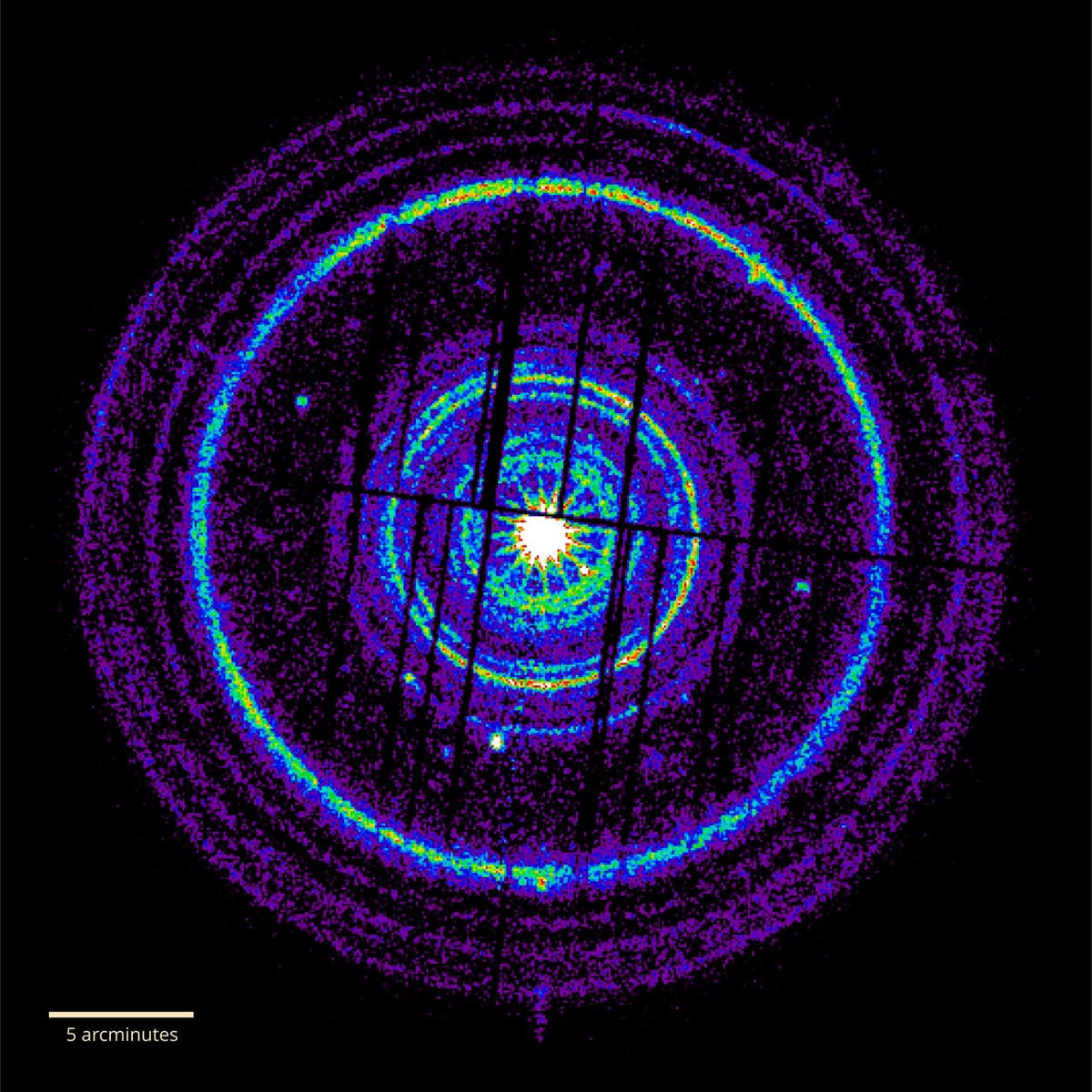
The brightest electromagnetic events known, they can emit as much energy in a few seconds as the Sun will release over its entire 10-billion-year lifetime, says NASA. Long-duration bursts last anywhere from two seconds to a few hundred seconds and appear to be associated with the death of massive stars in certain types of supernovae, NASA says.
Short-duration bursts last less than two seconds and appear to result from two possible scenarios —- the merger of two neutron stars to form a new black hole, or the merger of a neutron star and a black hole to form a larger black hole, says UCD.
We have a very small GRB detector that will fit in your hand, says Martin-Carrillo. But the technology involved in how the detector interacts with the camera and then reads this information is brand new, he says.
But GRB Detection Is Inherently A Crapshoot
You don’t know when they’re happening or where they’re happening, so you need to have as a wide a field of view as possible, says Martin-Carrillo. But we will be able to detect anything that emits a short flash of gamma rays, he says.
GRBs are thought to be highly focused, with most of the energy collimated into a narrow jet traveling near the speed of light, says NASA. Astronomers are only able to detect these GRB jets if they are pointed directly at us, NASA notes.
The UCD team will download its own GRB data. The main ground station is here on the roof of this physics building, Martin-Carrillo showed me.
EIRSAT-1’s onboard computer will know if something has been detected and then will download that information back to the UCD campus, says Martin-Carrillo. That will only happen in a very specific 10-minute window, maybe twice a day, he says.
Why Do We Need This?
Current GRB satellites are old; with CubeSats, we’re trying to build cheaper, more up to date GRB detectors, says Martin-Carrillo.
How Long Does It Take To Build A CubeSat?
The first one took about six years, but if you streamline the process, we could probably do it in three, says Martin-Carrillo.
After EIRSAT-1 proves its technology, a constellation of 20 to 30 CubeSat GRB detectors could soon follow.
If you have a constellation, you’ll be able to triangulate a GRB’s location on the sky, says Martin-Carrillo. The global astronomical community can then make follow up observations of these GRB events in a wide variety of wavelengths, he says.
As for the main benefits of such CubeSats?
You can upgrade the system much faster, so you’re not stuck with 1990s technology thirty years later, says Martin-Carrillo.
The Bottom Line?
We’re a small country of only 5 million, but in the last decade, Ireland has realized the benefit of the space industry, says Martin-Carrillo. The number of space startups here is growing exponentially, he says.
Read the full article here