





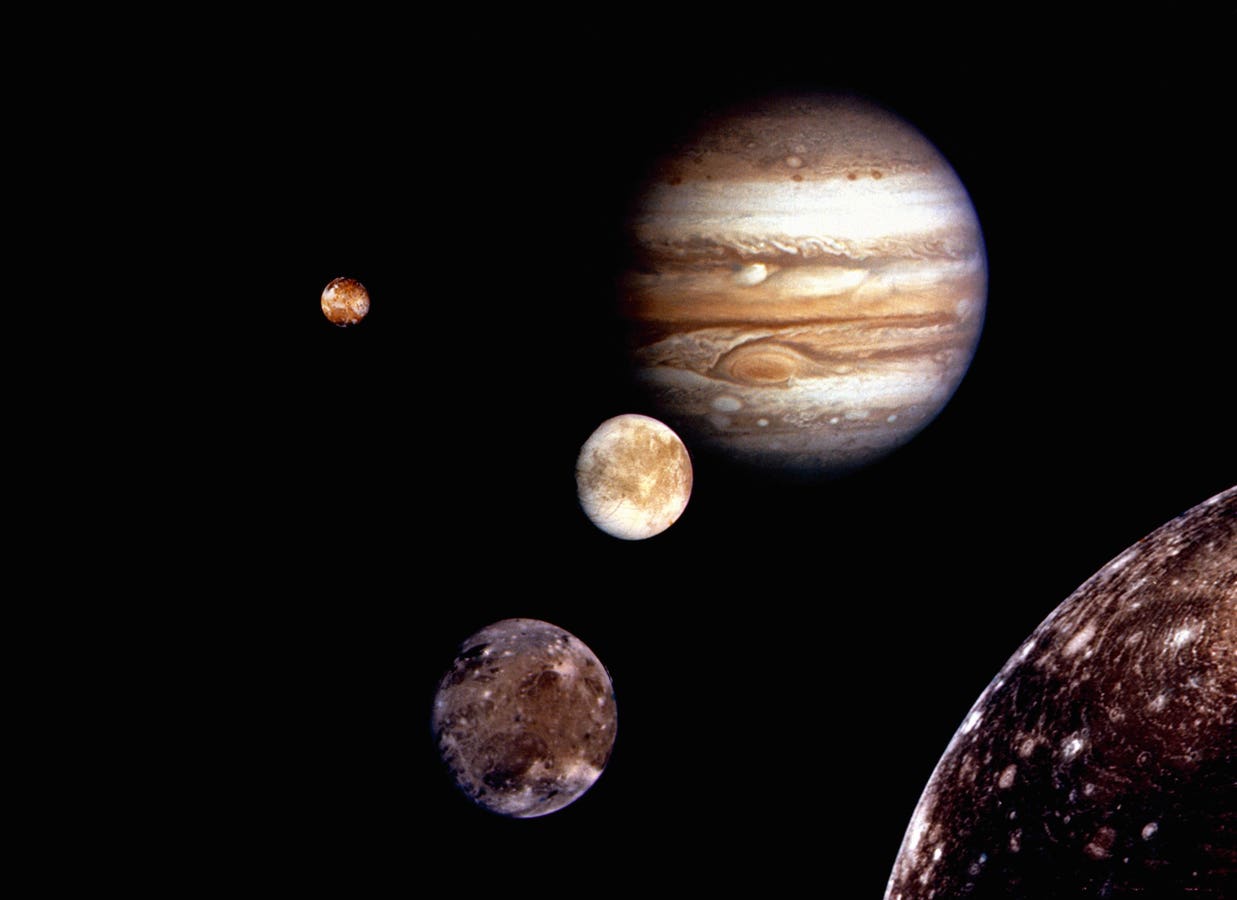
Go outside after dark this weekend, and you’ll see a bright “star” blazing in the eastern sky. It’s Jupiter, which has this week reached its brilliant opposition. With Earth between the sun and the giant planet, it’s at its biggest, brightest and best. Look closely, however—using any pair of binoculars or a zoomed-in phone camera—and you’ll see four dots of light in a line beside it. These so-called Galilean Moons—Io, Callisto, Ganymede and Europa—are Jupiter’s largest.
Now, they’ve each been given a soundtrack that recognizes their esoteric character.
The Galilean Suite
Outside observing the night sky, many stargazers listen to The Planets, the iconic seven-movement orchestral suite written by English composer Gustav Holst during the First World War. Just over a century later, it has a follow-up in The Galilean Suite, a major classical work from composer Dave Dexter that you can listen to here. It comprises four movements, each dedicated to Jupiter’s largest moons and comes in at about an hour.
Cosmic Tone Poems
“It’s an inevitable comparison—and I am inspired and influenced by Holst’s music—but not specifically The Planets,” said Dexter in an interview. “But I’m inspired by many composers—among the living by John Williams and Grant Kirkhope and the dead by Richard Strauss and Thomas Tallis.”
Dexter defines The Galilean Suite as tone poems, but while Holst’s inspiration for The Planets was astrological, this work is influenced by what we know about the moons’ geology.
“Their discovery is credited to Galileo, but they were possibly discovered at the same time by Simon Marius—and it’s his names for the moons that have stuck,” said Dexter. Since their 1610 discovery, the four Galilean moons have emerged as drastically different worlds. “It’s almost as if they were deliberately made to have music written about them because they’re just so distinct,” said Dexter.
Exploding Rock Music
It’s fair to say that of all the moons, it’s the Io—the most volcanic world in the solar system—that proved to be Dexter’s muse. “It’s constantly being squeezed, creating immense pressure and energy; it’s bursting all the time, and it’s covered in lava flows and pits,” he said. Cue an ominous sound with lots of low brass in the orchestral sections. “It has 400 volcanoes, and it’s very hostile, so I wrote music that fitted that—in a cliche way, but I think it’s effective because there’s nothing subtle about the moon.” At 23 minutes, it’s the most extended piece.
For Europa, the ice moon with an underground ocean that might contain life, Dexter goes with a more mysterious sound. “I use a lot of high woodwinds and high-tuned metal percussion like glockenspiel because it evokes that mysterious character,” he said. However, Dexter did not try to translate the possibility of sea life into music. “I was thinking purely about its physical characteristics,” he said. “It’s tempting to say that the glockenspiel at bar 46 represents bacterial evolution, but that would be a lie!”
Aurora On Ganymede
For Ganymede, Dexter got consumed by the idea that you could stand on the moon—the most habitable of the four—at night and see Jupiter and its aurora in its sky. “I went for a more modern, quirky feel with a triumphant theme that hints at colonization thousands of years in the future,” said Dexter.
Callisto seems the most challenging to write about. It’s usually seen as a wasteland too far from Jupiter to have liquid water or exciting geology. “It’s a big dead ice rock with the oldest surface in our solar system, but that’s fascinating to me because the only thing that changes it is other things hitting it,” said Dexter. The ancient, unchanging moon gets a more archaic sound that evokes an older world.
“I’m not a subtle composer,” said Dexter. “I like motifs, and I went very large—not all the way through—but the central themes are very full and very symphonic.”
Orchestral Manoeuvers
Although you can watch the Ganymede tone poem being performed by the Cape Town Philharmonic Orchestra, The Galilean Suite mainly exists as MIDI mock-ups painstakingly created using a computer. “Its purpose is to convince people that it would sound great with an orchestra,” said Dexter.
It definitely would—and performances of The Galilean Suite would provide the perfect musical counterpoint to both NASA’s $4.25 billion Europa Clipper mission, due to launch next year, and ESA’s $1.7 billion JUICE mission to orbit Jupiter’s moons. A one-of-a-kind musical work inspired by the very same moons we’re about to learn more about, The Galilean Suite deserves to be heard across the solar system.
Wishing you clear skies and wide eyes.
Read the full article here