





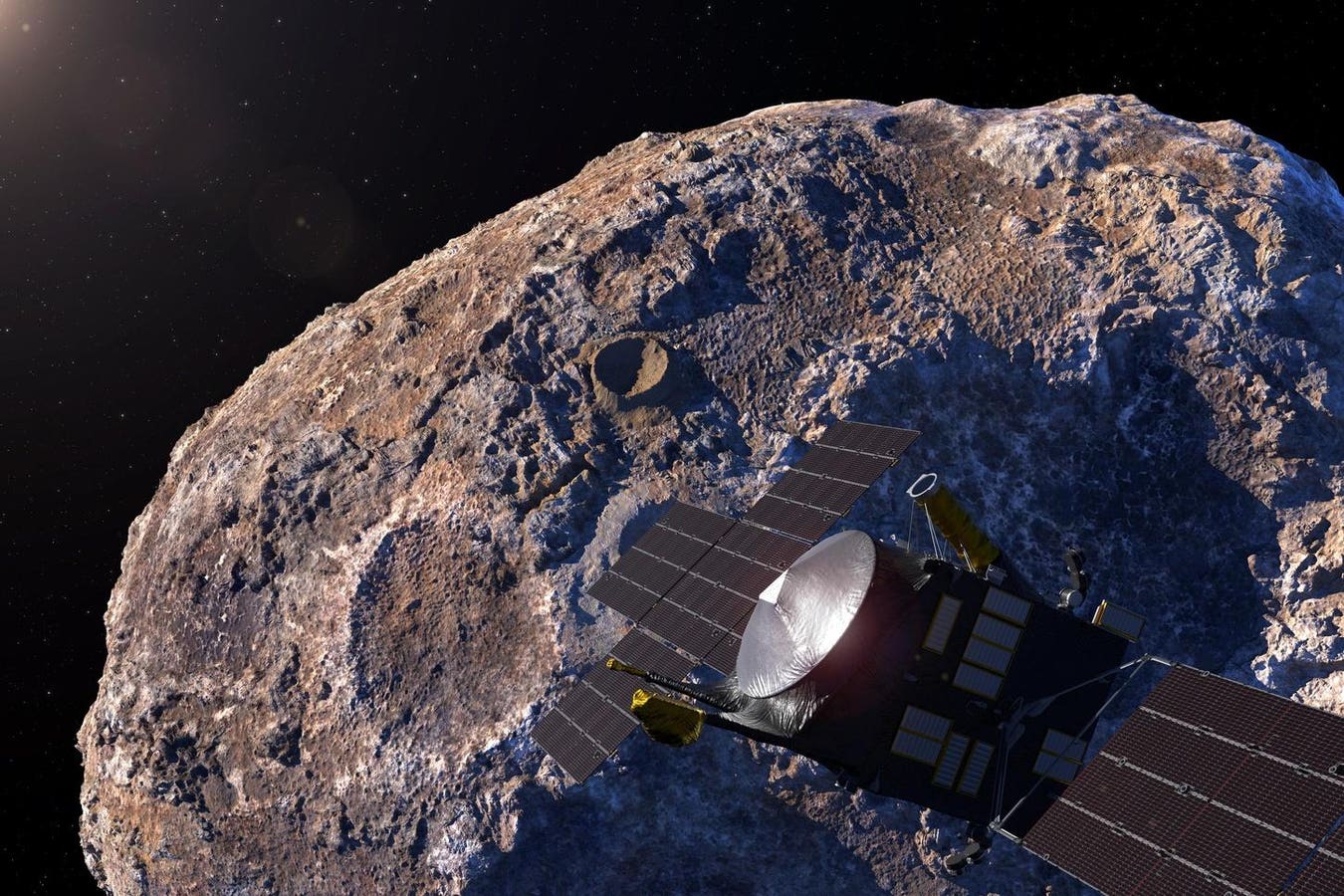
With last week’s successful launch of NASA’s mission to Psyche —- a largely unknown metal-rich asteroid on the outer edge of the Main Asteroid Belt, this mysterious planetoid could soon give up its secrets. First discovered in 1852, Psyche is thought to primarily be made up of iron, nickel, and silicates, and may even be an exposed nickel-iron core of an early planetesimal (a building block of the first planets in the solar system).
With onboard help from Johns Hopkins University’s Applied Physics Laboratory’s Gamma Ray and Neutron Spectrometer, Psyche’s chemical elements should be detected to high levels of precision.
The spacecraft will provide clues as to whether Psyche, which measures only some 280 km at widest, is a stripped planetary core, that once had an active dynamo, a mechanism that creates a magnetic field.
Once the NASA spacecraft arrives at Psyche in August of 2029, the spacecraft will over the next two years orbit the asteroid at a distance of about 700 km, says the Planetary Science Institute in Tucson. From there, it will progressively get closer to the planetoid as its instruments maps the surface and looks for evidence of an ancient magnetic field.
Core formation requires heat and melting, with dense metal phases separating from silicates and descending towards the center of the body, Psyche co-investigator Thomas Prettyman at the Planetary Science Institute tells me via email. The planetoid’s internal heat source was likely the decay of short-lived radioisotopes produced in nearby supernovae, he says.
As the radioisotopes decayed, Psyche cooled, forming a core, mantle, and crust, says Prettyman. The outer silicate layers could have been stripped away by impacts revealing the core, he says. This might have happened even while the core was still partially molten.
If it is a relict core of a planetesimal, it is likely to be among the oldest bodies in our solar system, Prettyman notes.
How Does The Gamma Ray And Neutron Spectrometer Instrument Work?
As cosmic rays and high energy particles bombard the asteroid’s surface, elements there absorb the energy, says NASA. In response, they emit neutrons and gamma rays of varying energy levels.
The spectrometer analyzes the asteroid’s elemental energy emissions which the team will then match with emission properties of known elements here on Earth. This will enable the detection of specific elements on the asteroid’s surface.
The detector relies on the rare element germanium to detect the elements’ emitted gamma rays.
Germanium is a relatively dense (or heavy, high atomic number) element, which enables it to efficiently stop gamma rays, David Lawrence, an APL planetary scientist and physicist, tells me via email. When gamma rays stop in germanium, the gamma rays’ ‘stopping energy’ creates an electrical signal that can be measured with high-precision electronics.
If there are very high iron abundances and substantive nickel abundances, this could provide indications of a core-like origin, says Lawrence. The actual value of nickel abundances (high or low) could indicate how it might have formed and/or differentiated.
The latter would indicate that at some point in its early history, Psyche’s interior structure had ‘differentiated’ into separate layers, usually structures of a core, mantle and crust.
I would expect to see typical rock-like elements, which includes iron, silicon, aluminum, calcium, oxygen, says Lawrence. If we see elevated abundances of sulfur that would be indicative of interesting volcanism.
As For Detecting An Ancient Magnetic Field?
Heat-driven circulation of conductive liquid metal within the core could have produced a strong magnetic field, says Prettyman. If the core froze from the outside in, then the outer layers would be magnetized, preserving a record of the dynamo that could be detected by the spacecraft’s magnetometer. Inward solidification would be most likely if the core was still molten when the outer layers were stripped away, he says.
In 2030, when the spacecraft reaches a low-altitude orbit around Psyche, we will start collecting our primary science data over approximately 100 days, says Lawrence. We expect that by the end of 2030 or early 2031 we will have a good knowledge of Psyche’s composition.
“It has taken years to optimize and perfect the engineering needed to design these detectors for use in planetary missions (which require low mass, low power),” says Lawrence.
What Is Most Exciting About Taking Data At Psyche?
“Our first opportunity for ‘excitement’ will be less than two months after launch when we do our initial check out,” says Lawrence, who is particularly keen to see if Psyche has detectable nickel abundances.
We have flown by or encountered several asteroids, but this one is a mystery, Rosaly Lopes, deputy director of the planetary science directorate at NASA’s Jet Propulsion Lab, tells me via email.
Who knows what impact craters will look like on a metal world? Will there be metal lava flows on the surface?
“I think the surface will be mind-boggling,” says Lopes.
Read the full article here