





When Soviet scientists landed their Venera series spacecraft onto the surface of Venus in 1975 and 1982, absolutely astounding imagery transmitted (before Venus destroyed the spacecrafts, some of whom crash-landed). Scientists hope to discover secrets of Uranus via a similarly doomed-to-be-crushed probe.
Atmospheric pressure at depth will ultimately destroy the Uranus probe’s metal. For comparison, standing on Earth, we experience 1 bar of pressure. The surface of Venus experiences 92 bars.
The California Institute of Technology (Caltech) hosted a three-day July workshop on the proposed Uranus Orbiter and Probe, a flagship class mission to an Ice Giant planet and surrounding moons. Scientists met to present and discuss UOP conduct and payload, covering all concepts of the Uranus system, interior to magnetosphere.
Discovering astronomer William Herschel initially wished to name the planet Uranus after King George III. In 1783, the blue colossus was officially named after the Ancient Greeks’ mythological god of skies—Οὐρανός, a pronunciation notoriously difficult for American newscasters during the historic NASA Voyager 2 flyby broadcasts. (Hint: oo-rah-nohs)
NASA Ames Research Center general engineer Joshua Monk outlined this UOP design: ‘The probe release will occur after orbit insertion and allow for one hour of in situ transmission to the orbiter’ (afterwards the orbiter will move to tour the Uranus moons).
Cerulean Blue
Unlike other planets, Venus and Uranus rotate from east to west. Exclusively Uranus, rotates on its side, a rolling ball, and its 98-degree axis tilt causes seasonal extremes. Winter on Uranus endures for 21 Earth years. Towards the planetary interior, Uranus is thought to reach 10,000 degrees Fahrenheit. Yet, compared to Jupiter, with an estimated core temperature of up to 60,000 degrees, Uranus remains frigid. If there were no reflected sunlight, Jupiter would glow from an inner warmth while Uranus would show an invisible darkness.
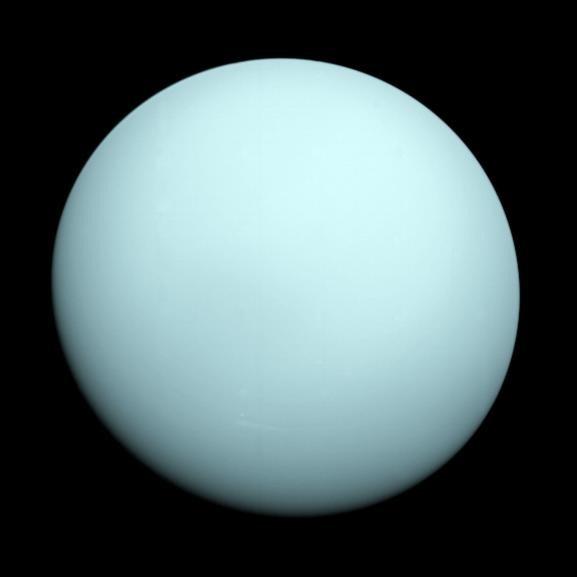
Methane molecules in the atmosphere of Uranus absorb sunlight, blocking reflection of the color red. Methane bounces back light in a distinctive cerulean. The phenomenon of snowing out is thought to create an opacity that pales the blue of Uranus when compared to the Solar System’s other Ice Giant—deep blue Neptune.
Frozen methane particulates cause a white out effect throughout Uranus.
NASA’s Voyager Spacecraft shot back home to Earth images of planet Uranus in 1986 and scientists wondered at the blandness of Uranus.
Voyager 1 and Voyager 2 (both launched from NASA Kennedy Space Center at Cape Canaveral, Florida, 1977) now travel beyond the Solar System through interstellar space as real-life Starship Enterprises at 38,000 miles per hour.
The Voyager 2 Uranus flyby in 1986 detected no internal core heat source. More recent observational studies imply that Uranus has an atmosphere that is extremely sluggish dynamically.
What Lies Within Planet Uranus?
Dr. Glenn S. Orton, senior research scientist at Jet Propulsion Laboratory tracked NASA’s Galileo Jupiter atmospheric entry probe data in 1995. That probe parachuted into the 28,000 degrees Fahrenheit Jovian cauldron and survived for 58 minutes until it hit 24 bars of pressure.
An authority on Jupiter’s atmosphere, and a co-author of “Hazy Blue Worlds: A Holistic Aerosol Model for Uranus and Neptune, Including Dark Spots” (Journal of Geophysical Research: Planets, 2022), Orton attended the July UOP workshop. I ask his opinion regarding the proposed mission.
Orton: The idea is that some of the remaining issues cannot be addressed except with a direct probe into the atmosphere of Uranus, coupled with the remote-sensing context supplied by an orbiter.
I next ask Giant Planet expert Prof. Tom Stallard of Northumbria University on the importance of investigating the magnetic field that surrounds Uranus.
Stallard: We are all familiar with the idea of a compass, that by holding what amounts to a small needle that threads its way through the magnetic field of the Earth, we can find magnetic north, and find the way home. Similar magnetic fields weave their way through Jupiter, Saturn and Mercury, and perhaps Mars long ago. But when we flew past Uranus and Neptune in the 1980’s, we discovered dizzying magnetic fields, with poles that point to the equator, that ultimately result from something strange in the interior of each planet. Understanding these magnetic fields, their influence on the planet’s atmosphere and surrounding space environment, is fundamental to our understanding of how magnetic fields vary conditions for all planets, including the wealth of new worlds discovered around other stars. The UOP aims to provide us with a ring-side view of these magnetic fields in action, unveiling their complexity and helping to reveal the strange interiors that generate them.”
The NASA Planetary Decadal Strategy identified the UOP to be the highest priority Flagship solar system mission in the coming decade. And Stallard states that investigations of the Uranus magnetosphere were one of the three science objectives.
Stallard: Given the critical importance of a magnetometer to understanding the magnetosphere, as well as the importance to the other principal objectives (for instance, in helping to understand the planet’s interior and in constraining liquid oceans within the moons of Uranus), it would be unthinkable for a large mission to Uranus to launch without a magnetometer.
The JPL Fauna
Founded by Caltech researchers, NASA’s JPL, home of the Mars Rovers and the intrepid Voyagers, envisions at least part of the UOP build. JPL is the leading center of exploration of the solar system and beyond.
JPL is where big cats (mountain lions) roam the vast parking lots, and a few deer graze freely amidst a meager greenery. JPL and nearby Caltech, dripping with the scent of jasmine in summer, seem like bits of Earthly paradise. But we want to explore Icy Giant Uranus. And soon, we shall. xxox
Read the full article here