




The Nobel Prizes are to be announced this week with great anticipation worldwide. Many acclaimed scientists will have sleepless nights wondering if the next day will bring forth a surprise call from Stockholm! The Nobel prize — for better or for worse — has become a touchstone for measuring success. The demographics of the laureates come under great scrutiny as well and often the ethnicity and country of origin is of immense interest as the Nobel foundation aims for greater diversity at multiple levels. Given the challenges of reconciling science and religion, there has also been some scrutiny of the religious affiliation or cultural traditions of laureates.
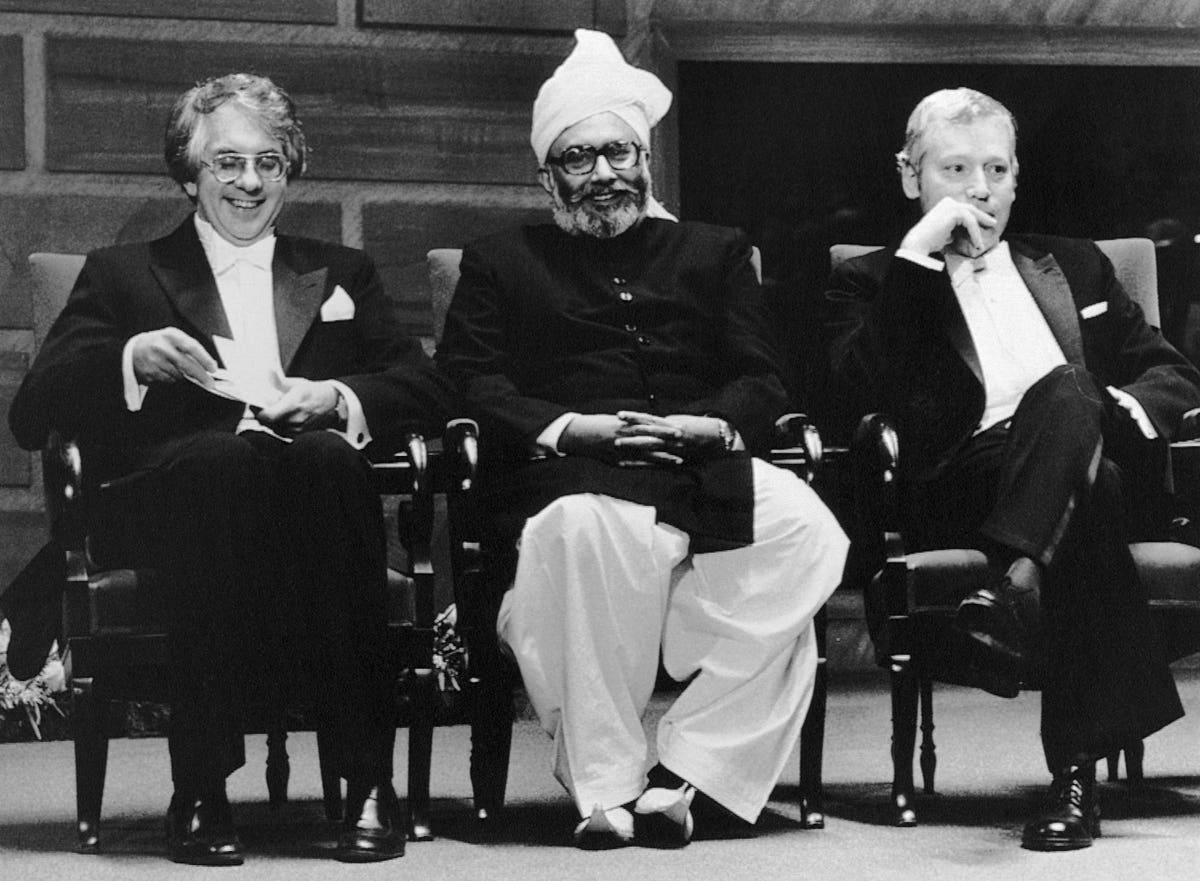
As a cultural Muslim, I belong to a community of at least 2 billion people worldwide (almost a fourth of humanity), and yet in the 122-year history of the award only three laureates in the sciences have been of Muslim lineage (2 in chemistry, 1 in physics and none in medicine or economics). Pakistan can partially claim one of them: Abdus Salam (British-Pakistani joint national), who shared the prize in physics in 1979, and memorably wore a traditional shervani and turban to the award ceremony in Sweden. However, as a member of the Ahmadiyya sect, he had a mixed reception at home with some measured accolades, but considerable ostracization as well. Salaam’s efforts on science education for developing countries are enshrined in the International Center for Theoretical Physics (ICTP) in Trieste Italy that he founded and now bears his name.
Ahmed Zewail, an Egyptian-American chemist based at the California Institute of Technology received a rare solo prize for chemistry in 1999. I had the good fortune of meeting him personally at the World Economic Forum in Davos in 2012 and asked him about the paucity of Muslim Nobel prize laureates. He smiled wistfully and affirmed what I had suspected as well: this is largely due to the relative intellectual inertia in the educational institutions in many Muslim countries. Before his death in 2016, Zewail saw his native Egypt honor him with a new “Science and Technology City.” Perhaps in due course this city will be the incubator for future Muslim Nobel laureates.
Turkish biologist Aziz Sancar shared the Nobel Prize in Chemistry in 2015 but has kept a relatively low profile with his public persona. When interviewed about his faith by a Turkish newspaper he stated that upon receiving the prize his home city of Chapel Hill, North Carolina honored him with a key to the city and in his speech, he noted: “I am proud of being a Muslim, but I cannot say it in many regions of the US because of current debates.” Sancar’s cautious statement also suggests a continuing civilizational tension that can lead many Muslims to shy away from trying to reconcile their epistemic identities between science and religion.
Nevertheless, there is a tendency for many Muslims to atavistically celebrate the accomplishments of tenth-century Islamic mathematicians, while investing little in developing contemporary educational capacity. Far too often we hear from imams about the etymology of algebra coming from Arabic and the pharmaceutical accomplishments of Avicenna, but do we ask why such pioneering scholars have scarcely been seen for a thousand years in Islamic countries? Furthermore, it is important to remember that the golden age of Islam was also its most pluralistic but even then, there were fundamentalist forces who constantly threatened these scientists. Let us not forget the ruins of Madinat-al-Zahra, once a showpiece of Islamic learning, just outside Cordoba, which was destroyed not by any invaders but instead by radical and retrogressive Muslim factions.
Those Muslims who are educated and proceed to develop successful professional careers are often sanguine with a comfortable job but would rather not invest in cutting-edge creativity. An interesting example is the medical profession in which many Muslims, and indeed Pakistani Muslims, have excelled considerably. However, most of these brilliant doctors are focused on making money in clinical practice rather than in creative research which would lead to laurels such as the Nobel prize. There is cultural complacence that leads to a mindset where success is marked by simply making a good living for the family, contributing some earnings to charity and then living a lavish life.
Interestingly, the two major rival sects of Islam – Shias and Sunnis – have approached science education quite differently. Yet these theological antagonists may find some convergence on science with the recent reproachment between Saudi Arabia (predominantly Sunni) and Iran (predominantly Shia). Despite many examples of draconian marginalization, Iran encouraged women to engage in higher education. The first woman to win the covetous Field Medal in mathematics, Maryam Mirzakhani, got her undergraduate degree at the Sharif University of Technology in Iran before moving to the United States. On the other hand, Saudi Arabia discouraged higher education for women, until recently, but invested in importing talent to universities such as the King Abdullah University of Science and Technology. However, there appears to be much greater commitment to developing local talent within the kingdom in recent years since the Vision 2030 was put forward.
As the pantheon of laureates grows larger and more diverse, the Islamic contribution to this prize remains embarrassingly small but we cannot blame the Nobel Foundation for this. Muslims need to inculcate a yearning for science among at multiple levels. Existing institutions such as the Islamic World Scientific Educational and Cultural Organization (ISESCO) need to have a more ambitious plan of action to promote research and critical thinking. The Nobel prize is coveted because it recognizes deep, critical and revolutionary research. Such research usually challenges orthodoxy and Muslim countries are still too shy to engage in such confrontations that might even remotely be perceived as an affront to literal interpretation of scripture. Islamic tradition provides relativistic approaches to reinterpreting scripture with changing times through the notion of ijtihad (independent reasoning) but mainstream commentators often quash this prospect to maintain an austere absolutism.
Muslim countries will need to show courage in confronting such forces of anti-intellectualism if Science and Faith will be meaningfully reconciled towards the kind of high-quality research needed for a Nobel prize in the sciences.
Read the full article here