





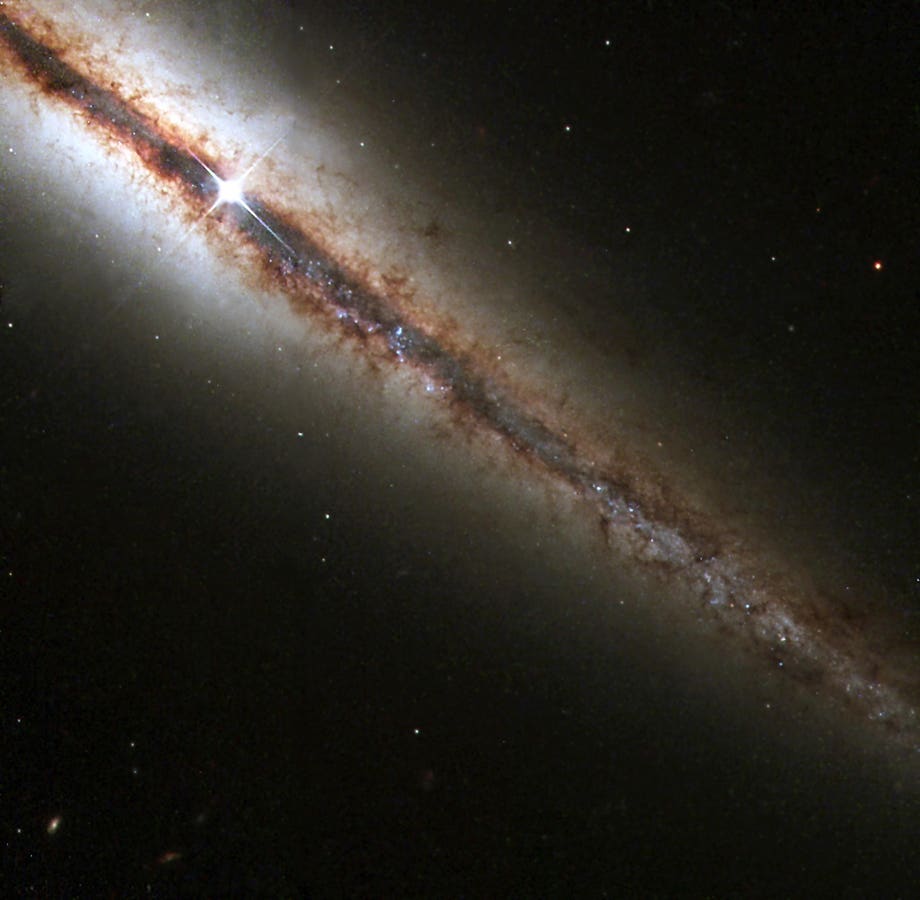
Our Milky Way Galaxy —- often billed as an ordinary massive spiral, one of billions of such disk galaxies that populate the observable universe —- got off to an unusually early, shotgun start. Or so says a new paper just submitted to The Astrophysical Journal.
What’s clear is that the Milky Way and likely many other galaxies like it were massive enough to begin disk formation within the first few billion years after the big bang. That’s a fact also confirmed by new observations made by NASA’s Webb Space Telescope.
Our findings suggest that the Milky Way assembled most of its mass early, and after that, it did not experience significant mergers with other galaxies that could destroy its disk, Vadim Semenov, a NASA Hubble and ITC postdoctoral fellow at Harvard University, told me via phone.
Using computer simulations of representative samples of Milky Way-like galaxies, the authors note that most such galaxies formed their galactic disks much later than our own Milky Way. But some ten percent of Milky Way-mass galaxies formed their disks quite early, similar to our galaxy, the authors write.
We looked at a relatively large sample of 61 such Milky Way analogs extracted from the simulation of a representative cosmological volume (essentially, a chunk of the universe), says Semenov. We find that galaxies tend to form disks when they become massive enough, he says. After the disk is formed, the rest of the galaxy evolution must be relatively quiet, without significant mergers with other galaxies which could destroy its disk, says Semenov.
Why is this important?
Understanding disk galaxy formation is a fundamental question in astrophysics, but it also connects to many other fields, from cosmology to planet formation, says Semenov. Most of the stars in the universe are formed in disk galaxies, he says. And stars, in turn, synthesize chemical elements thereby defining the chemical evolution of the universe, says Semenov.
The early universe appears to have been wild and woolly.
The rates at which stars were forming were higher; newly born massive stars exploded as supernovae more frequently, stirring up the turbulence in the gas of these early disks and making them thicker, says Semenov. Accretion of gas from the intergalactic medium was also more active and galaxy mergers were more frequent, he says.
As for our own Milky Way?
Galactic archeology data suggest that there were several stages in the evolution of our Galaxy, says Semenov. First, there was that chaotic state without a clear disk (a “proto-galaxy”), he says.
The progenitor of our galaxy was highly irregular and experienced vigorous and chaotic accretion of gas from the intergalactic medium and frequent mergers with other galaxies, says Semenov. With time this vigorous evolution settled down and a galactic disk emerged, he says. This early disk was likely very different from the disk that we see today, it was significantly thicker and more turbulent, he notes.
Later, however, it settled down to the thin disk that we see today, says Semenov.
As for what is most surprising about the team’s results?
One surprise was that the Milky Way analogs are not rarer than we found, says Semenov. From these results, one could expect that only a small fraction (if any) of Milky Way-mass disks are early-forming, he says. However, 10% of such early forming galaxies is quite a significant fraction, Semenov says.
Yet the authors note there is still no consensus on how galactic disks actually form.
That remains an open question, says Semenov.
Read the full article here