





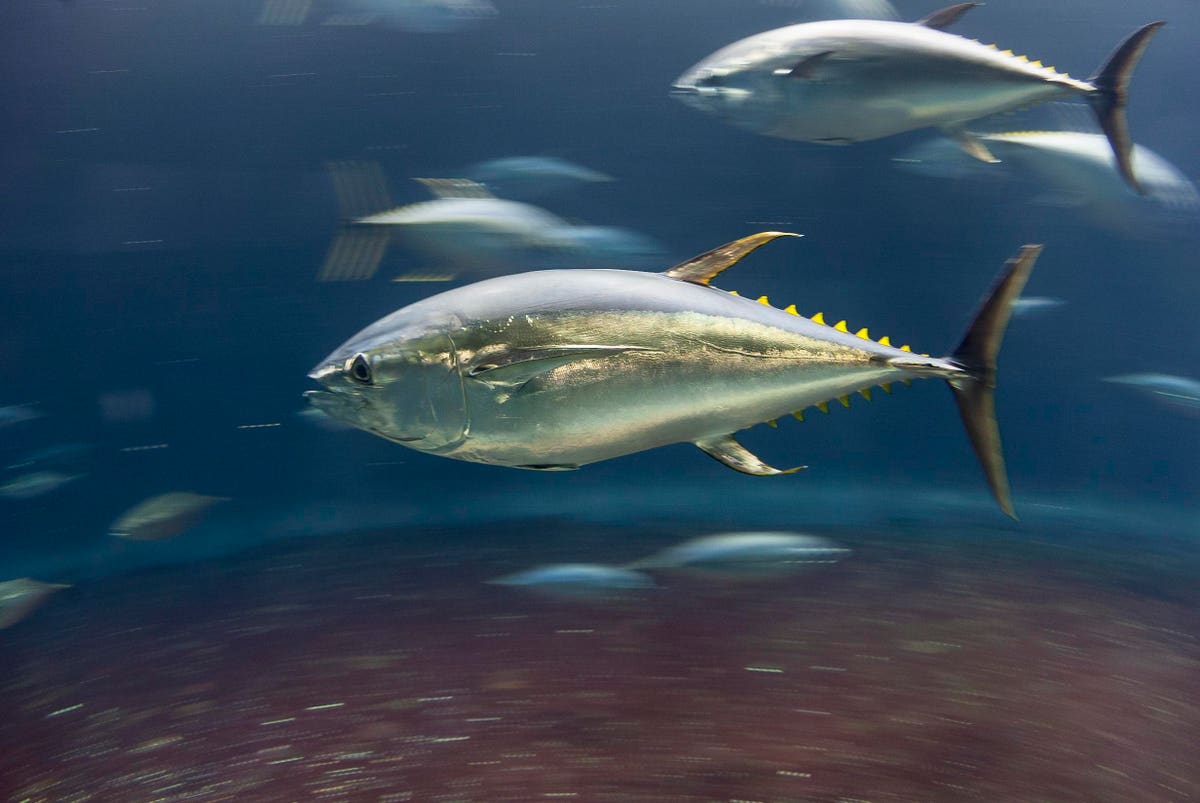
A new study has found that deep-sea mining may pose a big threat to tuna species moving into the eastern Pacific Ocean as climate change pushes them into the open ocean.
Dr Diva Amon, a scientific researcher at the Benioff Ocean Science Laboratory at the University of California, Santa Barbara and Director and Founder of NGO SpeSeas explains that climate pressures are expected to push bigeye, skipjack and yellowfin tuna from their current range near small, developing Pacific nations into a “climate refuge” in a deep-ocean zone of the eastern Pacific Ocean.
“These tuna are going to be leaving these Pacific Nations and moving into the high seas and progressively eastward,” she says, adding that the highly-mobile tuna might arrive to these new areas only to find it is already inhospitable due to deep-sea mining.
Amon is the lead author of a paper, published in the journal npj Ocean Sustainability, which focuses on the Clarion-Clipperton Zone of the Pacific Ocean, a maritime region southeast of Hawaii containing 1.1 million square kilometers (or 424,712 square miles, an area 11% of the land area of the United States) of deep-sea mining exploration contracts.
Although nodules harvested from deep-sea mining have been seen as potential sources of scarce minerals, there is increasing scientific evidence of the impacts on the sea floor and two different kinds of plumes in the water: one stirred up on the bottom and the other dumped from mining vessels.
“Deep-sea mining is like a combine harvester on the seafloor,” Amon says, “These machines will be removing the top 10 centimeters (4 inches) of soil, which is where the majority of life currently exists and once that damage is done, that life is not coming back.”
Amon says that a mining ship on the surface will then separate the nodules from the sediment, with waste materials being pumped back into the ocean, but it is unknown where in the water column that will be or how far that waste material might travel.
The researchers say there is also a risk that toxic metals in the waste materials could enter into the food chain and cause concerns among human consumers.
“Deep-sea mining is not an issue confined to the deep ocean, it will have impacts on wider ocean ecosystems and economies that depend on theses resources, including some of the most vulnerable economies on Earth,” Amon says.
In the paper, the researchers warn that changes in tuna locations could have profound risks to the economies, livelihoods, and well-being of small Pacific island countries and other coastal countries, compounded by the biodiversity and habitat loss possible from the emergence of deep-sea mining.
Study co-author Dr. Juliano Palacios Abrantes from the University of British Columbia says the impact of climate change on the health and geographic range of tuna species was already unclear.
“Deep-sea mining will only add to this uncertainty, further threatening tuna species and associated fisheries,” he says.
Impacts on the Global South
Amon says that the Global South is going to feel the most impact from deep-sea mining, even as they are not able to fund research into the deep-sea themselves.
“We know that the Clipperton zone provides about 21% of Mexico’s reported catch at the moment,” she says, adding that many Global South countries in the eastern Pacific are likely to be more fish from this migration of tuna, but deep-sea mining could mean that they end up catching less.
Amon, who grew up in Trinidad and Tobago, a Caribbean island state, says that her childhood experiences have fueled her interest and passion for deep-sea biology.
“As a kid, I had many questions about the ocean, I grew up in the ocean, on the ocean, which led to a desire to know more,” she says. “I think that my upbringing prompted this urge to preserve the deep sea so that more people like me can experience the deep sea.”
Amon explained that deep-sea biology is an incredibly expensive field of study, because of the need to withstand remote locations and crushing pressures.
“In the Global South, we do not have access to the deep ocean, it is studied by a handful of Global North Countries,” she says.
Another Global South scientist working on big fish is Kenyan marine biologist Nelly Isigi Kadagi.
Even though she grew up a rough, 17-hour drive away from the sea, she is now one of the key figures in the conservation of some of the biggest, most mysterious fish in the sea: Billfish like marlin, swordfish and their close relatives.
Read the full article here