




This story is part of a series on the current progression in Regenerative Medicine. This piece discusses the regeneration of the cardiovascular system.
In 1999, I defined regenerative medicine as the collection of interventions that restore to normal function tissues and organs that have been damaged by disease, injured by trauma, or worn by time. I include a full spectrum of chemical, gene, and protein-based medicines, cell-based therapies, and biomechanical interventions that achieve that goal.
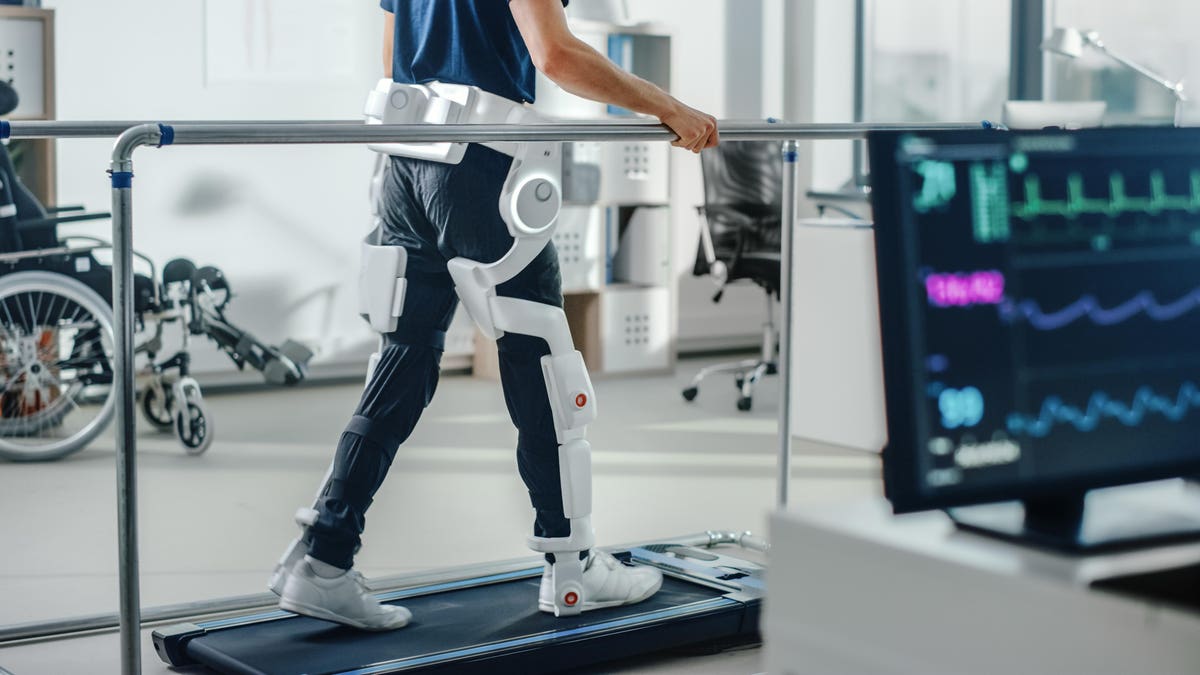
Advances in exoskeleton technologies will soon help those with impeded neuromuscular connections to walk autonomously once again. It is estimated that 14 million people worldwide suffer from neuromuscular diseases. Many diseases impact lower limb cognitive control and can worsen over time. Even with extensive physical therapy, many who suffer from these diseases may never walk again.
However, recent robotics initiatives may bring complete lower limb control back to those who lost it. Dr. Shuzhen Luo and colleagues from the New Jersey Institute of Technology developed a robust exoskeleton with advanced cognitive monitoring to catalyze rehabilitation efforts for those with neuromuscular disease. Here we discuss their system and the implications for brain-body regenerative medicine.
For most people to walk, the brain must communicate neural electrical signals down the spine to the muscles throughout the legs. Over many years, these electrical signals become second nature, and most people do not even think about walking as they do it. Those with neuromuscular impairments due to injury or disease have a weakened connection between their brain and lower limb muscles.
In conventional physical therapy, a trainer will slowly reintroduce walking motions to the legs, hoping the brain can relearn these movements and rebuild the neuromuscular connection. This may start as simply balancing on the legs, shifting body weight from one leg to the other, getting up from a chair, or slowly taking small steps. Conventional physical therapy can take months or even years, but successful rehabilitation is common.
The exoskeleton by Luo and colleagues takes a similar approach, albeit with much more technologically advanced methods. Robotic exoskeletons have been in development since the 1960s, first designed to be used by the US Army in combat. More recently, exoskeletons have been more commonly used in medical applications, namely surgical assistance and rehabilitation.
Luo’s exoskeleton takes the physical therapist’s role, training the brain to regain the feeling of walking by introducing slow and consistent movements to the lower limbs over extended physical therapy sessions.
The walking motion of the exoskeleton triggers muscle and joint activation in the legs despite a damaged or severed connection between the brain and muscles. The exoskeleton is programmed to walk based on the size parameters of the patient engaged to have a healthy motor function in their lower limbs.
Dr. Luo’s exoskeleton model is not the first to be used as a rehabilitation device. In fact, exoskeletons have been used successfully in physical therapy for years. What, then, makes the Luo exoskeleton a step above the rest?
Dr. Luo notes that one of the key challenges in developing a robust human-exoskeleton system “is to handle different degrees of uncertain human-exoskeleton interaction forces from the patients.” Most exoskeletons are ill-equipped to account for user errors such as imbalance, involuntary movements, and patient-to-patient muscle weaknesses, among other things.
To account for these unpredictable human interaction forces, the researchers built a learning-based software to implement with the exoskeleton. The goal was to teach the exoskeleton how the human body would interact with it before a user even began using it.
To do this, they integrated a musculoskeletal system into the exoskeleton’s initial code, essentially mapping how the average human would interact with the system, providing a basis for the little unpredictable forces.
Then, as a user walks with the exoskeleton over time, it learns their specific body movements and accounts for those forces to walk more smoothly.
Paralleling results found with conventional therapy, the exoskeleton helps those with both impaired and severed motor function relearn walking motion. Luo and colleagues used electroencephalography to study patients’ brain activity using the exoskeleton, observing neural reorganization and adaption to the new walking motion after months or years without the ability to walk autonomously.
However, there are many obvious limitations to the Luo exoskeleton. First and foremost, the form factor needs to be more bulky and inaccessible. Patients describe user discomfort, lack of fall mitigation, and limited utility outside of rehabilitation due to the size and structure of the exoskeleton. There are already exoskeleton models available or in development that fit this smaller framework, albeit without the advanced learning capacity of Luo’s. Later models should move towards a simpler and lighter design.
Secondly is the cost, as such a system would likely cost thousands if not tens of thousands of dollars. Notably, the exoskeleton is not designed for personal use, but the cost may be prohibitive for smaller physical therapy businesses to acquire the novel technology.
Thirdly, whether the exoskeleton presents, a significant advantage over conventional physical therapy needs to be clarified. Why invest in an expensive, cumbersome technology when an individual therapist can reproduce similar results?
Despite these concerns, the exoskeleton described by Luo and colleagues is an impressive step forward for rehabilitative robotics. While this system, in particular, may not be the peak of therapeutic ingenuity, it paves the way for regenerative medicine to take further steps in the right direction in the years to come.
To read more of this series, please visit www.williamhaseltine.com
Read the full article here