





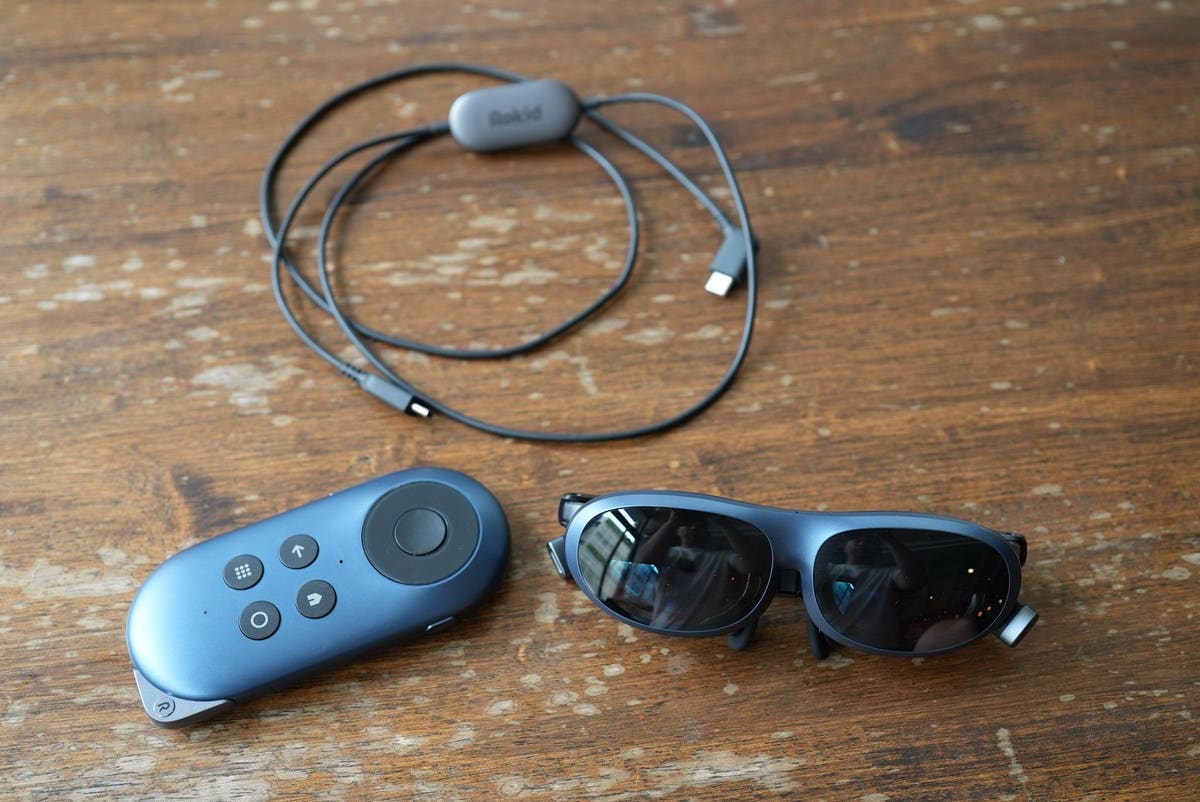
With the proliferation of streaming platforms and more people pulling the plug on conventional cable television subscriptions, the Android TV box is growing in popularity. But up until now Android TV boxes have been home-bound devices meant for connecting to a TV. Hangzhou-based Chinese tech company Rokid has made the world’s first Android TV box for AR glasses. It’s a logical product for the company’s portfolio, because Rokid also makes one of the best consumer grade AR glasses on the market, the Rokid Max.
A quick summary for those who may not be familiar with Android TV boxes or AR glasses. Android TV boxes are really just a very bare-bones computer, with a processor, internal storage, memory, running Google’s Android TV software which has access to streaming video apps like YouTube, Disney+, Amazon Prime, etc.
The AR glasses, at least the consumer grade kinds, are really just wearable displays in the shape of sunglasses. The Rokid Max has a pair of micro-OLED screens that pump out a single visual equivalent to about a 215-inch screen positioned 10 feet from the user. The screen feels large enough to cover the entire field of vision, but not so overwhelming that you have move your head around to look.
Rokid’s new product, named the Station, is an Android TV box in a portable handheld form. It looks like a cross between a conventional TV remote and a Nintendo Wii controller, with buttons for controlling content. I particularly like the circular direction pad which reminds me of the iPad click wheel from the mid-2000s.
Using the Rokid Station is dead simple. It has a standalone battery and an micro-HDMi display out port, so you just have to power it on and connect a cable to the Rokid Max (or another pair of AR glasses of choice, or even an external display), and the Android TV experience starts up. From there, you need an internet connection (whether it be WiFi or your phone’s mobile data), and the Rokid Station will be able to play any videos off any app that’s available on Google Play Store, including Amazon Prime, Disney+, Hulu, and of course, Google’s own YouTube.
Navigating through the interface is easy with the controls, but you can also use voice commands to summon Google Assistant provided you buy a separate Android TV remote. I wish the Rokid Station would have the ability to take voice commands on its own, but using the controls to cycle through the menu and input text is perfectly fine.
The Rokid Max’s visuals look great, and I love that you can choose to project the visuals onto the “real world” (hence why they’re AR glasses) or you can wear a lens cap to cover the lenses and see the video on a black space. I don’t have professional tools to capture the Max’s visuals, so the below was snapped with a camera behind the lens. To my eyes, the footage looked sharper, colors more vivid. You can see the brick wall behind the visuals, as I was wearing the glasses without lens cover. If I put on the lens cover, it feels like I’m watching a gigantic screen floating in front of my face in darkness.
The Rokid Station’s 5,000 mAh battery can power the Android TV for about five hours on a single charge. The Station can also double as a portable battery if your smartphone runs low. The Station also has 32GB of internal storage, which can store video files for offline viewing.
The Rokid Station’s use case should be clear: it allows the user to watch streaming content anywhere, as long as they have an internet connection and the Rokid Max. Even without internet connection, the Rokid Station can play local video files. It’s smaller and lighter than a phone so it’s easier to carry. I’ve been using the Rokid Station to play YouTube videos to my Rokid Max while I move around the house; the see-through nature of the glasses allow me to watch videos while still being aware of my surroundings.
Since the Rokid Station runs Android, you can install non-video apps like Spotify and use it to stream music, or mirror the display of your phone via Chromecast. This allows phones that do not have display output, such as the Google Pixel Fold, to be able to broadcast to the Rokid Max.
For what it is, the Rokid Station absolutely gets the job done. It’s available for pre-order now on Rokid’s website starting at $129, with a retail price of $139 set for after launch. The Rokid Max AR glasses, meanwhile, cost $439, but Rokid has a bundle package now that can be ordered at $529.
Read the full article here