





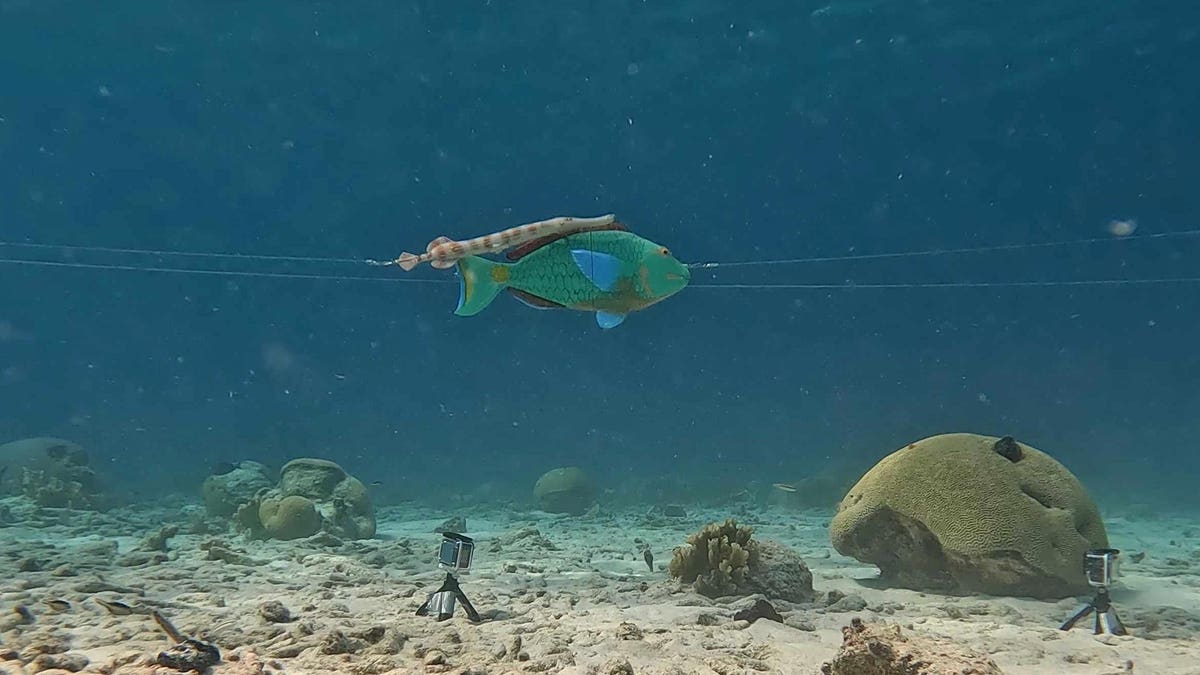
Human hunters make an art out of hiding. They wear camouflage, hang out in duck blinds and mask their scent. Fish, however, aren’t usually so elaborate about their hunting preparations—unless you’re a coral-reef-dwelling trumpetfish out hunting for delicious damselfish. Scientists have discovered an unusual way trumpetfish stalk their prey by using other fish to disguise their deadly movements.
What scientists learned about trumpetfish gives us a fascinating glimpse into life underwater, but it also has implications for understanding how animals are responding to environmental pressures on coral reefs.
University of Cambridge researcher Sam Matchette, a behavioral ecologist focused on understanding why animals do what they do, led a study on trumpetfish that involved a hands-on field experiment using 3D-printed model fish.
Ocean researchers had noticed something odd about trumpetfish. The long, thin fish had a habit of swimming alongside larger fish, demonstrating a “shadowing” behavior. A 2022 study, also led by Matchette, used information provided by divers to chronicle the behavior and track where and how often it occurred. That study showed trumpetfish shadowed bigger in fish in degraded and flatter coral reef habitats. Matchette and his team wanted to know why. Was this a clever way trumpetfish could get closer to their prey?
The team’s findings came out on Monday in the journal Current Biology. “This study provides the first evidence that predators can use other animals as concealment, which not only illustrates the incredible diversity of the ways that animals disguise themselves and their intent, but also broadens our understanding of how predators and prey interact in the wild,” Matchette told me over email.
The team headed to the Caribbean, set up a wire and pulled a hand-painted model of a trumpetfish through the water past damselfish colonies. The experiments took place in three different locations and involved 36 colonies of damselfish. Each colony was exposed to a trumpetfish model, a parrotfish model and a combined trumpetfish and parrotfish pair. Cameras captured each damselfish colony’s response.
When the trumpetfish model was alone, the damselfish took a look at it and then swam away to safety. The team tried this with a parrotfish model to mimic a species the damselfish didn’t find threatening. To test the shadowing behavior, the researchers attached the trumpetfish model to the side of the parrotfish model. The damselfish didn’t sense the danger when the models were combined. This showed the effectiveness of the shadowing action as a hunting disguise.
See the natural behavior and model-fish pulley system in action:
The experiment worked beautifully, but it took some time to dial it in. Matchette described how the air-filled models kept bobbing to the surface despite efforts to pack them full of fishing weights. After a week of troubleshooting, the team hit on a solution. “In the end, we had to crack them open, drill a ton of holes inside and deliberately flood the insides with water—a lot of work and initial stress but an effective solution,” Matchette told me.
While the study provides the first evidence of a non-human animal using another as a form of concealment, trumpetfish may not be the only critters that have adopted this behavior. “In theory, any predator that lives alongside other relatively large animals who do not compete for the same food source could adopt this stealthy strategy, particularly if their prey is especially vigilant,” said Matchette, who also called out the potential usefulness of this behavior as a way to hide from predators as well.
According to the EPA, coral reefs around the world are under pressure from pollution, overfishing, intensified tropical storms and the escalating climate crisis. Warming ocean water leads to coral damage and die-off.
The trumpetfish study illuminates an intriguing behavior, but this is about more than just a “wow, look at that” moment. It could be a look ahead at how animals react to an altered coral reef environment. Previous trumpetfish observations showed the shadowing behavior took place in specific locales where the reef is patchy or flat and offers less physical cover. The fish may be adopting the hiding strategy as a way to hunt more effectively in areas where the reef has degraded over time.
“This may become even more prevalent over the coming years with the alarming rate of degradation that we are witnessing in our coral reefs worldwide,” said Matchette. “Animals will be under ever-increasing pressure to adapt their behavior to this changing world and interactions like these may become more commonplace as a result.”
Read the full article here