





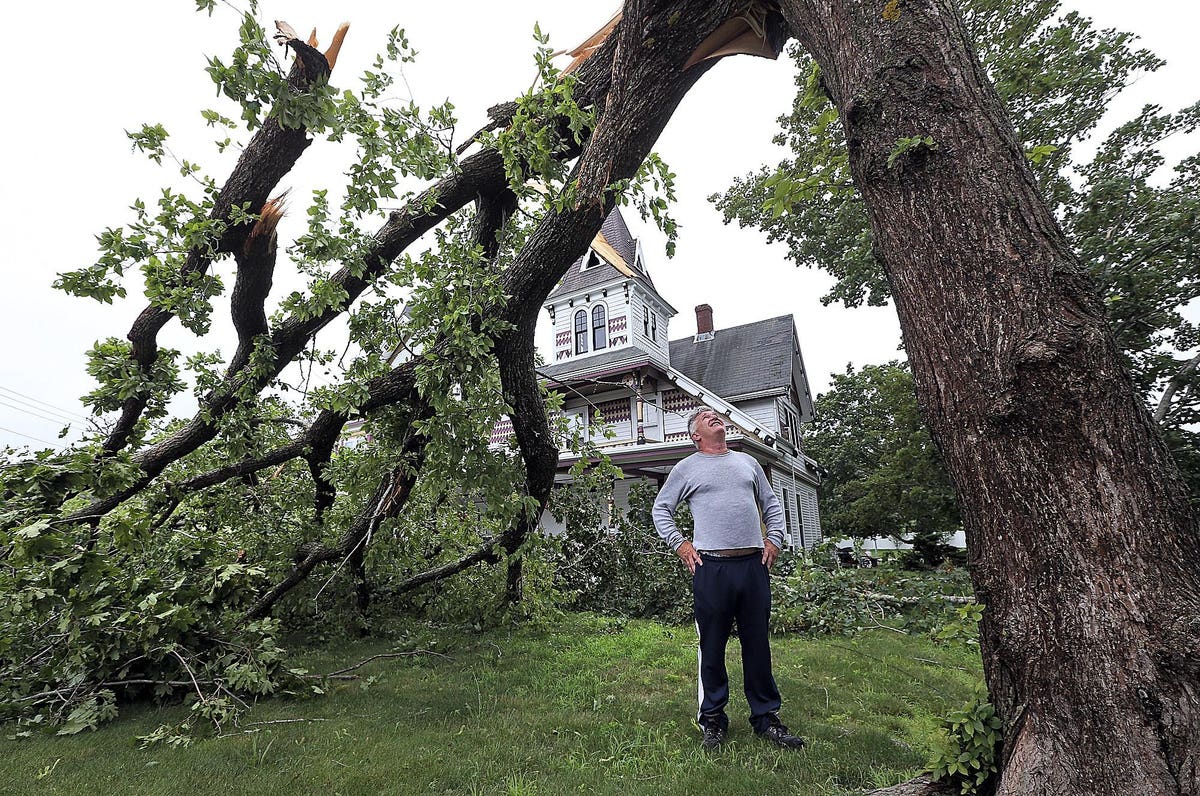
In recent years I have become more interested in the psychology of how people respond to weather information. Last month, severe storms moved through North Georgia. Trees were down all over the place, and many homes lost power for hours. It was fascinating how many people asked me if the widespread damage was caused by tornadoes. Based on reports from the National Weather Service, most of the damage was from straight-line wind gusts likely associated with downdrafts. Let’s define and explore the tornado fallacy.
Merriam-Webster dictionary defines fallacy as, “A false or mistaken idea.” In those July storms, numerous wind reports exceeded 50 mph and were as high as 69 mph, according to the National Weather Service. Though damage was widespread across the state, the agency only confirmed two tornadoes in Pickens County. Most of the damage around North Georgia was probably associated with downdraft winds. According to the National Weather Service website, “Damaging wind from thunderstorms is much more common than damage from tornadoes….many confuse damage produced by straight-line winds and often erroneously attribute it to tornadoes.” If the soil is particularly moist, high winds from severe or non-convective storms can be a nightmare for trees.
According to the same National Weather Service website, downbursts are, “Strong winds produced by a downdraft over a horizontal area up to 6 miles (10 kilometers).” They can be further delineated as macrobursts and microbursts based on size constraints. A derecho is a related storm system with significant swaths of excessive wind lasting for a sustained period of time. The diagram above illustrates how precipitation, dry air, and evaporation produce potentially devastating surface winds.
Unlike straight-line winds, a tornado is rotating column of air extending from supercell thunderstorms or in some cases, coupled to weaker cloud or surface boundary systems. The National Weather Service attributes confusion about tornado and straight-line wind damage to the following three things:
- Both can have pretty intense winds – Tornadoes (40 to 300 mph) and Downbursts (up to 165 mph).
- Winds at certain speeds can be very loud and sound like “roaring” irrespective of whether they are rotating or straight.
- Trees were broken or twisted off in odd ways.
When the National Weather Service conducts post-storm surveys, damage patterns often clearly reveal causation. However, the agency says that the third point is very commonly cited in the confusion about cause of damage. It is certainly the one I saw from friends in Georgia recently as they posted pictures of snapped trees or ominously swirling clouds.
The National Weather Service website says, “If wind speeds are high enough the tree will begin to tear apart in a twisting motion -even though the winds are relatively straight!” Last week, storms containing winds in excess of 80 mph blew through the Washington D.C. area leaving trees and other structures down throughout the region. According to Yahoo, many residents pondered whether a tornado caused the damage, but downbursts were the likely cause.
I argue that the tornado fallacy places the public at risk. People, emergency managers, and decision makers may only take appropriate actions if they see the words “Tornado Warning.” My own observations lead me to believe that the public has a greater level of anxiety for a Tornado Warning than a Severe Weather Warning. Yet, a Severe Storm Warning can be just as dangerous. According to the National Weather Service, a Severe Storm Warning means, “Winds 58 mph or stronger and/or hail 1 inch in diameter or larger.”
Is there a different badge of honor or coping that comes with knowing damaged was caused by a tornado rather than 60+ mph winds? Is a tornado more of a tangible explanation because movies, You Tube videos, and documentaries.? How do we get past this? In summary, a thunderstorm can happen and not be classified as severe. However, if there are Severe Thunderstorm Warnings, REACT.
Read the full article here