





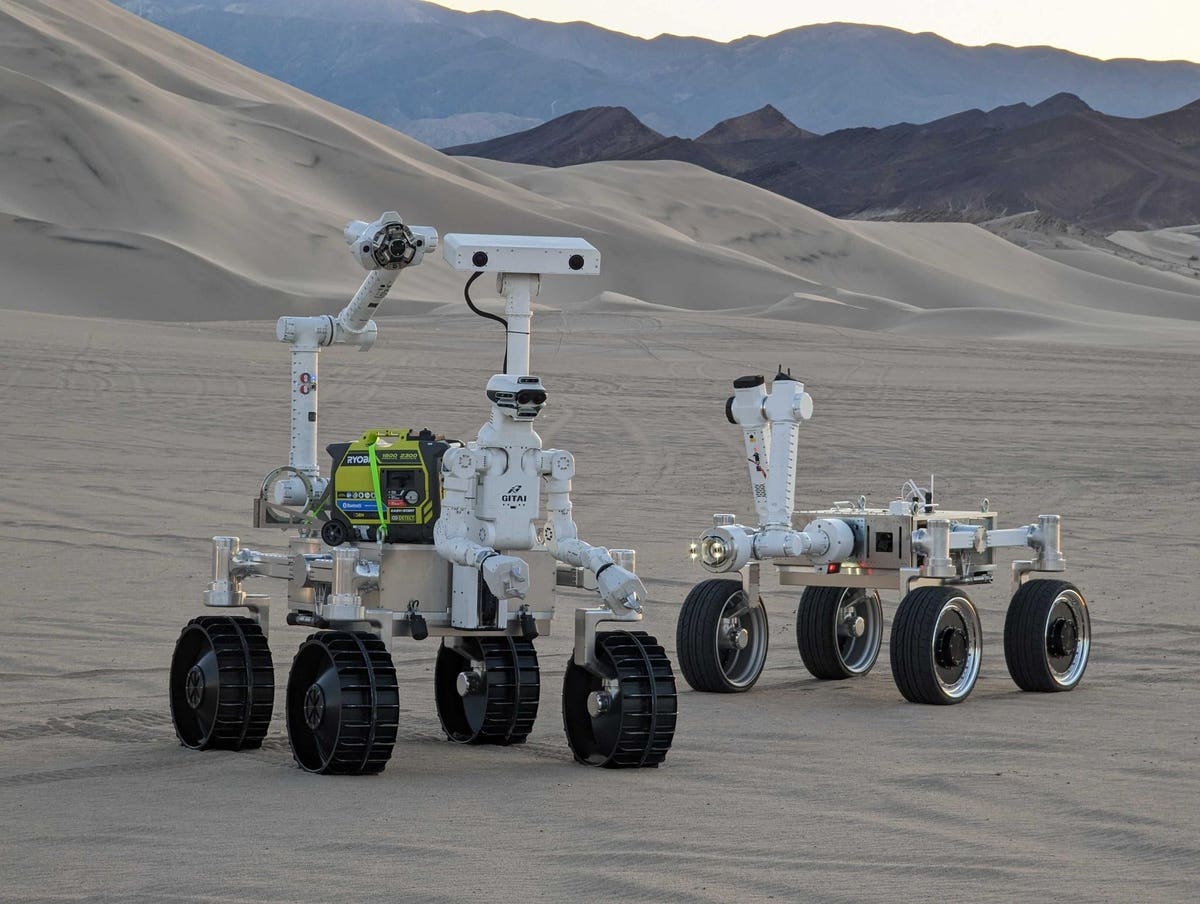
Tokyo-based company Gitai is developing a small, worm-like robot that can make repairs in space as well as a robot that can perform tasks on the Moon’s surface.
Sho Nakanose’s passion for robotics was inspired by tragedy: the passing of his mother ten years ago. Although he isn’t a doctor, he became obsessed with the idea that new technology might have somehow made things different.
“At the time, I strongly thought, if we could have new technology such as extension of human capabilities, I could have saved her life,” he says.
Ten years later, the 36-year-old has channeled that tragic inspiration into his Japan-based startup, Gitai. The company, which has so far raised over $47 million from venture capital firms such as Daiwa Corporate Investment Venture Growth Fund,Mitsubishi UFJ Capital IX and Global Brain CVC Funds, aims to build robots that can operate in space on a variety of missions, including soil sampling on the Moon. But at the center of Nakanose’s company is a simple idea: that using robots in space will save people’s lives and health.
It’s both expensive and dangerous for people to live and work in space. A crewed flight into orbit or to the International Space Station for example, costs start at $58 million per seat. Space travel also comes with many risks for those involved. According to NASA, radiation exposure brought on by space travel can increase cancer risk, damage the central nervous system causing difficulty for the brain to communicate with sensory organs, alter cognitive functions, reduce motor function and prompt behavioral challenges.
For Nakanose, using robotic technology potentially offers a more affordable and practical way to explore space without putting human lives at risk. He says that Gitai’s goal is to reduce space labor costs by 100 times by using their robotic technology and mitigate safety risks by sending the robots into orbit instead of humans.
The startup currently manufactures two products. The first is a 2-meter inch-worm type robotic arm. The machine is able to move like an inchworm and can also “be equipped with various attachments such as electric drills, shovels and robot hands to perform a range of tasks,” says Nakanose. This could potentially reduce the amount of times astronauts need to make spacewalks to perform maintenance or repair tasks on spacecraft or space stations.
Its second product is a Lunar robotic rover, which is about the size of a go-kart and has a range of several miles. “This rover has the capability to navigate and operate on the lunar surface,” Nakanose says This is important as NASA gears up to return humans to the Moon permanently.
Gitai isn’t the only space robotics company out there. The current market is dominated by companies like Canada’s MDA Space, which created the robotic arm for the International Space Station, and Luxembourg-based Redwire, which manufactures robotics systems for spacecraft. Demand for space robotics is growing, and analyst firm Grand View Research estimates the total market will be over $5 billion by 2027. The demand is due to the need for “efficient repair, service, and maintenance of geostationary satellites,” according to a report by the firm. “Cost-effectiveness, better productivity, and the ability to perform in the extreme space environment are the prime factors driving the demand for space robotics technology,” the report reads..
Despite the dominance of legacy companies, Christopher Stott, an analyst at Lonestar Data Holdings Inc., says that Gitai’s technology may enable it to outcompete its legacy competition. “While MDA and Redwire are the industry’s key providers of space robotics today, Gitai could give them real competition becoming the SpaceX equivalent in their market share,” says Stott.
The company already has a number of customers in the industry. Nakanose says the company has a lot to offer other space companies. “We can be a good partner to minimize the infrastructure costs such as transportation and labor costs together,” he adds.
A decade ago, Nakanose’s life had nothing to do with robotics or space. He was an IT consultant at IBM Japan in 2009, replacing old systems with new SAP (German software company) systems for customers. But it wasn’t long before he was looking for another path, he says, because he was “not cut out to be a corporate employee in a large company,” says Nakanose. So in 2013, he moved to India and started CloudLancer India, Pvt, Ltd, a company that operated two main businesses, contracting web system development for clients and developing their own web and smartphone applications for marketing and education. He sold CloudLancer in 2015 to an Indian Company for an undisclosed amount, then moved back to Tokyo to pursue his passion for robots.
In 2016, Nakanose founded Gitai, with an aim of building less expensive robotic systems to aid with space construction and maintenance. The company name means “Cybernetic body” in Japanese, but is probably more recognizable as the name for the cybernetic bodies in the anime film Ghost in the Shell, a favorite of Nakanose’s.
In 2021, the company says it successfully conducted its first tech demo in the International space station with an autonomous space robot that was able to mimic lunar explorations and construction along with spacecraft repair. In 2024, the company will be conducting another tech demo outside of the ISS. The company also has more missions lined up with the Japanese space agency, Toyota and others.
In May, the company raised a $30 million series B round, and aims to use that capital to expand its operations in the United States at its Torrance, California location to boost its manufacturing capacity. Nakanose says the startup’s most important project in the future will be developing robots that aim to construct solar panels, communication antennas, habitation modules and generators in space and providing thousands of robots to the lunar surface.
“As a start up we will provide thousands of our robots to the lunar surface and Martian surface to construct lots of solar panels, communication antennas, habitation modules and generators,” says Nakanose. “which is going to be our most important project in the near future.”
MORE AT FORBES
Read the full article here