





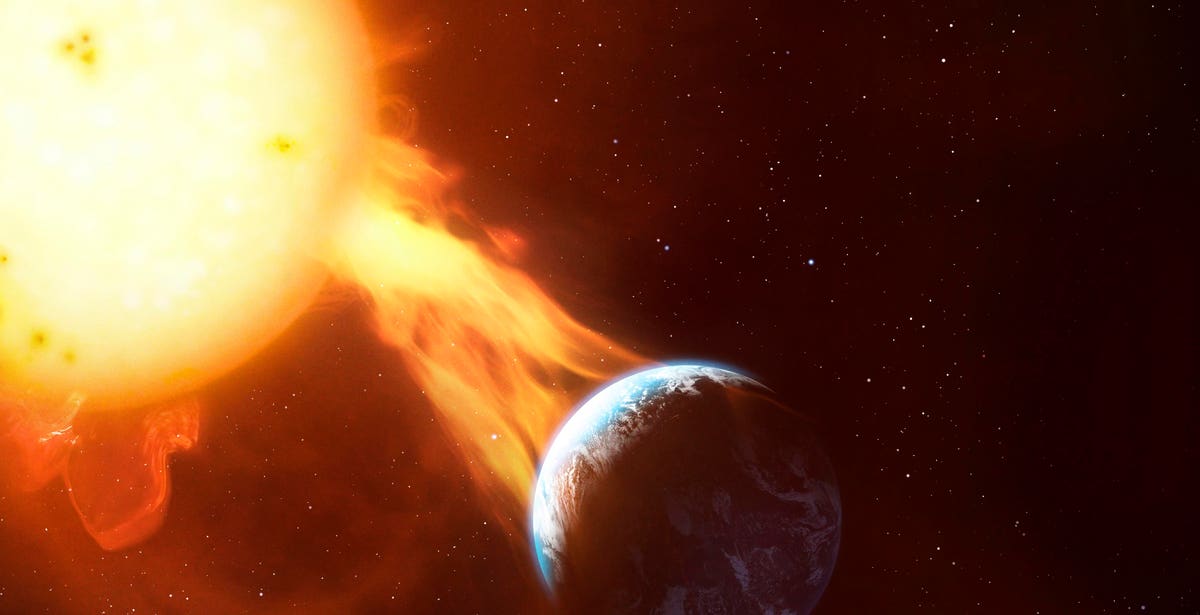
An international team of scientists have discovered a huge spike in radiocarbon levels 14,300 years ago by analyzing ancient tree-rings. The radiocarbon spike was caused by a massive solar storm, the biggest ever identified.
A team of researchers from the Collège de France, CEREGE, IMBE, Aix-Marseille University and the University of Leeds measured radiocarbon levels in ancient trees preserved within the eroded banks of the Drouzet River, near Gap, in the Southern French Alps. Looking at the individual tree-ring allows researchers to reconstruct environmental and chemical changes for almost every year the tree lived. By stacking sections of many trees together, scientists can reconstruct a tree-ring record spanning many thousand years.
The tree trunks, which are subfossils—remains whose fossilization process is not complete—were sliced into tiny single tree-rings. Analysis of these samples identified an unprecedented spike in radiocarbon levels occurring precisely 14,300 years ago. By comparing this radiocarbon spike with measurements of beryllium, a chemical isotope found in Greenland ice cores, the team proposes that the spike was caused by a massive solar storm that would have ejected huge volumes of energetic particles into Earth’s atmosphere.
Coronal mass ejections or flares are powerful releases of solar charged particles and magnetic fields, traveling on the solar wind towards Earth. When such a flare hits Earth, it can cause a solar storm which disrupts the planet’s magnetosphere, causing the charged particles to collide with Earth’s atmosphere forming new isotopes, including the radioactive beryllium-10 and carbon-14 (commonly referred as radiocarbon) .
“Radiocarbon is constantly being produced in the upper atmosphere through a chain of reactions initiated by cosmic rays. Recently, scientists have found that extreme solar events including solar flares and coronal mass ejections can also create short-term bursts of energetic particles which are preserved as huge spikes in radiocarbon production,” explained Edouard Bard, Professor of Climate and Ocean Evolution at the Collège de France and CEREGE, and lead author of the study.
Scientists are trying to see how often such solar storms happened in the past to better estimate future risks.
“Extreme solar storms could have huge impacts on Earth. Such super storms could permanently damage the transformers in our electricity grids, resulting in huge and widespread blackouts lasting months. They could also result in permanent damage to the satellites that we all rely on for navigation and telecommunication, leaving them unusable. They would also create severe radiation risks to astronauts,” said coauthor Tim Heaton, Professor of Applied Statistics in the School of Mathematics at the University of Leeds.
Nine such extreme solar storms—known as Miyake Events—have now been identified as having occurred over the last 15,000 years studying tree-rings and ice layers records. The most recent confirmed Miyake Events occurred 1,030 and 1,250 years ago. This newly-identified 14,300-year-old storm is, however, the largest that has ever been found—roughly twice the size of these two.
The exact nature of these Miyake Events remains very poorly understood as they have never been directly observed instrumentally. They highlight that we still have much to learn about the behavior of the sun and the dangers it poses to society on Earth. We do not know what causes such extreme solar storms to occur, how frequently they might occur, or if we can somehow predict them.
The largest, directly-observed, solar storm occurred in 1859 and is known as the Carrington Event. British astronomer Richard Christopher Carrington observed a gigantic outburst of charged particles and light on the solar surface. In the following weeks, polar lights were observed during daylight as far as the equator. At the time, long before mobile telecommunications and the widespread use of electronic devices, damage was fortunately limited to telegraph lines. The solar storm recorded in the subfossil trees was an estimated ten to hundred times more powerful.
Today the National Oceanic and Atmospheric Administration’s Space Weather Prediction Center monitors solar activity and its impact on our infrastructure. Not appropriately shielded electronics are still at a high risk of interference and jamming. A similar massive event happening today could be catastrophic for our technology-based society.
The study “A radiocarbon spike at 14,300 cal yr BP in subfossil trees provides the impulse response function of the global carbon cycle during the Late Glacial” was published in the Philosophical Transactions of the Royal Society A: Mathematical Physical and Engineering Sciences (2023). Additional material and interviews provided by University of Leeds.
Read the full article here