





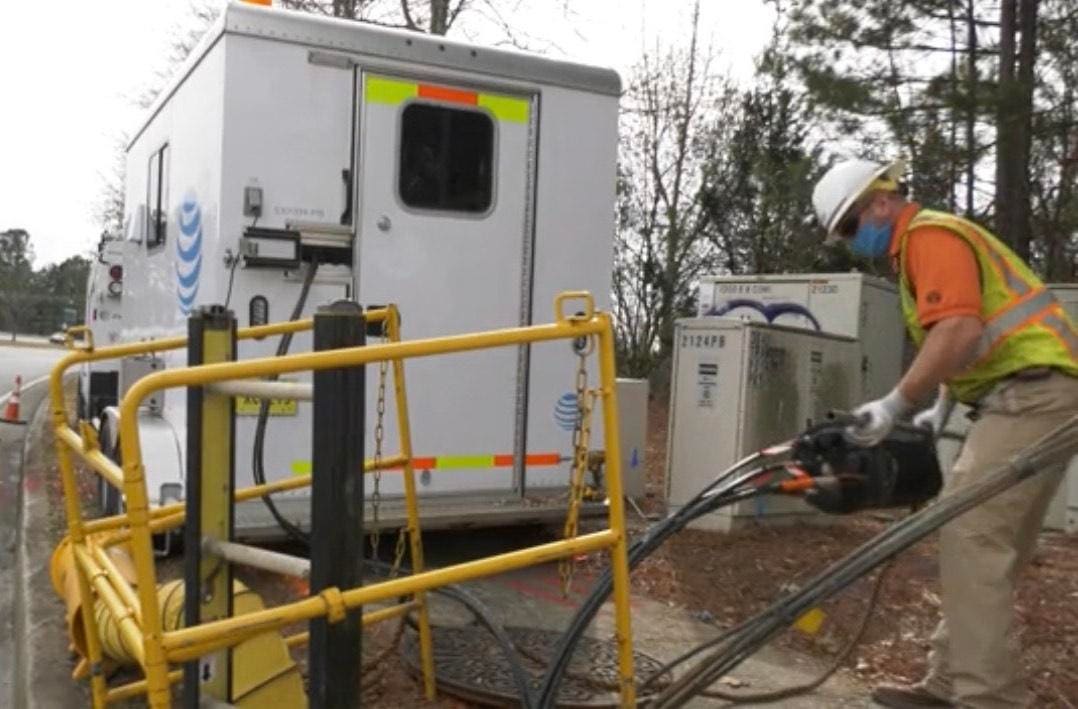
On July 9, The Wall Street Journal (WSJ) posted an investigative article regarding the potential dangers of lead-clad telecommunications cabling. Not surprisingly, this is stirring concerns among both telecom providers and the public. Shortly after the WSJ story broke, I was briefed on the issue by USTelecom, a broadband industry consortium, and now I want to weigh in with my own insights.
Lead-clad cabling’s history
Lead-clad telecom cabling has been around for a long time. Its initial installation can be traced back to the 1880s when the U.S. was building out its telegraph and then telephone infrastructure. Unfortunately, during that time any documentation of these installations was on paper records, often handwritten, that could decay or be misplaced over the decades. Nearly 150 years have passed since the earliest installations, with ownership of the cabling typically changing hands multiple times along the way.
As a result, accurately identifying the amount of lead-clad cabling and its specific installation sites in aerial, underground and underwater scenarios is a monumental challenge. The good news is that lead-clad cabling was phased out in the 1950s after the industry developed a new type of sheathing. The bad news is that it will be difficult to find all the lead-clad cabling that’s still out in the wild. Plus, there are open questions about which types of these installations create real public health concerns and which ones should simply be left alone.
Health risk concerns — fact or fiction?
The WSJ’s story is a culmination of nearly a year and a half of research. There is no disputing that the health risk concerns tied to lead are real, given extensive prior investigations into exposure-related health issues created by lead-based paint and lead water piping. However, I’m concerned about the WSJ’s research methodologies in reaching its conclusions, and especially the imbalance of citing environmental groups, including the Environmental Defense Fund (EDF) and Below the Blue, while not providing USTelecom access to all the data or methodology underlying the investigation’s conclusions. USTelecom’s detailed perspective on the issue can be found here.
Separately, AT&T has put forward its own position on the lead-clad cabling in its network. The company attests that less than 10% of its two million miles of copper cabling is lead-clad, with two-thirds of that amount either buried or contained in conduit. Those deployments likely pose minimal health concerns, and it may be in the EPA’s best interest not to force AT&T and other companies to remediate or remove that kind of infrastructure so long as it still serves residential, commercial and first responder communications. It is also worth pointing out that the EDF’s open letter to the EPA last week did not voice concerns regarding the removal of underground or in-conduit cables.
From my perspective, the remaining one-third of AT&T’s lead-clad footprint requires further evaluation to determine the need for remediation. That’s where the WSJ’s identification of 2,000 cables that it believes pose significant health risks might be helpful. However, the EDF’s open letter also highlights that the 2,000 cables in question include both telecom and electric cables, which the WSJ does not distinguish in its reporting.
Wrapping up
I certainly don’t dismiss the concerns raised by the WSJ article, but I do find fault with its sensationalism and its apparent lack of balance in presenting the facts and corresponding risks. From everything I can tell, I believe that USTelecom and specific carriers including AT&T and Verizon are genuinely committed to transparency in acknowledging and addressing the footprint of lead-clad telecom cabling.
In my recent conversations with AT&T leadership, the company reiterated its commitment to ensuring the health and safety of its employees, its customers and the communities it serves. That commitment continues to be demonstrated through a voluntary testing program for AT&T employees who have been exposed to lead-clad cables, ongoing testing of the company’s expansive cable footprint and in-person site visits to areas that contain lead-clad cables to determine needed action.
Further investigation by the EPA will likely follow, but I am confident that the U.S. telecommunications industry will step up in the best interest of public safety.
Moor Insights & Strategy provides or has provided paid services to technology companies like all research and tech industry analyst firms. These services include research, analysis, advising, consulting, benchmarking, acquisition matchmaking, and video and speaking sponsorships. The company has had or currently has paid business relationships with 8×8, Accenture, A10 Networks, Advanced Micro Devices, Amazon, Amazon Web Services, Ambient Scientific, Ampere Computing, Anuta Networks, Applied Brain Research, Applied Micro, Apstra, Arm, Aruba Networks (now HPE), Atom Computing, AT&T, Aura, Automation Anywhere, AWS, A-10 Strategies, Bitfusion, Blaize, Box, Broadcom, C3.AI, Calix, Cadence Systems, Campfire, Cisco Systems, Clear Software, Cloudera, Clumio, Cohesity, Cognitive Systems, CompuCom, Cradlepoint, CyberArk, Dell, Dell EMC, Dell Technologies, Diablo Technologies, Dialogue Group, Digital Optics, Dreamium Labs, D-Wave, Echelon, Ericsson, Extreme Networks, Five9, Flex, Foundries.io, Foxconn, Frame (now VMware), Fujitsu, Gen Z Consortium, Glue Networks, GlobalFoundries, Revolve (now Google), Google Cloud, Graphcore, Groq, Hiregenics, Hotwire Global, HP Inc., Hewlett Packard Enterprise, Honeywell, Huawei Technologies, HYCU, IBM, Infinidat, Infoblox, Infosys, Inseego, IonQ, IonVR, Inseego, Infosys, Infiot, Intel, Interdigital, Jabil Circuit, Juniper Networks, Keysight, Konica Minolta, Lattice Semiconductor, Lenovo, Linux Foundation, Lightbits Labs, LogicMonitor, LoRa Alliance, Luminar, MapBox, Marvell Technology, Mavenir, Marseille Inc, Mayfair Equity, Meraki (Cisco), Merck KGaA, Mesophere, Micron Technology, Microsoft, MiTEL, Mojo Networks, MongoDB, Multefire Alliance, National Instruments, Neat, NetApp, Nightwatch, NOKIA, Nortek, Novumind, NVIDIA, Nutanix, Nuvia (now Qualcomm), NXP, onsemi, ONUG, OpenStack Foundation, Oracle, Palo Alto Networks, Panasas, Peraso, Pexip, Pixelworks, Plume Design, PlusAI, Poly (formerly Plantronics), Portworx, Pure Storage, Qualcomm, Quantinuum, Rackspace, Rambus, Rayvolt E-Bikes, Red Hat, Renesas, Residio, Samsung Electronics, Samsung Semi, SAP, SAS, Scale Computing, Schneider Electric, SiFive, Silver Peak (now Aruba-HPE), SkyWorks, SONY Optical Storage, Splunk, Springpath (now Cisco), Spirent, Splunk, Sprint (now T-Mobile), Stratus Technologies, Symantec, Synaptics, Syniverse, Synopsys, Tanium, Telesign,TE Connectivity, TensTorrent, Tobii Technology, Teradata,T-Mobile, Treasure Data, Twitter, Unity Technologies, UiPath, Verizon Communications, VAST Data, Ventana Micro Systems, Vidyo, VMware, Wave Computing, Wellsmith, Xilinx, Zayo, Zebra, Zededa, Zendesk, Zoho, Zoom, and Zscaler. Moor Insights & Strategy founder, CEO, and Chief Analyst Patrick Moorhead is an investor in dMY Technology Group Inc. VI, Fivestone Partners, Frore Systems, Groq, MemryX, Movandi, and Ventana Micro.
Read the full article here