





To attract the public to go through their doors, what is the most popular attraction at aquariums? Some might say it’s dolphins, others seals. Love them or hate them, there is always a long line of people in front of the glass to catch a glimpse of a shark. However, unlike smaller species, larger species rarely spend their entire lives inside aquariums. “Sharks held in aquaria are normally caught from wild stocks, and larger species cannot be kept indefinitely due to their size and pelagic lifecycles,” explains shark scientist Dr. Oliver Jewell of the University of Western Australia.
Despite this, relatively little work has been done tracking shark movements once they have been released back into the wild. This intrigued Jewell, and got the wheels in his head turning when there was talk about releasing a shark from the Ocean Park Aquarium in the Shark Bay World Heritage Area, Western Australia.
“Why not take advantage of this chance to study just that?” he thought, and started digging around to figure out how to better study this unique release. His first thought was biologger tags, a technology he was well acquainted with thanks to have previously studied the habitat movements of other large shark species using them. Biologger tags, also known as bio-logging or animal-borne tags, are specialized electronic devices attached to sharks for the purpose of collecting and recording data about their behavior, movements, and physiological parameters. These tags provide valuable insights into the life history, habitat use, migration patterns, and ecological role of sharks.
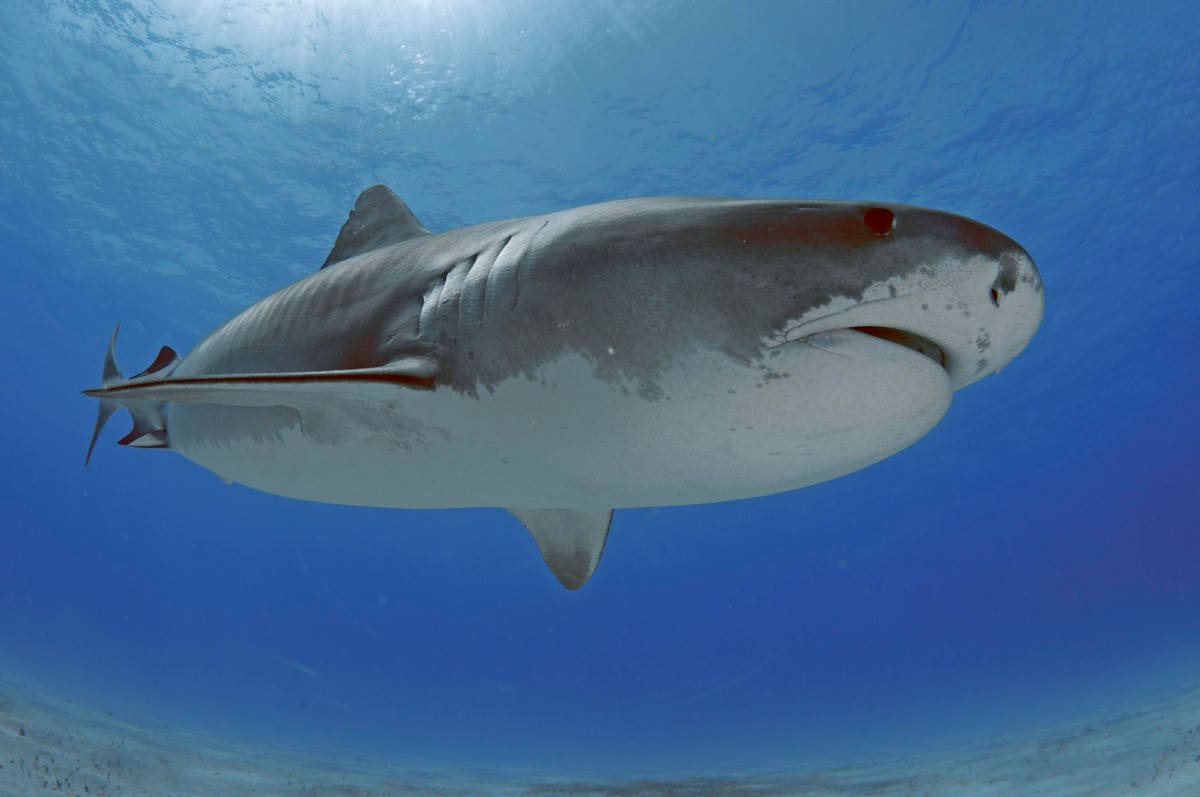
But he had previously studied great white sharks (Carcharodon carcharias). This wasn’t a great white shark in captivity… it was a tiger shark (Galeocerdo cuvier). Tiger sharks are large and powerful marine predators that are capable of traveling long distances in the wild. While some species of sharks can adapt to captivity under specific conditions, it is generally challenging to provide a suitable environment that meets the complex needs of tiger sharks in captivity. Growing to be one of the larger shark species, they can reach lengths of over 15 feet (4.5 meters) and have a diverse diet that includes fish, turtles, marine mammals (such as dugongs, which is a favorite meal of theirs in Shark Bay), and even other sharks. A highly mobile predator, they’re not generally considered suitable candidates for long-term captivity which is why after two years in captivity at the Ocean Park Aquarium in the Shark Bay World Heritage Area, Western Australia, the sub-adult tiger shark was ready to go back to the wild.
The 7.2 ft long (2.2 m) male shark was tagged inside the main display area of Ocean Park Aquarium to record the movements of the tiger shark while captive so that the team of scientists could monitor it’s pre- and post-release fine-scale movements following two years of captivity in an aquarium. They also compared its movement to a wild tiger shark tagged nearby. “To compare this shark’s movement to a shark not kept in captivity, we also caught, tagged, and released a wild 9.1ft/2.8 m female tiger shark at Big Lagoon, located approximately 15.5 miles (25 km) north of Ocean Park Aquarium,” explained the authors in the academic journal article about the event.
The captive tiger shark displayed uniform levels of activity and depth use for most of the 10 hours recorded in the aquarium, except for a slight increase in activity within the first 2 hours after deployment, possibly as a result of adjusting to the extra drag caused by the deployed tag. Video from the camera tag showed several tight turns, but no major bursting events were recorded, and no further feeding events took place besides the shark taking the bait to get fitted with the tag.
“A comparison with the data obtained from the wild tiger shark revealed some similarities but also differences in movement patterns, with the major differences seen in turning rates and vertical velocity,” the team reported. For example, even though the captive shark’s depth range was restricted, it displayed the highest vertical velocity inside the aquarium: “This high velocity may be an artefact of the shallow environment inside the aquarium, resulting in oscillations captured at faster rates by the unit, as this was not seen in the post-release data for the same shark.”
But did it survive? The tag seems to point to one answer – yes. Despite its different movement patterns, with vertical oscillations notably absent and greater levels of turning exhibited by it than the wild tiger shark, this male tiger shark made it. “The results we obtained with the CamTag provide unique insight into the release of a captive shark and the comparison of this shark’s behaviour to one that has been living in the wild,” the scientists conclude. “Future post-captive studies should aim for longer deployment durations, which may reveal how long it takes to reduce the differences between the movements of the captive and wild sharks.”
Read the full article here