





Declawing larger cat species like lions and tigers negatively affects their muscular capabilities, according to a new study
© Copyright by GrrlScientist | hosted by Forbes | LinkTr.ee
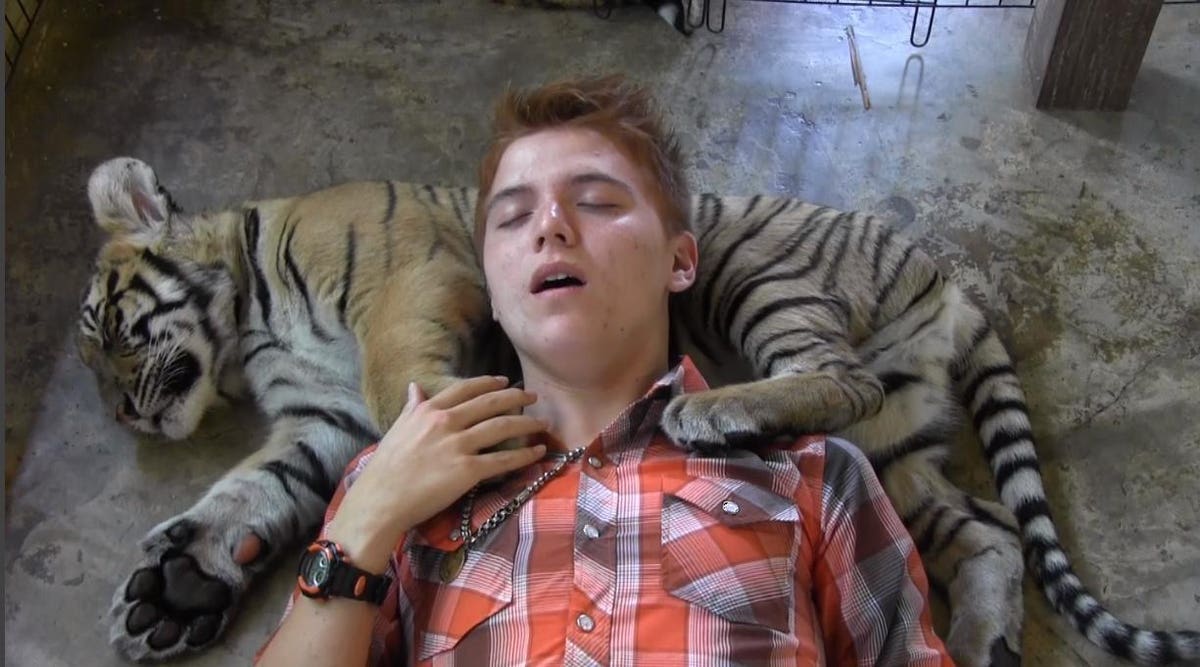
Domesticated housecats are declawed to prevent them from clawing furniture or people, whereas big cats, such as lions and tigers that are kept in captivity are declawed (usually as kittens) to reduce the risk that they will rip holes in tourists who are eager to pay for photographs.
But increasingly, this surgical procedure is viewed as a form of animal cruelty, especially in big cats.
“What people might not realize is that declawing a cat is not like trimming our fingernails; rather, it is removing part or all of the last bone of each digit,” comparative and functional anatomist Adam Hartstone-Rose, an Associate Professor of Biology at North Carolina State University and the corresponding author of this study said in a statement.
“Like us, each cat finger has three bones, and declawing is literally cutting that third bone off at the joint.”
It has estimated that 20-25% of domestic housecats have been declawed in the United States (ref), a surgical procedure that leads many of these cats to experience a lifetime of bleeding, lameness, infections, and foot or back pain. But housecats are not the only cats whose claws are amputated: although it is illegal in the United States to surgically modify big cats, they are also victims of this practice to make them less dangerous to handle for entertainment purposes.
If declawing tends to create a lifetime of physical problems for a comparatively small and lightweight housecat, what are the long-term effects of declawing big cats like lions and tigers? We know that larger cats have a much larger body volume than housecats so they have a greater body mass. We also know that paw size increases at a slower rate than does body mass (mass corresponds to volume), so larger cats end up having smaller feet relative to their body size. Thus, the mass pressing down on each foot in big cats is proportionally greater per surface area than for house cats. For this reason, the researchers suspected that declawing might have an outsized effect on big cats.
The investigate this question, researchers examined the muscle anatomy in more than a dozen big cats — from smaller species such as bobcats, servals and ocelots, to lions and tigers — to shed some light on the effects that declawing has on forearm muscle architecture.
They measured both muscle density and mass, and also examined muscle fibers from both clawed and declawed big cats. They found that for tigers and other large species, declawing resulted in 73% lighter musculature in the digital flexors in the forearm (Figure 1). These are the muscles that unsheath the claws. Overall, forelimb strength decreased by 46% to 66%, depending on the size of the cat (Figure 2), and other muscles in the forelimb did not compensate for these reductions in the digital flexors.
Thus, as this study found, declawing has a substantially larger effect on the muscular capabilities of big cats, and because these muscle deficiencies are not compensated in larger cats, they probably have even more functionally devastating consequences for tigers and other large species.
“When you think about what declawing does functionally to a housecat, you hear about changes in scratching, walking or using the litter box,” lead author of the study, Lara Martens, an undergraduate research assistant at NCState and a veterinary assistant pointed out. Ms Martens also is an animal care intern at Carolina Tiger Rescue, a wildlife sanctuary that was a partner in this research. This nonprofit sanctuary rescues exotic carnivores, especially big cats, who have often been neglected or mistreated.
“But with big cats, there’s more force being put through the paws. So if you alter them, it is likely that the effects will be more extreme.”
It’s also important to remember that big cats are more reliant on their forelimbs than are smaller cats.
“Additionally, big cats are more reliant on their forelimbs — they bear most of the weight, and these bigger cats use their forelimbs to grapple because they hunt much larger prey,” Ms Martens explained. “So biomechanically speaking, declawing has a more anatomically devastating effect in larger species.”
Basically, the researchers confirmed that declawing is a surgery that permanently cripples cats, big and small. At the time of this writing, 42 countries — including Australia, England, Japan, Finland, Sweden, Estonia, the Netherlands, Germany and Switzerland — prohibit declawing surgeries for non-medical reasons under their laws against cruelty to animals. (Some countries, such as Israel, recognize declawing as a criminal offense punishable either by one year in prison or a sizeable fine.) And many veterinarians in the United States simply refuse to perform the procedure for ethical reasons.
“As scientists, it is our job to objectively document the effects of this surgery on the animals,” Professor Hartstone-Rose concluded. “But it is hard to ignore the cruelty of this practice. These are amazing animals, and we should not be allowed to cripple them, or any animals, in this way.”
Source:
Lara L. Martens, Sarah Jessica Piersanti, Arin Berger, Nicole A. Kida, Ashley R. Deutsch, Kathryn Bertok, Lauren Humphries, Angela Lassiter and Adam Hartstone-Rose (2023). The Effects of Onychectomy (Declawing) on Antebrachial Myology across the Full Body Size Range of Exotic Species of Felidae, Animals 13(15):2462 | doi:10.3390/ani13152462
SHA-256: 9ab94921e06b203a216cb219d873f92ea4083642075e2e0be632939cd42949aa
Socials: Bluesky | CounterSocial | LinkedIn | Mastodon | MeWe | Post.News | Spoutible | SubStack | Tribel | Tumblr | Twitter
Read the full article here