





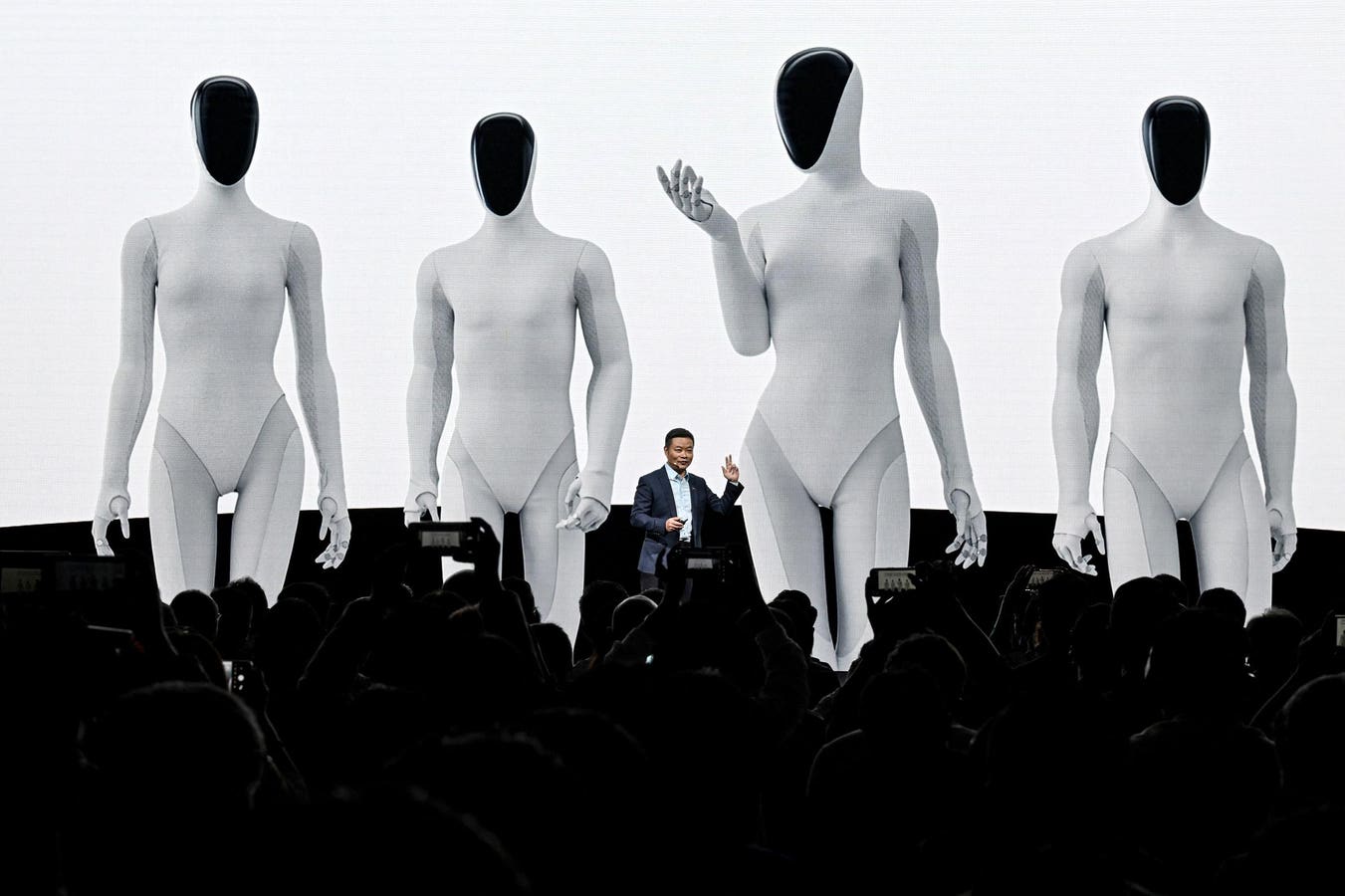
A few short months ago, almost every robot made by the hundreds of companies working on humanoid robots could charitably be described as slow, topping out at around three mph. Walking was on the edge of plodding, and arm movements bordered on sluggish and awkward. But just this weekend, we saw a robot running quickly, gracefully, and smoothly.
That’s one clear signal that robots – and other machines that are getting eyesight and intelligence – are evolving quicker now than ever before.
“All of a sudden giving AI a body is becoming economically viable at scale,” says Mat Gilbert, director of AI and data at Synapse, in a recent TechFirst interview.
The costs to embed AI in physical hardware are coming down at exactly the same time AI is getting orders of magnitude better. Hardware is no longer a blocker, and physical AI – AI embedded in robots and other smart machines – is already delivering significant ROI, says Gilbert.
That’s why Amazon has over a million warehouse robots now and why it is investing even more, with Nvidia, into other physical AI robotics companies.
Lidar has dropped from $75,000 to “hundreds, not thousands, of dollars,” says Innoviz, the company that supplies lidar sensors for BMW’s i7. At the same time, batteries are down about 85% over the course of a decade. Sensors are cheaper, chips are cheaper, actuators – think robotic muscles – are cheaper too.
For a full humanoid, costs have dropped 40%, says Goldman Sachs Research. That’s unexpectedly fast.
“The manufacturing cost of humanoid robots has dropped — from a range that ran between an estimated $50,000 (for lower-end models) and $250,000 (for state-of-the art versions) per unit last year, to a range of between $30,000 and $150,000 now. Where our analysts had expected a decline of 15-20% per annum, the cost declined 40%.”
Of course, giving AI a body isn’t easy, even if it is getting cheaper.
Physical AI isn’t just a connection to the cloud where a robot can query ChatGPT and get an answer back 10 seconds later. Latency matters if a robot has to avoid a collision, lift a heavy object safely, or stop near a human being. And that means on-board compute.
“If I need very quick real-time processing and reaction, I’m probably going to put that on the edge,” says Gilbert.
But not everything needs instant reaction. Some processing will live on local servers or in the cloud, where larger AI models can handle more difficult reasoning tasks that might be more forgiving to higher latency. The result is a hybrid architecture built to accommodate on-device reflexes, local reasoning, as well as cloud-based learning and optimization.
The mix of cheaper hardware, better AI, and hybrid on-device as well as cloud compute has enabled extremely fast development.
Sankaet Pathak, the CEO of humanoid robot company Foundation, told me that 18 months after founding, the company has a humanoid robot prototype, and not just a basic one. I’ve heard similar stories from Apptronik, and of course Figure, which makes the robot that looks to be running and moving smoother and faster than any other right now, started just over two years ago.
Putting humanoid robots into spaces with humans is still a challenging problem though, not least because of safety concerns.
Unlike digital AI, real-world robotics mistakes have real-world consequences. Those aren’t typically hallucinations like you might get from an LLM.
“For the physical world, actions often aren’t reversible … it’s not just a wrong sentence,” says Gilbert. “It’s potentially a catastrophic physical movement.”
That’s why, he says, the home is the “last frontier” of physical AI and robotics. Homes are unstructured, unpredictable, constantly changing. There are small children, even infants, as well as pets around and potentially underfoot. And of course there are adults as well: also unpredictable.
That makes the home the ultimate test of general purpose humanoid robots:
“We know we’ll have solved general humanoid robotics when you can take a humanoid robot and it can walk into any American home and make a cup of coffee.”
And, perhaps, when the average family can afford one.
Read the full article here