




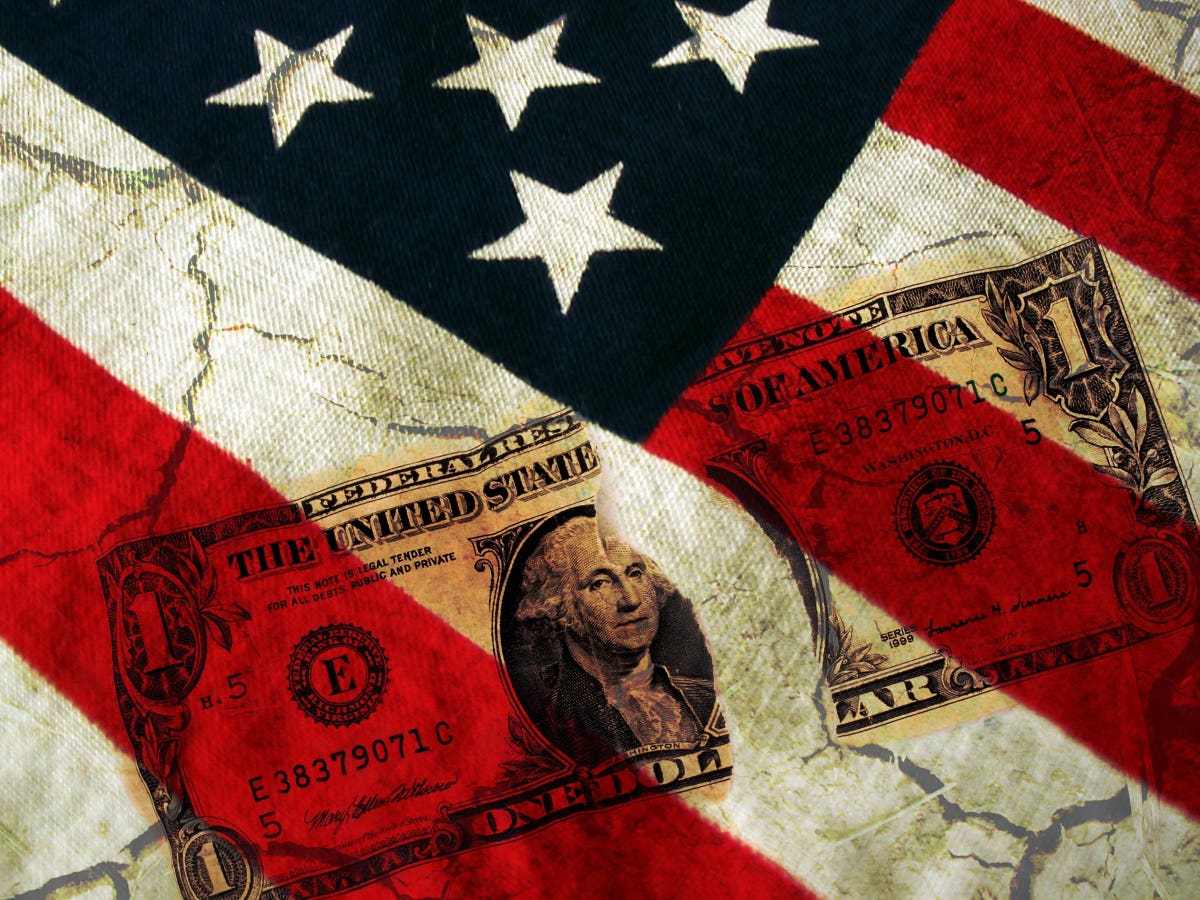
Yesterday, Fitch issued a downgrade of US long-term debt from AAA to AA+. Is there a universe in which this makes sense or is it Fitch that deserves a downgrade?
First and foremost, it needs to be made clear that it is impossible for the United States to be forced into default on debt denominated in dollars. Not unlikely, not improbable, but impossible. However, don’t take my word for it:
“The United States can pay any debt it has because we can always print money to do that. So there is zero probability of default.” Alan Greenspan “In the case of United States, default is absolutely impossible. All U.S. government debt is denominated in U.S. dollar assets.” Peter Zeihan, Vice President of Analysis for STRATFOR
“In the case of governments boasting monetary sovereignty and debt denominated in its own currency, like the United States (but also Japan and the UK), it is technically impossible to fall into debt default.” Erwan Mahe, European asset allocation and options strategies adviser
“There is never a risk of default for a sovereign nation that issues its own free-floating currency and where its debts are denominated in that currency.” Mike Norman, Chief Economist for John Thomas Financial
“There is no inherent limit on federal expenses and therefore on federal spending…When the U.S. government decides to spend fiat money, it adds to its banking reserve system and when it taxes or borrows (issues Treasury securities) it drains reserves from its banking system. These reserve operations are done solely to maintain the target Federal Funds rate.” Monty Agarwal , managing partner and chief investment officer of MA Managed Futures Fund
“As the sole manufacturer of dollars, whose debt is denominated in dollars, the U.S. government can never become insolvent, i.e., unable to pay its bills. In this sense, the government is not dependent on credit markets to remain operational.” Federal Reserve Bank of St. Louis
“A sovereign government can always make payments as they come due by crediting bank accounts — something recognized by Chairman Ben Bernanke when he said the Fed spends by marking up the size of the reserve accounts of banks.” L. Randall Wray, Professor of Economics and Senior Scholar, Levy Economics Institute
This doesn’t mean that there can’t be other consequences, like inflation or crowding out of the private sector (both of which also require at that we are already at full employment), but default is off the table.
How does this match what AAA means to Fitch? Their own definition is:
“’AAA’ ratings denote the lowest expectation of default risk. They are assigned only in cases of exceptionally strong capacity for payment of financial commitments. This capacity is highly unlikely to be adversely affected by foreseeable events.”
Sounds like the US is AAA to me!
Or is it? To be fair, let’s have a look at the specific reasons Fitch lowered the rating:
- the expected fiscal deterioration over the next three years,
- a high and growing general government debt burden,
- the erosion of governance…over the last two decades that has manifested in repeated debt limit standoffs and last-minute resolutions.
Numbers 1 and 2 betray an ignorance of the manner in which federal government financing actually works, which is not terribly encouraging. That’s strikes one and two against Fitch. But it’s hard to argue with #3, at least not the part reflected in further comments later in the document: “there has been a steady deterioration in standards of governance over the last 20 years.”
No doubt, at least 20 years.
Can the US be forced into debt default?
Never. Shame on you, Fitch.
Could the gridlocked, highly-partisan, and dysfunctional US government prevent us from meeting financial obligations we absolutely have the legal and economic ability to meet?
Yes. Shame on us, United States. And for that, the debt is the least of our worries.
Read the full article here