





The big AI companies promised us that 2025 would be “the year of the AI agents.” It turned out to be the year of talking about AI agents, and kicking the can for that transformational moment to 2026 or maybe later. But what if the answer to the question “When will our lives be fully automated by generative AI robots that perform our tasks for us and basically run the world?” is, like that New Yorker cartoon, “How about never?”
That was basically the message of a paper published without much fanfare some months ago, smack in the middle of the overhyped year of “agentic AI.” Entitled “Hallucination Stations: On Some Basic Limitations of Transformer-Based Language Models,” it purports to mathematically show that “LLMs are incapable of carrying out computational and agentic tasks beyond a certain complexity.” Though the science is beyond me, the authors—a former SAP CTO who studied AI under one of the field’s founding intellects, John McCarthy, and his teenage prodigy son—punctured the vision of agentic paradise with the certainty of mathematics. Even reasoning models that go beyond the pure word-prediction process of LLMs, they say, won’t fix the problem.
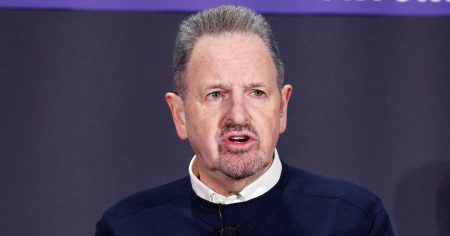
“There is no way they can be reliable,” Vishal Sikka, the dad, tells me. After a career that, in addition to SAP, included a stint as Infosys CEO and an Oracle board member, he currently heads an AI startup called Vianai. “So we should forget about AI agents running nuclear power plants?” I ask. “Exactly,” he says. Maybe you can get it to file some papers or something to save time, but you might have to resign yourself to some mistakes.
The AI industry begs to differ. For one thing, a big success in agent AI has been coding, which took off last year. Just this week at Davos, Google’s Nobel-winning head of AI, Demis Hassabis, reported breakthroughs in minimizing hallucinations, and hyperscalers and startups alike are pushing the agent narrative. Now they have some backup. A startup called Harmonic is reporting a breakthrough in AI coding that also hinges on mathematics—and tops benchmarks on reliability.
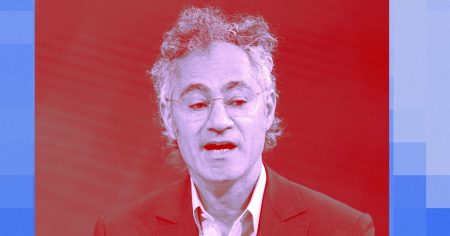
Harmonic, which was cofounded by Robinhood CEO Vlad Tenev and Tudor Achim, a Stanford-trained mathematician, claims this recent improvement to its product called Aristotle (no hubris there!) is an indication that there are ways to guarantee the trustworthiness of AI systems. “Are we doomed to be in a world where AI just generates slop and humans can’t really check it? That would be a crazy world,” says Achim. Harmonic’s solution is to use formal methods of mathematical reasoning to verify an LLM’s output. Specifically, it encodes outputs in the Lean programming language, which is known for its ability to verify the coding. To be sure, Harmonic’s focus to date has been narrow—its key mission is the pursuit of “mathematical superintelligence,” and coding is a somewhat organic extension. Things like history essays—which can’t be mathematically verified—are beyond its boundaries. For now.
Nonetheless, Achim doesn’t seem to think that reliable agentic behavior is as much an issue as some critics believe. “I would say that most models at this point have the level of pure intelligence required to reason through booking a travel itinerary,” he says.
Both sides are right—or maybe even on the same side. On one hand, everyone agrees that hallucinations will continue to be a vexing reality. In a paper published last September, OpenAI scientists wrote, “Despite significant progress, hallucinations continue to plague the field, and are still present in the latest models.” They proved that unhappy claim by asking three models, including ChatGPT, to provide the title of the lead author’s dissertation. All three made up fake titles and all misreported the year of publication. In a blog about the paper, OpenAI glumly stated that in AI models, “accuracy will never reach 100 percent.”
Read the full article here