





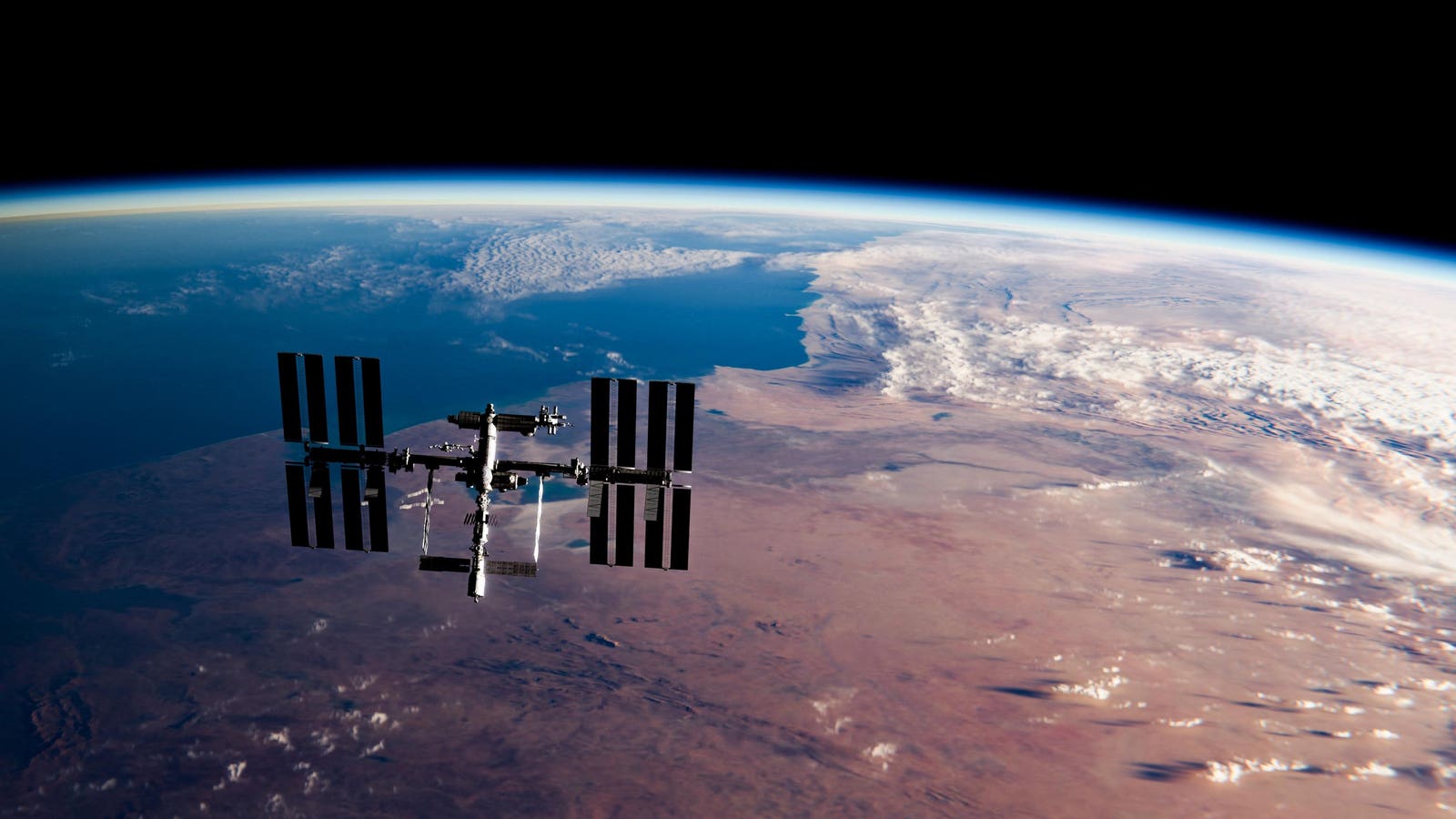
Have you ever seen the International Space Station? It buzzes around the planet every 90 minutes or so, but as Earth revolves beneath it, it appears to take a different trajectory.
Cue NASA’s latest app for iOS and Android smartphones and called Spot The Station. It’s existed as a website for many years and has guided millions of stargazers wanting a glimpse for a few minutes of the American football field-sized orbiting laboratory as it whizzes across the night sky at 17,000 mph.
NASA isn’t retiring that online service, which still allows users to sign up for a daily email telling you if—and if so, exactly when—the ISS will appear above your home. However, ISS-spotting has become a popular feature in many stargazing apps so it’s no surprise that the space agency has now produced its own.
The timing is no accident. The app’s release comes just a month ahead of the 25th anniversary of ISS on December 6, 2023.
Using NASA’s New ISS App
It’s straightforward. It’s built around one page, which shows a 3-D representation of Earth with the current path of the ISS showing cutting around it. It also shows your exact location on Earth. At the top of the screen, there are two boxes, one that tells you the date of the next sighting from where you live while the other gives you a countdown of days, hours, minutes and seconds.
The next pass may be just minutes away, or it may be over a month until the next sighting. That’s not because the ISS isn’t crossing over your house, but the app only tells you when there will be visible sightings.
When To See The ISS Above Your Home
The ISS is typically visible only around sunset and sunrise. That’s because what you’re actually seeing is sunlight reflecting off the spacecraft’s solar panels, so the sun has to be just below the horizon.
Although the app does also give you information on sightings at night these are going to be much harder to see. To that end, the app allows you to toggle these off, which is a good idea, and set notifications 10 minutes before sightings close to sunrise or (more likely) sunset.
How To Find The ISS Using Augmented Reality
Powered by a built-in compass, the app also has an augmented reality mode that allows you to point your phone at the night sky and see where the ISS will appear and even where it is currently in relation to you (which may well be underneath you).
The app also has a tab for the latest news from NASA relating to the ISS, such as information about new crew movements and spacewalks.
What The ISS Looks Like From Earth
The ISS always appears in the west, roughly speaking, crosses the sky and disappears into Earth’s shadow to the east, taking between one and six minutes depending on the altitude. As it disappears, the astronauts on board will see one of the 16 sunsets they see in every 24-hour period.
From around 227 nautical miles/420 kilometers below, the ISS looks like a bright, white, constant light in the night sky—much like a moving star. Is it easy to tell the difference between the ISS and a plane? Yes, in practice, it’s really easy. After all, the tail lights of aircraft typically flash, whereas the flare caused by the solar panels on the ISS is a steady light source. As the ISS flies over your house, it can get incredibly bright for a few seconds, but will quickly wane as it moves further east.
“Even after 23 years of continuous human presence aboard the International Space Station, it’s incredibly exciting to see the station when you look up at just the right moment,” said Robyn Gatens, International Space Station director at NASA Headquarters in Washington. “The orbiting laboratory that continues to provide so many unique, tangible benefits for humanity really isn’t that far out of reach.”
Wishing you clear skies and wide eyes.
Read the full article here