





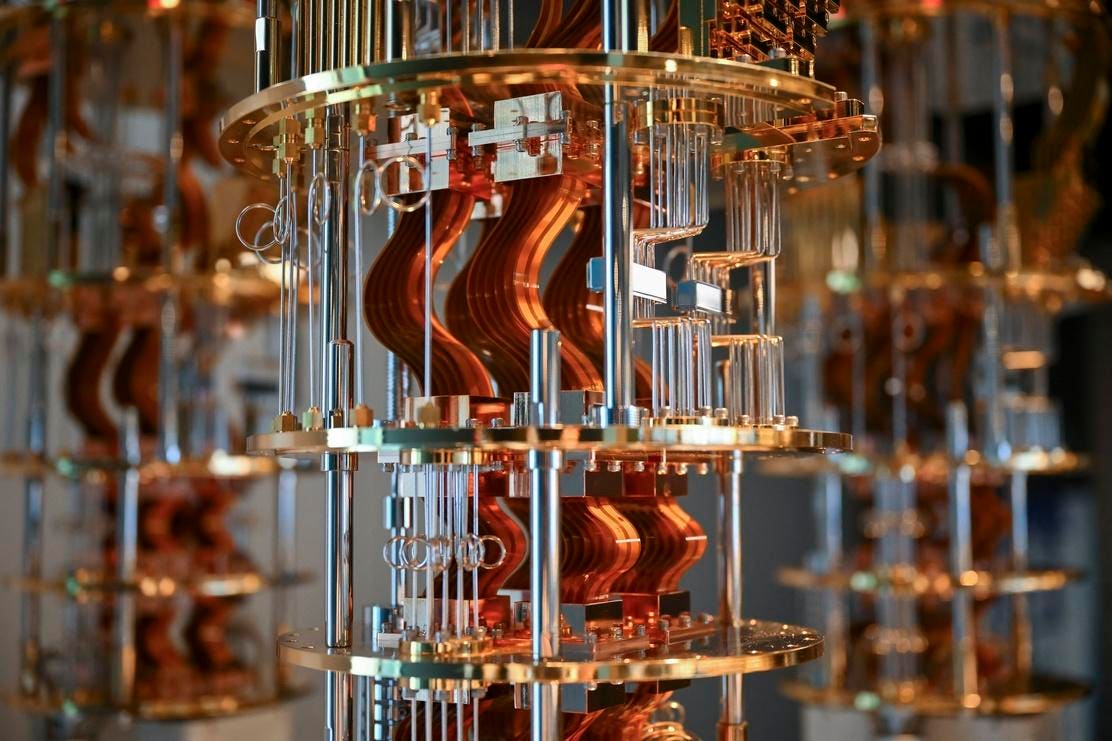
When a Series A funding round gets extended four months after closing, it usually means that the company that raised the round is so hot they essentially have investors begging to put their money in. I’m not sure if that’s happening here, but Quantum Art, the trapped-ion quantum computing startup with a roadmap to a massive 1,000-qubit quantum computer, just extended its $100 million series A with an additional $40 million in funding.
That brings the company’s lifetime funding to roughly $164 million, most of it in this big A round. Bedford Ridge Capital, which led the original $100 million tranche announced in December, led the extension as well. New investors joining the cap table include Hudson Bay Capital, Poalim Equity, LIP Ventures, Wolverine Global Ventures and IDA Ventures.
Quantum Art says the extension was driven by investor demand, and it lands just as the company is making its first real move from R&D into commercial deployment. Along with the extra cash, Quantum Art said it is preparing to launch a Quantum-as-a-Service offering, its first formal commercial product.
This quantum-as-a-service offering will “serve as a central pillar” of the company’s go-to-market strategy, meaning it plans to mostly offer cloud-based quantum computing, not shippable hardware. That’s the same playbook IBM Quantum, IonQ, IQM Quantum Computers and Quantinuum have been refining for years, but it’s a significant step for the relatively newer startup.
When I spoke with CEO Dr. Tal David for TechFirst last fall, he framed Quantum Art’s bet in musical terms: today’s quantum systems run operations one or two qubits at a time, sequentially. Quantum Art uses spectrally engineered laser pulses to operate on tens of qubits simultaneously.
“Instead of playing my guitar note by note, we play chords,” David told me.
Combined with what the company calls optical segmentation (using lasers to partition a single long ion chain into 20+ independently operating cores) and reconfigurable connectivity that moves information rather than physically shuttling ions, Quantum Art claims a viable roadmap to a million physical qubits in a 50-by-50-millimeter footprint.
I covered the architecture in more depth in October.
The new money is for three things, according to the company. First up is finishing Perspective, a 1,000-qubit multi-core machine Quantum Art has positioned as its first commercial-scale system. Hitting 1,000 physical qubits with the company’s claimed error-correction efficiency (roughly 10 physical qubits per logical qubit) would put it in striking range of meaningful quantum advantage on real workloads.
Second, the funding will support development of the advanced optical technologies that scaling requires, given that Quantum Art’s laser systems are arguably as much of the engineering challenge as the ion traps themselves. And finally, there’s global business development: sales, partnerships, and the international footprint expansion that the QaaS launch implies.
“Most approaches still run into scaling limitations, while Quantum Art’s architecture is designed to overcome those constraints,” Michael Reidler, a partner at Bedford Ridge Capital, said in a statement. “We believe that gives the company a meaningful advantage as the market matures.”
Quantum Art’s roadmap calls for Perspective to come online by 2027, supporting roughly 100 logical qubits. The company demonstrated a 200-ion chain late last year, which it claims is the longest fully controlled trapped-ion chain to date … a stability proof point that matters more than headline qubit counts because coherence and control, not just quantity, determine whether a quantum computer can actually do useful work.
We’ll see if they can extend that into deliverable quantum advantage.
Read the full article here