



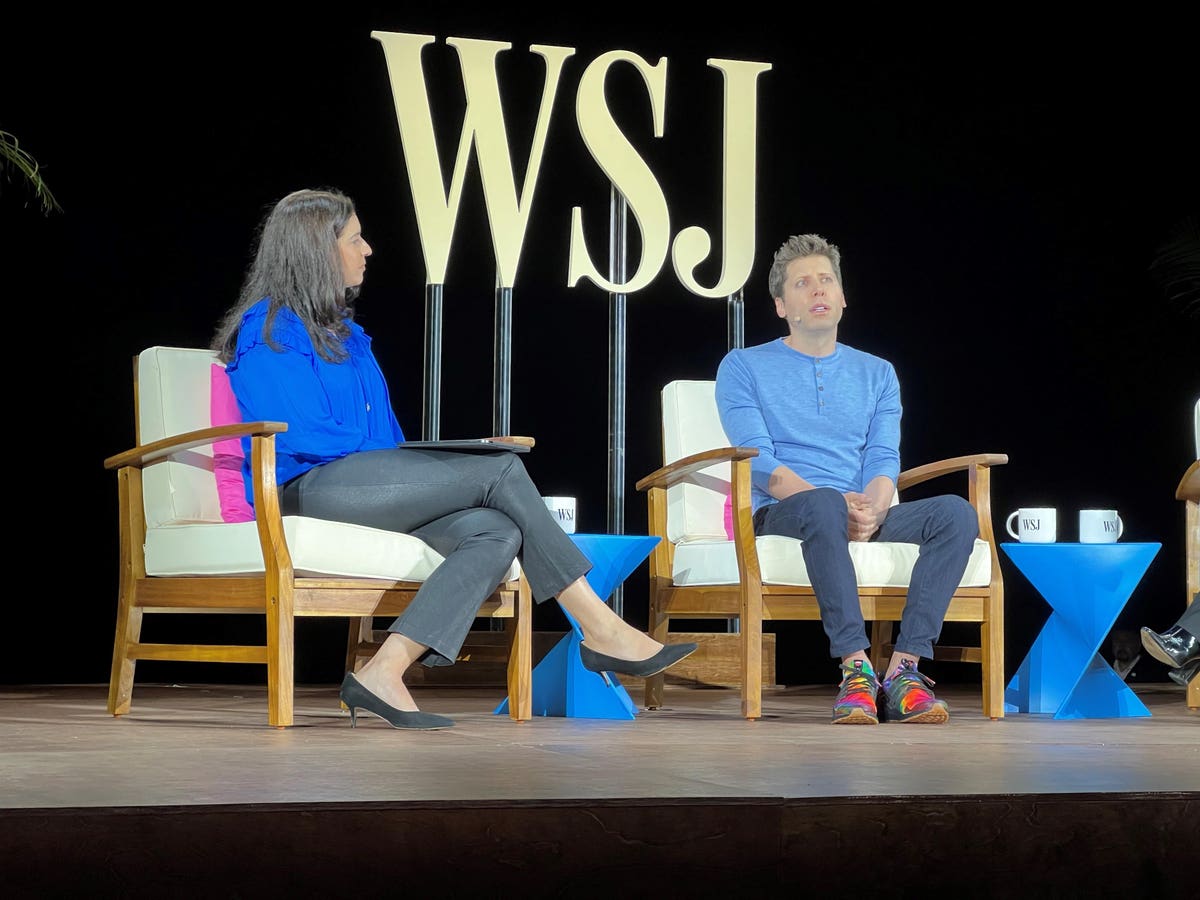
I first attended the Wall Street Journal (WSJ) Tech Live event at The Montage in Laguna Beach in October 2017, and while ripe with CEO, founder, investor, media, and celebrity perspectives on technology developments, the focus seemed to be on incremental change. Fast forward to the 2023 edition of WSJ Tech Live, which the Wall Street Journal captured the spirit and urgency of in their summary of the 3-day event, “WSJ Tech Live 2023: Tech Leaders Discuss the World-Changing Potential of AI, and Some of its Risks”.
To be sure, there are many AI skeptics out there, and adoption of AI capabilities within large companies is bound to be measured and unfold at a more gradual pace. The WSJ event though was a view into the future, which some of the presenters suggested was just around the corner. The opening presentation of WSJ Tech Live reflected the sense of urgency among business leaders to come to grips with the potential power of AI — Competing in the Age of Gen AI. This was merely a warmup for three-days of mind-stretching, jaw-dropping discussion of the potential impact of AI on industry, the world, and humankind, for good and for ill.
This year’s program featured notable AI pioneers including OpenAI CEO Sam Altman, venture investor Vinod Khosla, Stanford University professor Fei-Fei Li, Meta product chief Chris Cox, and DeepMind co-founder and author Mustafa Suleyman, who presents a historical perspective on AI and the impact of technological transformations in his newly published book, The Coming Wave: Technology, Power, and the Twenty-First Century’s Greatest Dilemma.
While most business leaders are striving to grasp an understanding of the potential impact of Generative AI for their companies and customers, Suleyman and speakers at the WSJ event like Sam Altman, are already focused on what is coming next, which they call Artificial General Intelligence (AGI). They define AGI as the state where AI can perform all human cognitive skills better than the smartest human. Suleyman argues that AI will achieve this human-level performance within the next three years, noting that “within the next few years, AI will become as ubiquitous as the Internet”. He adds, “The coming wave of technologies threatens to fail faster and on a wider scale than anything witnessed before”.
The thesis of Suleyman’s new book, The Coming Wave, is that technology, notably AI, is advancing at a speed where its arrival and impact will be both profound and inevitable. Suleyman attributes the transformative power of AI to the massively parallel processing power of today’s computers, combined with the proliferation of vast new sources and levels of data. Suleyman notes, “Eighteen million gigabytes of data are added to the global sum every single minute of every day”. It is this ability of machines to process massive amounts of data with speed that gives AI the power to exceed human capabilities. As he sees it, AI will be faster, cheaper, more accessible, and widely diffused. Suleyman speaks of “quantum supremacy”, the idea that AI can “complete a calculation in seconds that would have taken a conventional computer 10,000 years”.
So, how will AI impact the business world? Suleyman believes that AI can improve the efficiency of tasks, but with the consequence of eliminating redundant roles and displacing industry sectors. He asks, “what if a large majority of white-collar tasks can be performed more effectively” with AI. Suleyman notes that automation and mechanization have had a long history of displacing human labor. At WSJ Tech Live, OpenAI’s Altman commented, “Every technology revolution affects the job market, I’m not afraid of that at all. That’s the way of progress. And we’ll find new and better jobs”. Vinod Khosla expressed the viewpoint that “AI will be able to replace 80% of 80% of all jobs within 10-20 years”.
Suleyman suggests that there is a positive side of this job replacement of “intellectual manual labor”. He believes that AI will spur new demand and create new jobs that liberate mankind from mundane tasks. He makes the case that this has been true of technological progress over the course of human history. Suleyman cites a recent McKinsey study, claiming that “more than half of all jobs could see many of their tasks automated by machines within the next 7 years”. He concludes that the “days of cognitive manual labor are numbered”.
Suleyman is a self-proclaimed technology optimist who believes that AI will empower humankind. He employs a close reading of history to make his argument. Suleyman argues that while societal problems and challenges will persist, the quality of life for the vast majority of the world is indisputably better off today than it was 50, 100, or 500 years ago when measured by progress and well-being. He believes that, like other disruptive technologies of past eras and epochs, AI will bring unparalleled advances in healthcare, food abundance, education, human longevity, personal freedom, and human comfort.
This is not to say that Suleyman is complacent about the disruption which will be caused. While he sees vast potential for AI as an engine of progress, like other engines of progress over the course of human history, he foresees “unprecedented risks” from misuse of AI, resulting in the potential for calamity and repression. He notes, “AI is a powerful tool for extraordinary good, but fraught with immense dangers and ethical dilemmas”. Suleyman warns of the risk of an “intelligence explosion” that results in a superintelligence “fully impossible to control or contain, where humanity will be no longer be at the top of the food chain”, and acknowledges that “surveillance technologies are ubiquitous, increasingly granular in their ability to home in on every aspect of citizens lives”.
AI risks include the dissemination of disinformation and misinformation, abuse of privacy, weaponization, sudden job displacement, and concentration of power. To mitigate these risks, Suleyman advocates for the establishment of constraints and guardrails that he believes are urgently needed to ensure that the benefits of AI outweigh the risks. He points out the necessity of ensuring that “humans be in the loop” and proposes policies of “containment” which include the establishment of guideposts, national and international regulation, the development of responsible use standards, the establishment of limits on the use of AI, and the ability to shut AI down in extreme instances as a safeguard. Suleyman recognizes that none of this will be easy, noting that regulation alone is not enough. He points to initiatives such as the European Union AI Act as a starting point but acknowledges that “technology evolves week by week; legislation takes years”.
What comes next? Suleyman points to the acceleration of robotics technologies, which he describes as “AI’s physical manifestation; AI’s body” and the “physical instantiation of AI”. He reflects, “Just as John Deere’s plow once transformed the business of agriculture, robot-oriented inventions are transforming how food gets to our table”. He continues, “AI is pushing robots toward their original promise: machines that can replicate all the physical actions of a human and more”.
In the end, Suleyman believes that the benefits of AI will outweigh the risks – the ability of AI to help grow food, detect natural disasters, increase the standard of living, improve the quality and affordability of healthcare, and increase education. But he cautions, “we are going to live in an epoch when the majority of our daily interactions are not with other people but with AIs”. He closes by noting that history teaches that there have always been unintended consequences resulting from technology advances, and poses a philosophical question for us all, “Will AI unlock secrets of the universe or create systems beyond our control?”
Read the full article here