




Startup DreamersStartup Dreamers
  • Home
  • Startup
  • Money & Finance
  • Starting a Business
    • Branding
    • Business Ideas
    • Business Models
    • Business Plans
    • Fundraising
  • Growing a Business
  • More
    • Innovation
    • Leadership
Trending

Activists Are Taking On Elon Musk’s SpaceX IPO

May 15, 2026

10 States Enter Aurora ‘Strike Zone’ On Friday

May 15, 2026

How to Disable Google’s Gemini in Chrome

May 14, 2026
Facebook Twitter Instagram
  • Newsletter
  • Submit Articles
  • Privacy
  • Advertise
  • Contact
Facebook Twitter Instagram
Startup DreamersStartup Dreamers
  • Home
  • Startup
  • Money & Finance
  • Starting a Business
    • Branding
    • Business Ideas
    • Business Models
    • Business Plans
    • Fundraising
  • Growing a Business
  • More
    • Innovation
    • Leadership
Subscribe for Alerts
Startup DreamersStartup Dreamers
Home » Earth-Like Planets Suddenly More Likely After Webb Telescope Discovery
Innovation

Earth-Like Planets Suddenly More Likely After Webb Telescope Discovery

adminBy adminJuly 24, 20230 ViewsNo Comments3 Mins Read
Facebook Twitter Pinterest LinkedIn Tumblr Email

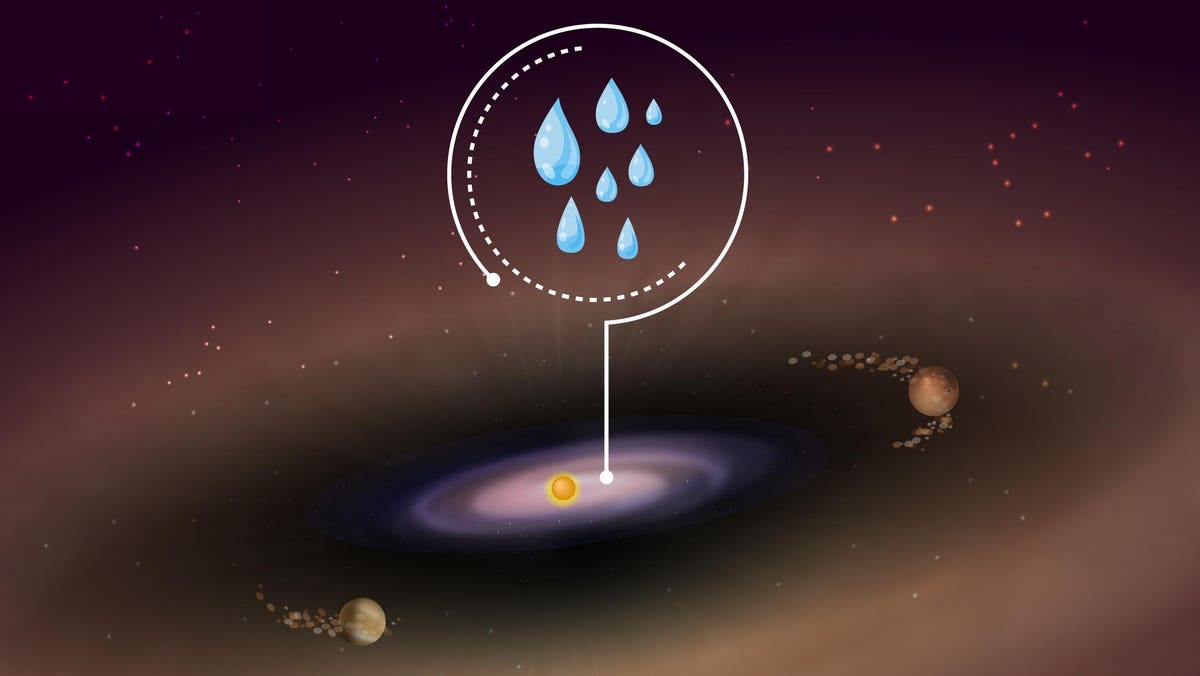
Water has been detected around a young star about 400 light-years from the solar system that was last week revealed to have a “double planet.” It could mean that rocky planets across the galaxy develop with water on their surfaces —a key ingredient to sustain life.

Observations by the James Webb Space Telescope found the water in the planet-forming disk of a star called PDS 70—in precisely the same region that rocky planets orbit the sun in our solar system.

The water is in the form of hot vapur around 625Fº/330ºC.

It’s an important find because it suggests that rocky planets in general—including Earth—may be able to evolve with water on their surface.

That’s a big change from the received wisdom that water must have got to Earth (and rocky inner planets in any star system) via impacts of thousands of icy asteroids and comets from the outskirts.

PDS 70 is thought to host two Jupiter-sized planets that share the same orbit—the first time that’s ever been observed. However, they orbit far from the region where water has been found.

This makes PDS 70—which is in the southern hemisphere constellation Centaurus—a very special star system that could change how astronomers think about how rocky planets form and evolve.

Water Birth

“We now may have found evidence water could also serve as one of the initial ingredients of rocky planets and be available at birth,” said Giulia Perotti, lead author of a paper published today in Nature and an astronomer at the Max Planck Institute for Astronomy (MPIA) in Heidelberg, Germany.

The researchers found water in the inner disk of PDS 70, which “implies that potential terrestrial planets forming therein have access to a water reservoir,” the paper reads. They think water formed in this region rather than being transported in from the outer reaches of the star system.

Extremely Exciting

“This discovery is extremely exciting, as it probes the region where rocky planets similar to Earth typically form,” said Thomas Henning, Director of the MPIA and Co-principal investigator the MINDS (MIRI Mid-Infrared Disk Survey) program, which uses JWST’s Mid-Infrared Instrument (MIRI).

It had been thought that water naturally forming around a star can’t survive its heat, leading to rocky planets that are naturally dry. If that’s now ruled-out as a fundamental rule then rocky planets with water may exist across our Milky Way galaxy.

The MINDS project will, hope the researchers, show whether water is common in the terrestrial planet-forming zones of evolved disks around young stars—or whether PDS 70 is a one-off.

Wishing you clear skies and wide eyes.

Read the full article here

Share. Facebook Twitter Pinterest LinkedIn Tumblr Email

Related Articles

10 States Enter Aurora ‘Strike Zone’ On Friday

Innovation May 15, 2026

Forza Horizon 6 Release Date, Early Access And Game Pass Details

Innovation May 14, 2026

‘One Time Restart’—Microsoft Changes Windows After 15 Years

Innovation May 13, 2026

‘Big News’—Google Changes Android Messages After 12 Years

Innovation May 12, 2026

Google And Microsoft Warn Passkeys May Not Stop Hackers

Innovation May 11, 2026

Bonus Winners, Highlights And Analysis

Innovation May 10, 2026
Add A Comment

Leave A Reply Cancel Reply

Editors Picks

Activists Are Taking On Elon Musk’s SpaceX IPO

May 15, 2026

10 States Enter Aurora ‘Strike Zone’ On Friday

May 15, 2026

How to Disable Google’s Gemini in Chrome

May 14, 2026

Forza Horizon 6 Release Date, Early Access And Game Pass Details

May 14, 2026

ChatGPT Has ‘Goblin’ Mania in the US. In China It Will ‘Catch You Steadily’

May 13, 2026

Latest Posts

Elon Musk’s Last-Ditch Effort to Control OpenAI: Recruit Sam Altman to Tesla

May 12, 2026

‘Big News’—Google Changes Android Messages After 12 Years

May 12, 2026

Using AI for Just 10 Minutes Might Make You Lazy and Dumb, Study Shows

May 11, 2026

Google And Microsoft Warn Passkeys May Not Stop Hackers

May 11, 2026

Bonus Winners, Highlights And Analysis

May 10, 2026
Advertisement
Demo

Startup Dreamers is your one-stop website for the latest news and updates about how to start a business, follow us now to get the news that matters to you.

Facebook Twitter Instagram Pinterest YouTube
Sections
  • Growing a Business
  • Innovation
  • Leadership
  • Money & Finance
  • Starting a Business
Trending Topics
  • Branding
  • Business Ideas
  • Business Models
  • Business Plans
  • Fundraising

Subscribe to Updates

Get the latest business and startup news and updates directly to your inbox.

© 2026 Startup Dreamers. All Rights Reserved.
  • Privacy Policy
  • Terms of use
  • Press Release
  • Advertise
  • Contact

Type above and press Enter to search. Press Esc to cancel.

GET $5000 NO CREDIT