





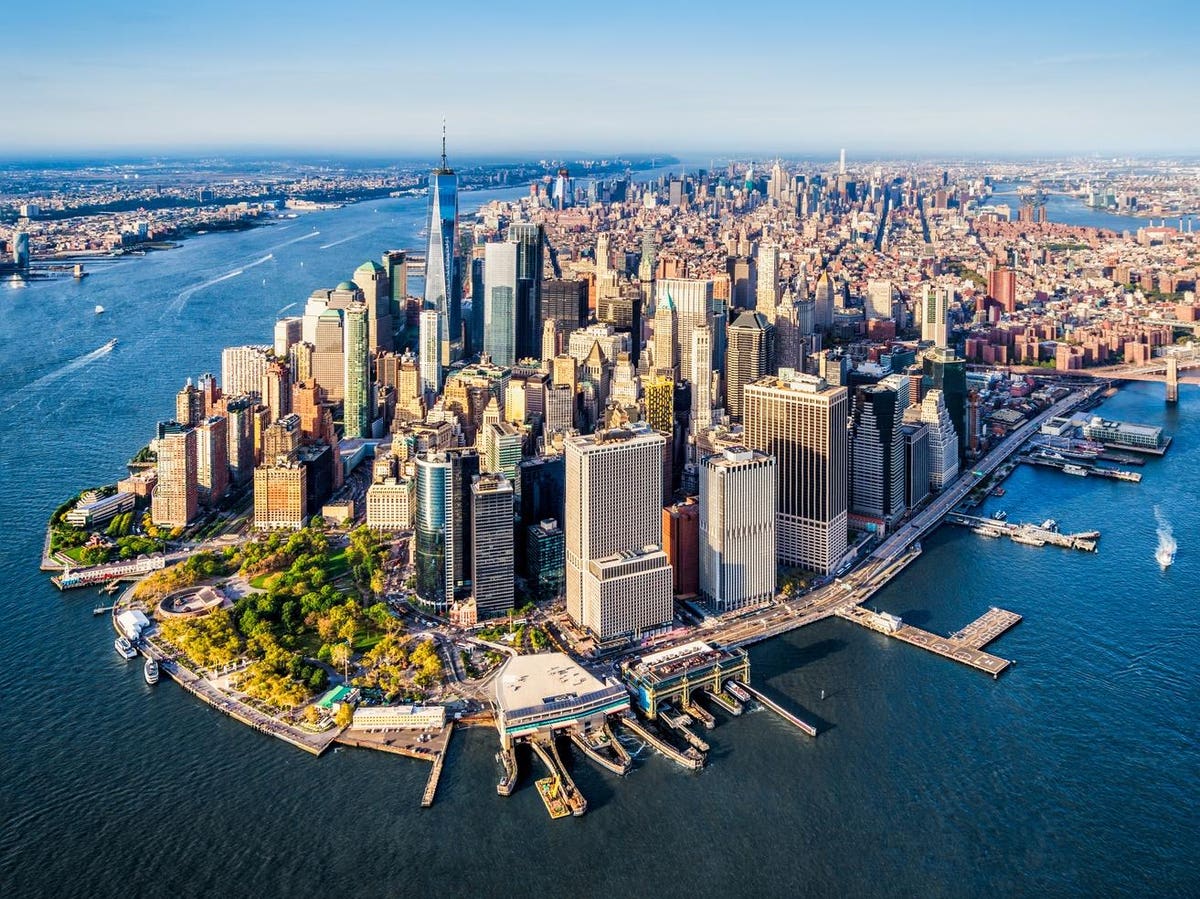
Large coastal cities like NYC face a double threat from climate change and subsidence
New York City is the most populous city in the U.S. Thanks to climate change, it is also under an ever-increasing threat of coastal flooding and storm surges. An estimated 1.3 million New Yorkers now live within or directly adjacent to the city’s floodplain, and that number could rise to 2.2 million by the end of the century.
Flooding trends have prompted many low-lying coastal cities to invest in protective infrastructure – building seawalls, raising roads, creating artificial barriers, dikes and reefs. These ‘hard’ structures have become the default option for cities wanting to defend against flooding. In 2017, 14% of the total U.S. coastline had been armored in this manner, and that percentage looks set to grow. But the reality is that seawalls are a blunt instrument; not a finely-tuned solution. They’re expensive to build and require constant maintenance – the U.S. Army Corps of Engineers’ latest plan to protect NYC from coastal storms is costed at $52.6 billion. Making space for a seawall also causes the destruction or displacement of important coastal habitats – a study from 2016 found that “seawalls supported 23% lower biodiversity and 45% fewer organisms than natural shorelines.” They’re rarely a permanent solution, with existing walls requiring ‘top ups’ to increase their height.
And as a group of researchers from the U.S. Geological Survey (USGS) and the University of Rhode Island (URI) has shown, rising water isn’t the only threat to NYC. Relentless construction is also causing the city to subside, exacerbating the risk of future flooding.
Subsidence is a catch-all term, used to describe the sinking of the Earth’s surface that results from both natural processes and human activities. Earthquakes, erosion, groundwater extraction, and mining can all cause the downward vertical movement of soil and rock. In their (open-access) paper, published in the journal Earth’s Future, the USGS/URI team focused on the contribution that “the cumulative mass and downward pressure exerted by the built environment” makes to the city’s overall subsidence. In other words, they wanted to calculate the collective weight of NYC’s buildings*. Taken together with knowledge of the underlying geology, they could then estimate the degree of sinking (in millimeters) resulting from those buildings.
They accessed the footprint and height of all 1,084,954 buildings in New York City’s five boroughs via a free, public database developed by Microsoft. To get the total area of each building, the researchers estimated the number of floors (based on a fixed ceiling height) and multiplied it by the footprint. The mass calculation also involved some necessary simplifications – for example, they assumed that the structure itself exerted 2.0 kN/m2 (called the ‘dead load’ in engineering). This value is representative of reinforced concrete; a truly ubiquitous building material. The ‘live load’ – which accounts for the contents of the building – was averaged to be 4.79 kN/m2 to account for the wide variety of building uses in the city. They found that, NYC’s buildings collectively weigh 7.64 x 10¹¹ kg (1.68 trillion pounds), distributed over a 778.2 km2 area.
The surface geology of New York City has been widely studied, but is fairly complex; a patchwork that includes “silt, sand, and clay lake deposits, glacial moraines, outwash and till, beach deposits, and bedrock outcrops,” as well as artificial fill along the water line. Because of this, it’s not possible to know precisely what sits beneath every building. And with more than a million buildings involved in the calculation, information on the specific foundation style of each one was fairly limited. To address this, the researchers to create a series of regional soil and bedrock models, and applied them to the city.
Their modelling results varied widely, and had a high degree of uncertainty due to the various simplifications involved. However, they all agreed that some areas of the city have been subsiding faster than others. There’s very little building-related subsidence in areas such as midtown Manhattan, because there, foundations tend to be anchored directly into hard bedrock. However, lower Manhattan and southern Brooklyn are both built largely on artificial fill – a mix of materials that is far less compact than any natural geological terrain. This makes those areas particularly vulnerable to sinking under the pressure of buildings.
The researchers then compared their results to those from previous studies that used satellite techniques (namely, interferometry and GPS measurements) to map ground deformation. What not a direct comparison, this allowed them to infer the potential contribution of the urban building load to the city’s overall subsidence.
They found that the average subsidence rate across the city is 1-2mm/year, but in areas such as Queens and Brooklyn, it is significantly higher; “… up to about 4½ millimeters a year,” Parsons told CNN. That might not sound like a lot, but when you consider that globally, sea levels have risen 98.5 mm in the past 30 years (a mean of 3.28 mm/year), the impact becomes clearer. Speaking to Time, lead author Tom Parsons described the likelihood of parts of NYC eventually being permanently under water as “… inevitable. The ground is going down, and the water’s coming up. At some point, those two levels will meet.”
The Big Apple is not alone in this. A global study published in 2021 concluded that subsiding cities will experience rising seas at rates up to four times faster than stable regions. A separate study from 2022 looked at the 48 largest coastal cities in the world, which together represent about a fifth of the global urban population. 44 of those cities were found to have areas that are sinking faster than sea levels are rising. Subsidence has already caused some governments to resort to drastic measures. Indonesia is moving its capital from Jakarta to Nusantara, a purpose-built city on the island of Borneo (which comes with its own significant environmental issues).
The authors of this Earth’s Future study aren’t calling for the urgent evacuation of New York City. Rather, they write that their goal “… is to raise awareness that every additional high-rise building constructed at coastal, river, or lakefront settings could contribute to future flood risk, and that mitigation strategies may need to be included.” Let’s see if their message sinks in.
—
* They excluded “…. roads and other paved areas, sidewalks, parks, bridges, railways etc.” from their calculation, so their loading factor is likely an underestimate.
Read the full article here