





In our vast ocean realm, where speed and prowess can often dictate who rules, a select group of fast-swimming apex predators have taken a special place amongst those at the top. Known as ‘regional endotherms,’ these animals boast a unique set of features such as elevated body temperatures, centralized red muscles, and thick-walled hearts, which have evolved to support their fast and predatory lifestyle.
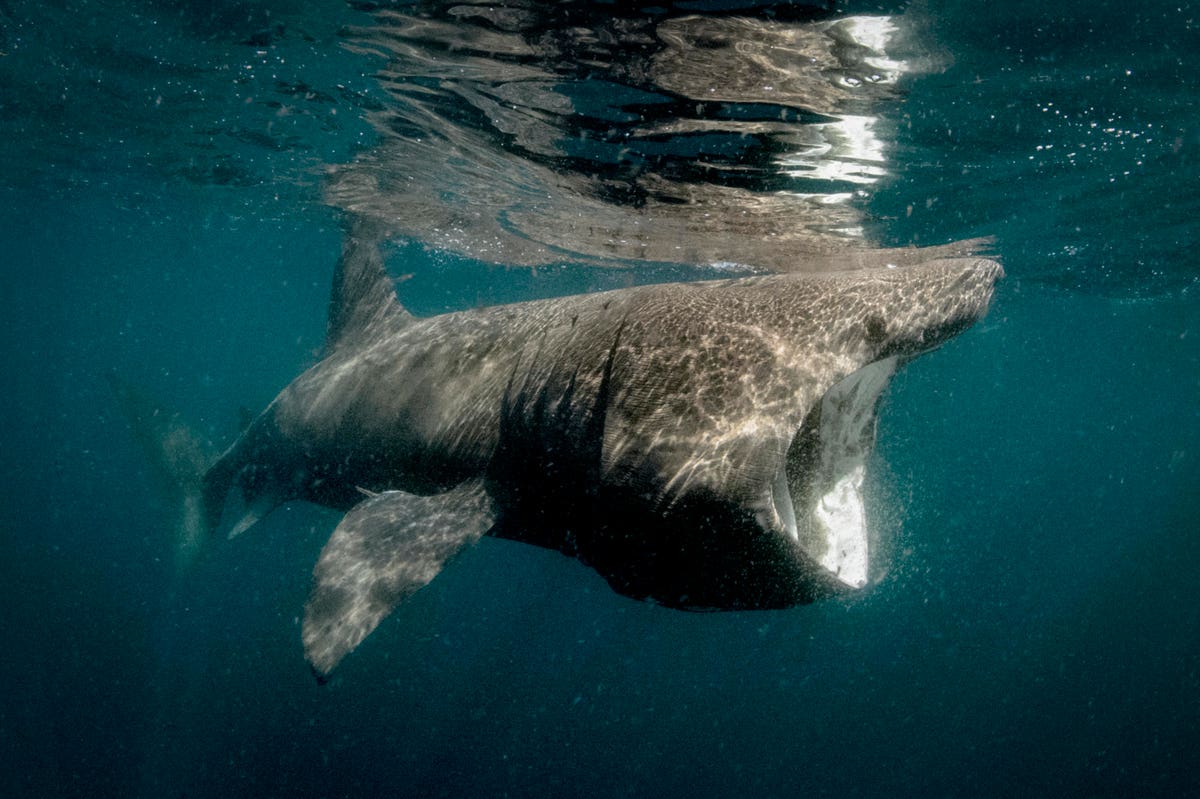
However, amongst this elite league, a surprising anomaly exists – the endangered basking shark (Cetorhinus maximus). These gentle giants are known for their enormous size, reaching lengths of up to 40 feet (12 meters), making them the second-largest fish in the world. As colossal filter-feeding planktivores, their primary diet consists of tiny planktonic organisms (such as copepods and krill) which they filter from the water using the specialized gill rakers you often see in pictures lining either side of the inside of their mouth. Basking sharks are a highly migratory species, exhibiting long-distance movements between feeding grounds. Often spotted near coastal areas during the summer months when plankton blooms occur, their slow and steady cruising speeds allow them to efficiently filter-feed while conserving energy. Due to their gentle nature and non-threatening behavior, basking sharks have become popular in the ecotourism world, attracting enthusiasts seeking awe-inspiring encounters with these majestic creatures.
Despite their ecological significance and growing popularity with tourists who are ready to take the cold plunge to see them, basking sharks face various threats. Historically, they have been extensively hunted for their liver oil, fins, and meat, leading to significant declines in their populations. Although hunting has largely stopped, they are still susceptible to accidental capture in fishing gear, particularly in gillnets and trawls. This bycatch poses a significant threat to their survival, especially when it occurs in areas critical to their feeding and breeding activities. Additionally, because they spend so much time at the surface, they’re highly vulnerable to boat strikes and marine pollution, as well as habitat degradation due to human activities along coastal areas. The combination of these threats, along with their slow reproductive rate, has resulted in basking sharks being listed as an endangered species, warranting urgent conservation efforts to protect these gentle giants and preserve the ecological balance they contribute to in our oceans.
Unlike its fierce counterparts, the basking shark is a filter-feeder, and until recently, it was assumed to possess the typical anatomy and physiology of fully ectothermic fishes. But it turns out it may not be. And lead study author scientist Haley R. Dolton of Trinity College Dublin wanted to learn more. In 2020, her team conducted beach dissections in England on two stranded male basking sharks, measuring 3.8 and 4.5 meters in total length – Specimens A and B, respectively. Though logistical constraints prevented the scientists from carrying out comprehensive transverse sections on these specimens, partial cross-sections were made, allowing the creation of a 3D reconstruction of the red muscle distribution. In the following year, hearts were collected from two more basking sharks stranded on the west coast of Ireland – a 6.9-meter female and a 4.8-meter male – Specimens C and D, respectively. The examination of their ventricles revealed a surprising average of about 47% outer compact myocardium, a trait often associated with highly active regional endotherms.
Further investigations with the aid of electronic biologging tags provided exciting insights. “A new electronic biologging tag package was deployed [on individuals] for body temperature measurements without the need for capture or handling for sensor attachment, reducing potential stress to the animal,” the authors explained. This technology showed that subcutaneous white muscle temperatures of free-swimming basking sharks consistently exhibited an elevation of 1.0 to 1.5°C above ambient water temperature. This intriguing discovery is similar to the temperature elevation observed in regional endothermic species, but markedly distinct from fully ectothermic sharks like the whale shark.
With these anatomical and physiological findings collectively, the research team believes it has become increasingly evident that planktivorous basking sharks challenge the traditional classification of ‘fully ectothermic’ fishes. The presence of red muscle medially in the trunk, a thick-walled ventricle, and elevated subcutaneous body temperatures suggest that these large sharks possess traits more commonly associated with regional endotherms. This revelation could explain their close phylogenetic relationship to other regionally endothermic shark species, and the puzzling observations of their cruising speeds and trans-oceanic movements. It may also likely contribute to their ability to navigate cooler waters while efficiently undertaking ram filter-feeding, which involves overcoming substantial drag during their relatively fast feeding speeds.
The significance of this newfound understanding will markedly help the management of this animal. “This changes our understanding of the physiology of this species and might help improve distribution and population forecasting in future,” the authors state. As the enigma of the endangered basking shark is gradually being unraveled, the team is in awe of its remarkable adaptation and surprising endothermic traits, defying traditional categorization and opening doors to a deeper understanding of the wonders that lie beneath the waves.
Read the full article here