




Riding a cross-country motorcycle equipped with nets might seem more like Mad Max than science, but its key to saving a species in Kazakhstan that survived the Ice Age.
Salemgareyev, the Lead Specialist of the Association for the Conservation of Biodiversity of Kazakhstan, says that he was a boy when he first heard about the Saiga Antelope, the goat-sized animal he is now trying to protect from extinction.
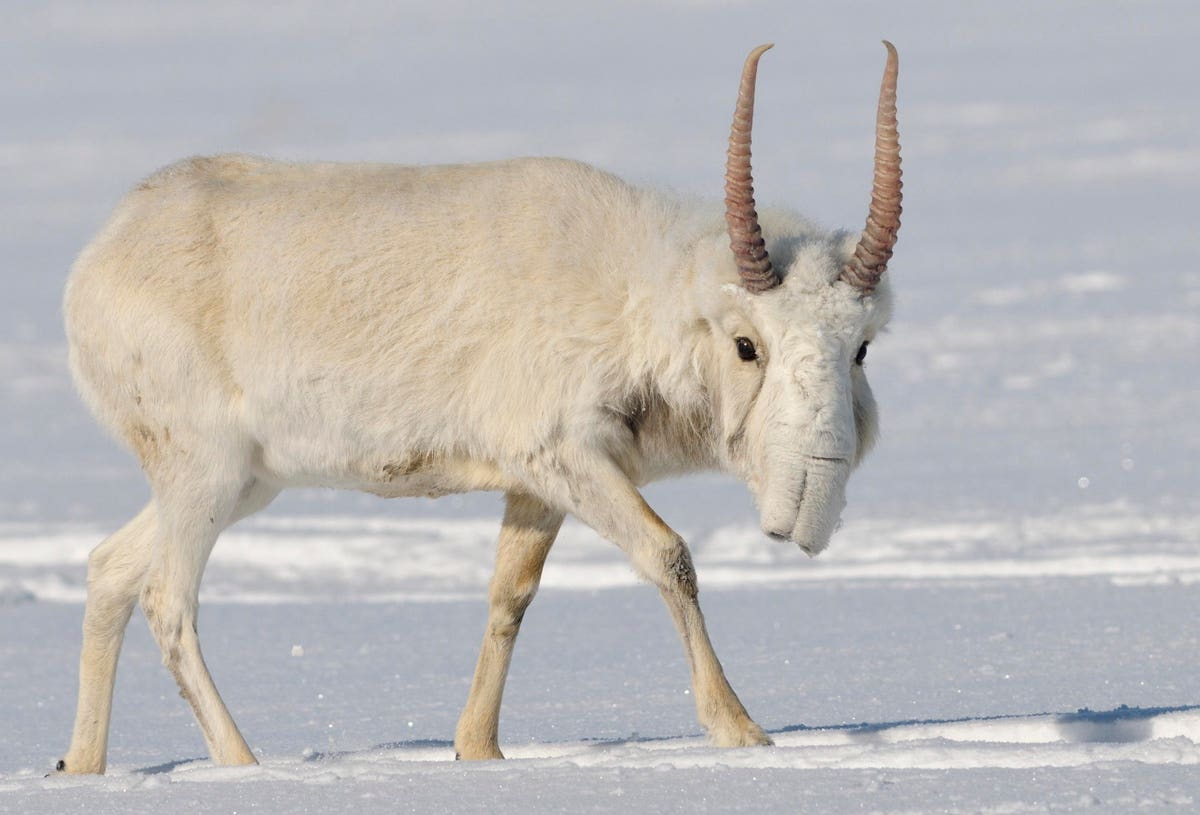
“It is an antelope with a very memorable nose: its soft, bloated, mobile nose looks like a trunk,” he says, adding that many thousands of these ungulates make long migrations (600 to 700 kilometres in one direction) in search of food and water and the harsh winter climate.
Salemgareyev says that in order to find out if Saiga Antelopes had changed their routes and to assess threats to the species, the team decided to put satellites tracking devices on the herbivores.
But there was a catch: because of the peculiarities of the Saiga Antelope, they did not want to risk using tranquilizers, so had to find other ways to catch the animals in the vast steppes of Kazakhstan.
“We therefore developed a mobile netting technique using cross-country motorbikes,” he says, “As a result, we have managed to tag over 200 satellite transmitters on saigas since 2009.”
Salemgareyev says the main results of this work are that valuable migration data has been obtained and migration corridors identified for three populations in Kazakhstan, with the number of saigas increasing to 1.8 million from historic lows.
“This should be shared and if possible applied to other species in Kazakhstan and other countries,” he says, adding that the work also lead to the extension of the network of Protected Areas in Kazakhstan.
In 2023, UK charity Whitley Fund for Nature honored Salemgareyev with a Whitley Award for his conservation work with the saiga antelope.
Face to Face
Salemgareyev grew up in a small village in the north of Kazakhstan close to Naurzum reserve, founded in 1931.
“This is where my fascination and interest in wildlife began,” he says, “Being a schoolboy, I visited the office of the reserve every week to see what the staff were doing and to choose my future interest in nature conservation.”
Salemgareyev was 12-years-old when he learned about the Saiga Antelope and its unusual nose.
“The first time I saw a saiga in person was when I became a biology student,” Salemgareyev says, adding that this involved a great deal of luck because at the end of the last century the number of saigas had critically declined.
“This meeting with a saiga helped me to make a decision and after graduating from university I joined the team of the ACBK and for over 13 years now I have been studying saigas and how, where and why they travel,” he says, “And every time I think I know everything about them, they surprise me again!”
Salemgareyev says that Kazakhstan’s huge areas undeveloped by humans are an important feature for biodiversity conservation.
“It is very important for us to preserve these areas and of course to study species in the wilderness and to restore those species that used to exist in these areas,” he says, “For example, I am also coordinating the reintroduction of the kulana to Central Kazakhstan, which is a species that needs vast open spaces, but at the same time the steppe and semi-desert need large ungulates to support the ecosystem along with saigas.”
Mammal Conservation
Another Global South scientist who grew up close to the landscape and species she’s dedicated her life to is Tulshi Laxmi Suwal, the founder of Small Mammals Conservation and Research Foundation in Kathmandu, Nepal.
Nepal is home to two of the eight species of pangolin — the Chinese pangolin and the Indian pangolin and they are known as “friends of farmers” for the vital ecosystem services they provide, with a single pangolin eating 70 million ants and termites a year.
Years after being advised against studying pangolins on the grounds that they were just “small mammals,” she is now also a member of the International Union for Conservation of Nature (IUCN) Pangolin Specialist Group.
“My research led to me being known as the “pangolin lady” at home and around the world and I have been working with pangolins now for 15 years”, she says, “The species is very shy and gentle, unlike some other wildlife so there was not a physical risk in conducting the study.”
Read the full article here